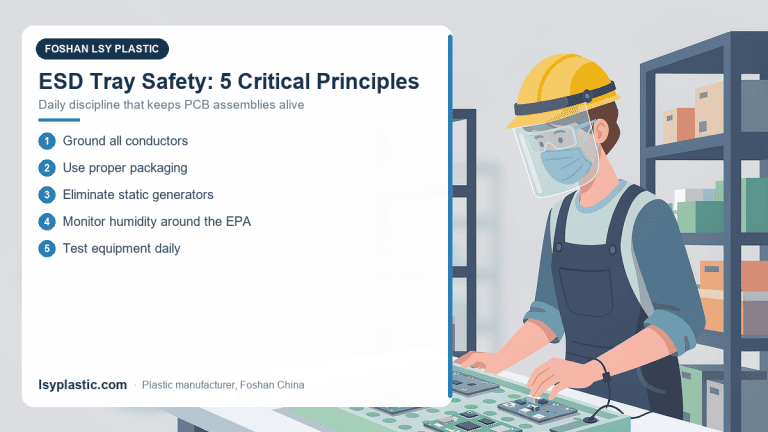
Let’s be honest: there is nothing worse than a batch of PCBs passing the final test at your factory, only to fail dead-on-arrival (DOA) at your client’s facility.
Choosing between bins, boxes and trays? Our ESD-safe containers buying guide compares them side by side.
More often than not, the culprit isn’t a soldering error—it’s Electrostatic Discharge (ESD) during transport.
If you are moving sensitive electronics, you know that a standard plastic bin is basically a static generator. But when you look for solutions, the terminology gets messy. Conductive? Dissipative? EU Standard vs. General?
We’ve broken down the chaos. Here is a no-nonsense guide to choosing the right Conductive ESD Storage Boxes for your specific workflow, whether you are running a fully automated warehouse or a manual repair bench.
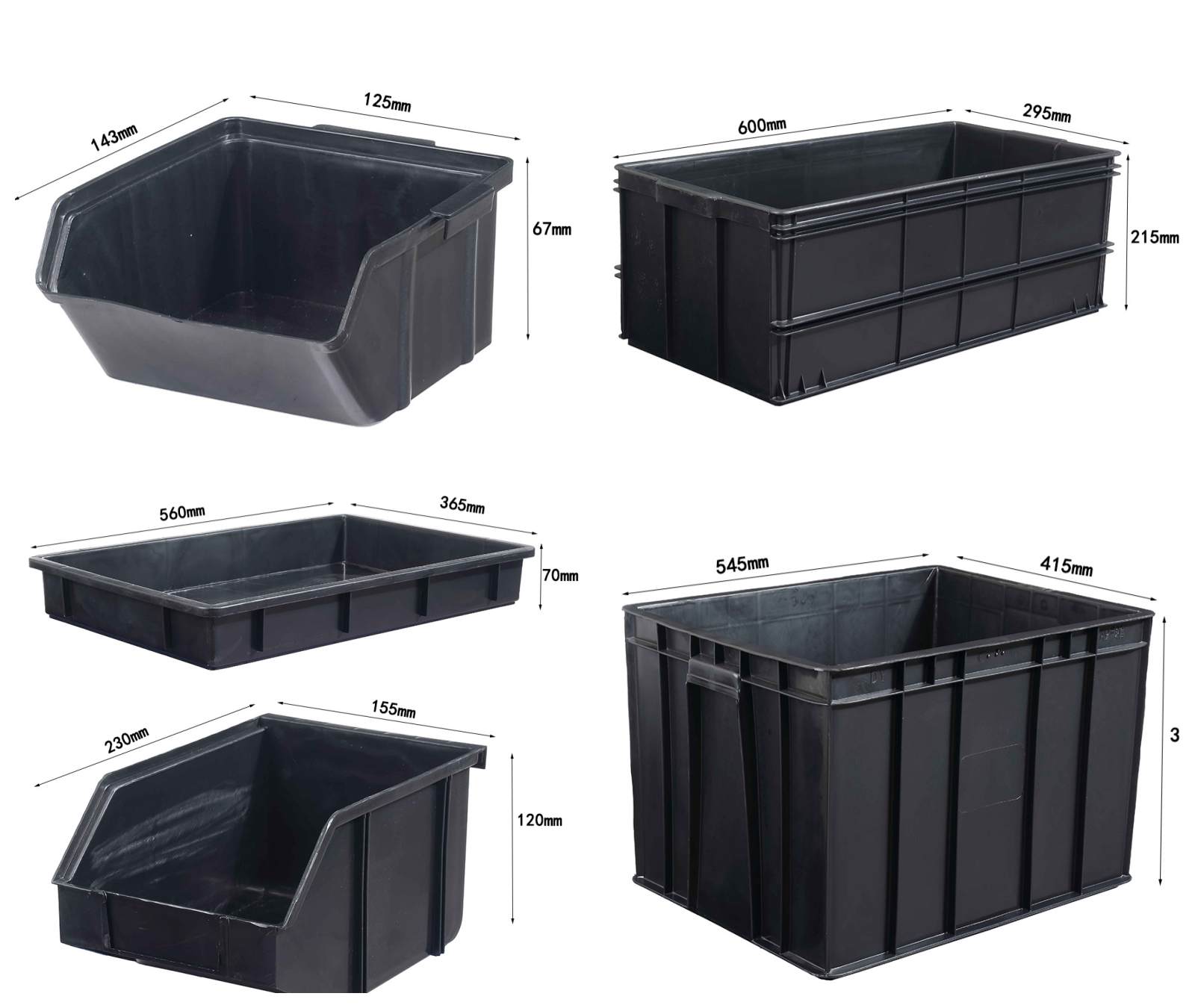
The Basics: Why “Black” Matters (Conductive vs. Anti-Static)
First, let’s clear up a common misconception. Not all “ESD safe” boxes are created equal.
You might see pink or blue bags/bins. Those are usually “Anti-static” (coated). They are okay for short-term use, but the coating wears off.
For industrial logistics, you need Conductive Polypropylene (PP). This is what we manufacture.
- The Look: Always Black.
- The Science: We mix carbon fiber/powder directly into the plastic.
- The Result: A permanent surface resistance of 104−106Ω104−106Ω.
Think of it this way: Anti-static pink plastic is like a raincoat (temporary protection). Conductive black plastic is like a grounded metal shield (permanent armor). If you are shipping expensive wafers or ECUs, always go with conductive black.
Scenario 1: The Automated Warehouse
Your Best Bet: EU Series ESD Boxes
If your facility uses automated conveyor belts, Miniload systems, or standard 1200×800mm pallets, do not buy random sizes. You need the EU Series.
These boxes follow the European VDA standard. Why does this matter?
- Standard Footprint: They come in modular sizes like 600×400mm and 400×300mm. They fit perfectly on pallets with zero overhang.
- Automation Friendly: The bottoms are reinforced and perfectly flat. They won’t wobble on rollers or get stuck in sensors.
- Rigidity: They are built to be stacked high without buckling under the weight.
💡 Pro Tip: If you are shipping automotive parts to OEMs, the EU series is often the mandatory spec.
Scenario 2: The Heavy-Duty Workshop
Your Best Bet: General Series Turnover Boxes
Sometimes, you just need a box that can take a beating.
The General Series (often identified by numbers like 18#, 30#, or “Thickened”) is the workhorse of the industry. These don’t always follow the strict EU dimensions, which gives you more variety in shapes.
- Need a massive crate for bulky power supplies? The 18# box is huge.
- Need a super-thick wall for heavy metal castings? The Thickened Series handles the abuse.
These are perfect for mixed-use factories where the boxes are handled manually, thrown onto trucks, and reused for years.
Scenario 3: SMT Lines & Flat Components
Your Best Bet: ESD Trays & Flat Boxes
Here is a common pain point: You put a stack of PCBs inside a deep crate. To get the bottom one, you have to dig through the top ones, risking scratches and static friction.
ESD Trays solve this. They are low-profile (shallow), ranging from 20mm to 100mm high.
- Visibility: You can see exactly what’s inside.
- Safety: No “digging” required.
- Density: You can stack 20 trays in the same vertical space as 3 large crates.
If you handle LCD screens, tablets, or raw PCBs, switch to trays. Your defect rate will thank you.
Scenario 4: The Assembly Bench (Kanban)
Your Best Bet: Parts Bins (Sloping Boxes)
Walk over to your assembly technicians. Are they fumbling with ziplock bags to get screws or capacitors? That’s wasted time.
ESD Parts Bins (or Sloping Boxes) feature an open-front “hopper” design.
- Hang them: On louvered panels to create a picking wall.
- Stack them: Use riser legs (F-Series) to keep them on the bench.
This setup is essential for Kanban systems. When the bin is empty, you swap it out. It keeps the workflow smooth and the components grounded right up until the moment they are soldered.
Scenario 5: The “Oddballs” (Long or Specific Items)
Your Best Bet: Specialty Containers
What do you do with a 1.2-meter long LED tube? You can’t fold it.
Standard boxes won’t work here. You need Specialty ESD Containers.
- For Lighting: We make Lamp Boxes that are over 1.3 meters long specifically for LED manufacturing.
- For Sorting: Use Divided Grid Boxes (like the 8-grid tray) to keep sub-assemblies from touching each other.
Quick Comparison Guide
Google loves data, and so do engineers. Here is the breakdown:
| Series | Best Used For | Key Feature |
|---|---|---|
| EU Series | Automated Warehouses, Palletizing | Standard Dimensions (VDA), Flat Bottom |
| General Series | Heavy Industry, Mixed Storage | High Impact Resistance, Variety of Sizes |
| ESD Trays | PCBs, LCDs, SMT Lines | Low Profile, Easy Access |
| Parts Bins | Assembly Benches, Small Parts | Open Front, Hangable (Louvered Panels) |
Final Thoughts
ESD damage is invisible, but the cost isn’t. Investing in the right conductive storage is cheaper than replacing a single shipment of fried electronics.
Not sure which size fits your product? Don’t guess. Measure your component (Length x Width x Height) and check our Full Catalog Here. If you need a custom solution or a bulk quote for your factory, drop us a message. We speak “Engineer.” For more guides on this topic, check our Plastic Storage Containers Complete Guide.
Related ESD guides: ESD storage containers and bins · ESD safe storage containers
Frequently Asked Questions
Why does black matter for ESD storage?
Black usually signals carbon loading, but not all black plastic is ESD-safe. What matters is surface resistance, not colour, so verify the rating from the data sheet rather than judging by appearance.
What ESD storage suits an automated warehouse?
Static-dissipative containers compatible with conveyors and AS/RS, with consistent dimensions and a controlled surface resistance band. Confirm the rating and that handling equipment is ESD-safe.
What ESD storage suits SMT lines and flat components?
Flat, stackable ESD trays and bins that hold PCBs and flat components securely, with dissipative material and features that prevent sliding. Match the compartment layout to your components.
How do I stop DOA failures from ESD?
Use the right ESD band for the risk, ground operators and equipment, and choose containers that drain charge controllably. LSY moulds ESD bins, trays and containers; no MOQ for domestic orders, overseas orders ship FCL.