Meta Description: Learn 5 proven residue-free disinfection methods for kids plastic dining chairs. Foshan Lingshan Ying’s FDA & LFGB certified food-grade plastic chairs are built for safe, daily cleaning in nurseries, kindergartens, and maternal care centers.
Opening: Kids Plastic Dining Chair Hygiene Is a Non-Negotiable in Childcare Operations
Kids plastic dining chairs carry more contamination risk than almost any other surface in a childcare facility. Infants mouth armrests. Toddlers smear food across seat surfaces. Chairs rotate between children across multiple daily sessions.
Standard disinfectants solve one problem and create another — chemical residues that linger on surfaces young children touch constantly.
Foshan Lingshan Ying Plastic Products Co., Ltd. manufactures FDA and LFGB certified food-grade kids plastic dining chairs engineered for safe, residue-free cleaning. This guide gives childcare operators five field-tested disinfection methods that actually work.
H2: Why Standard Cleaning Falls Short for Kids Plastic Dining Chairs
Most childcare facilities use the same disinfection products across all surfaces — floors, countertops, and children’s seating alike. That approach works for adult commercial environments. It does not work where infants and toddlers are the end users.
H3: How Contamination Builds Up on Childcare Plastic Seating
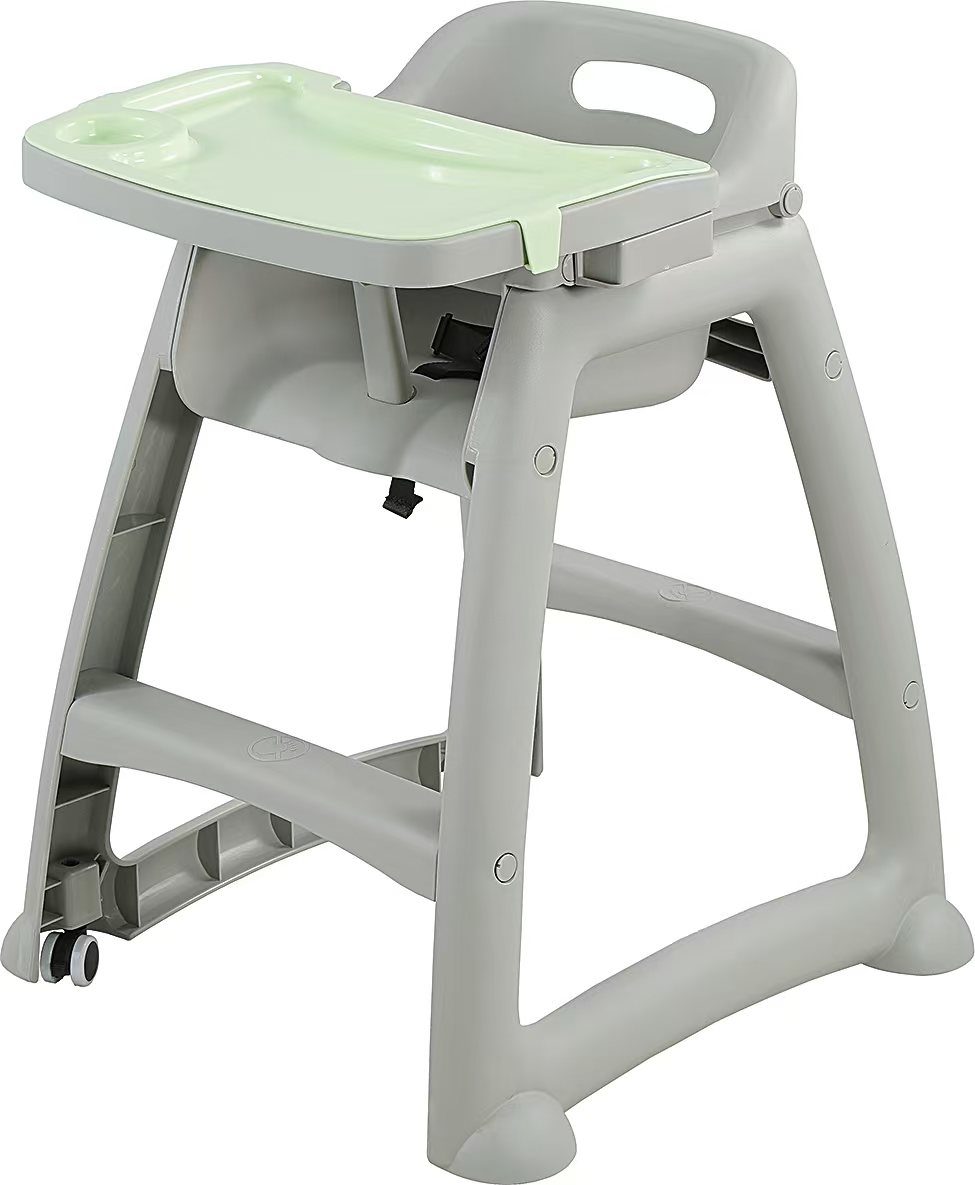
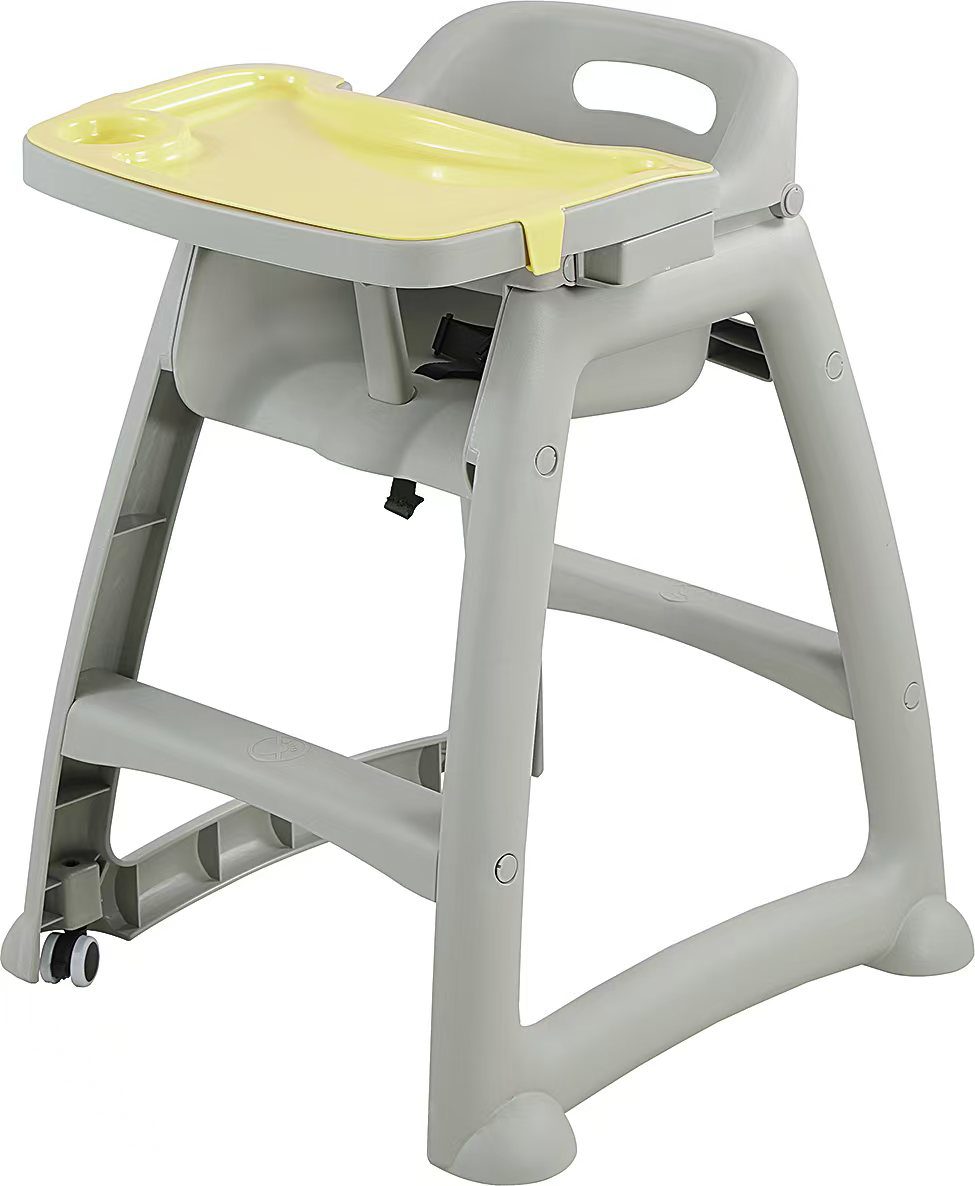
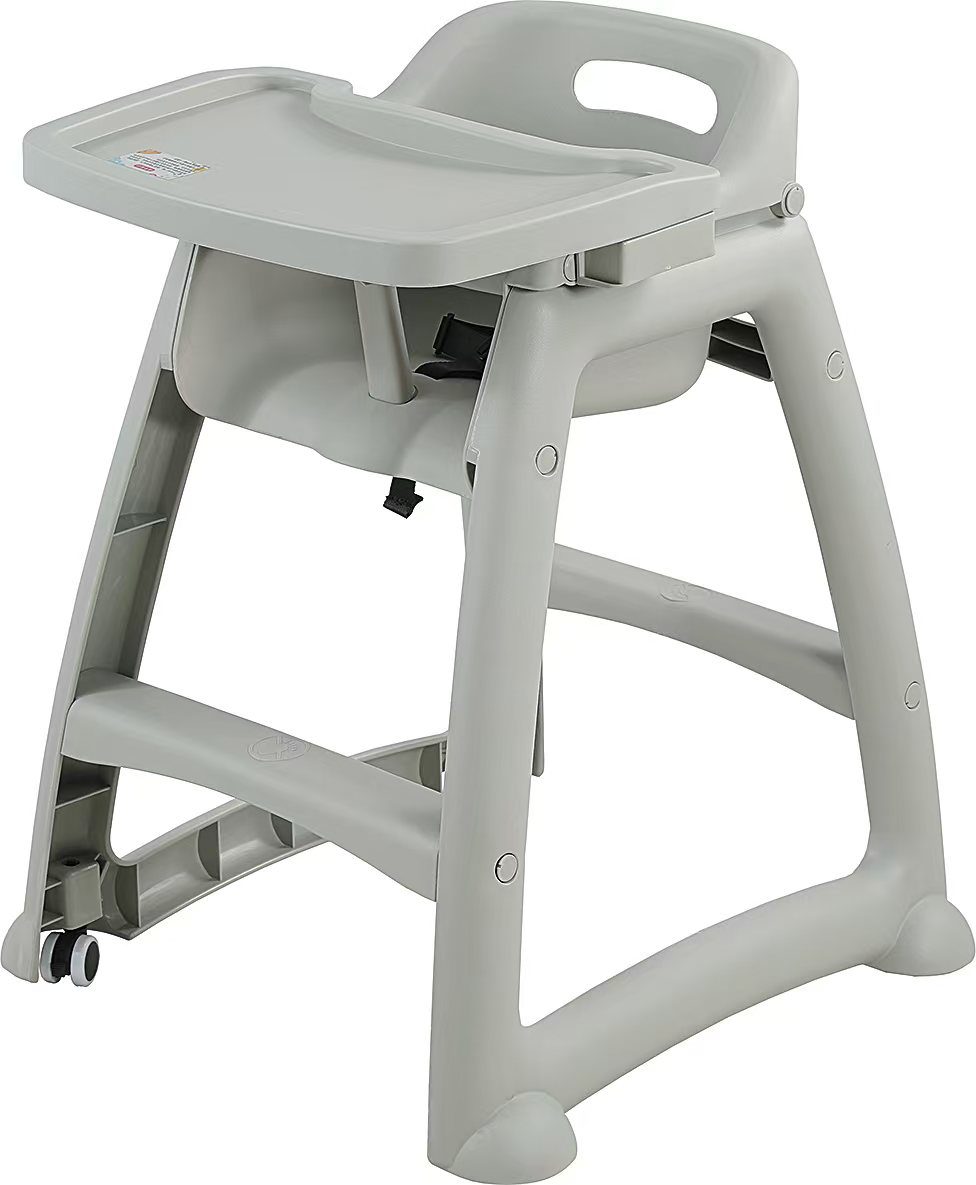
A single kids plastic dining chair in a busy nursery goes through four to six feeding sessions per day. Between each session, food residue, saliva, and airborne bacteria accumulate on every contact surface.
The contamination pattern is predictable:
- Seat surface and back — food smears, moisture, and skin contact residue
- Armrests and tray edges — direct mouth contact from infants under 18 months
- Chair joints and leg bases — biofilm buildup from floor contact and liquid runoff
- Stacking contact points — cross-contamination between chairs stored in direct contact
Residue-free cleaning for childcare plastic seating must address all four zones — not just the visible seat surface.
H3: The Chemical Residue Problem Most Buyers Overlook
Quaternary ammonium compounds (QACs) are the most common active ingredient in commercial disinfectant sprays. They are effective against bacteria and viruses. They are also persistent surface residues that do not fully evaporate after application.
For adult commercial kitchens, this is manageable. For a 12-month-old who presses their face against a chair armrest, it is a direct exposure risk.
The EU’s EN 14476 standard and the US EPA Design for the Environment program both recognize this distinction. Childcare-specific disinfection protocols require either rinse-off application or residue-free chemistry — not standard spray-and-leave methods.
Foshan Lingshan Ying’s food-grade kids plastic dining chairs are manufactured with non-porous PP surfaces specifically to support rinse-free disinfection methods without residue trapping.
H2: 5 Residue-Free Disinfection Methods for Kids Plastic Dining Chairs
Each method below is matched to a specific operational context — daily turnover cleaning, weekly deep cycles, and monthly maintenance. Childcare operators can combine methods based on their facility schedule.
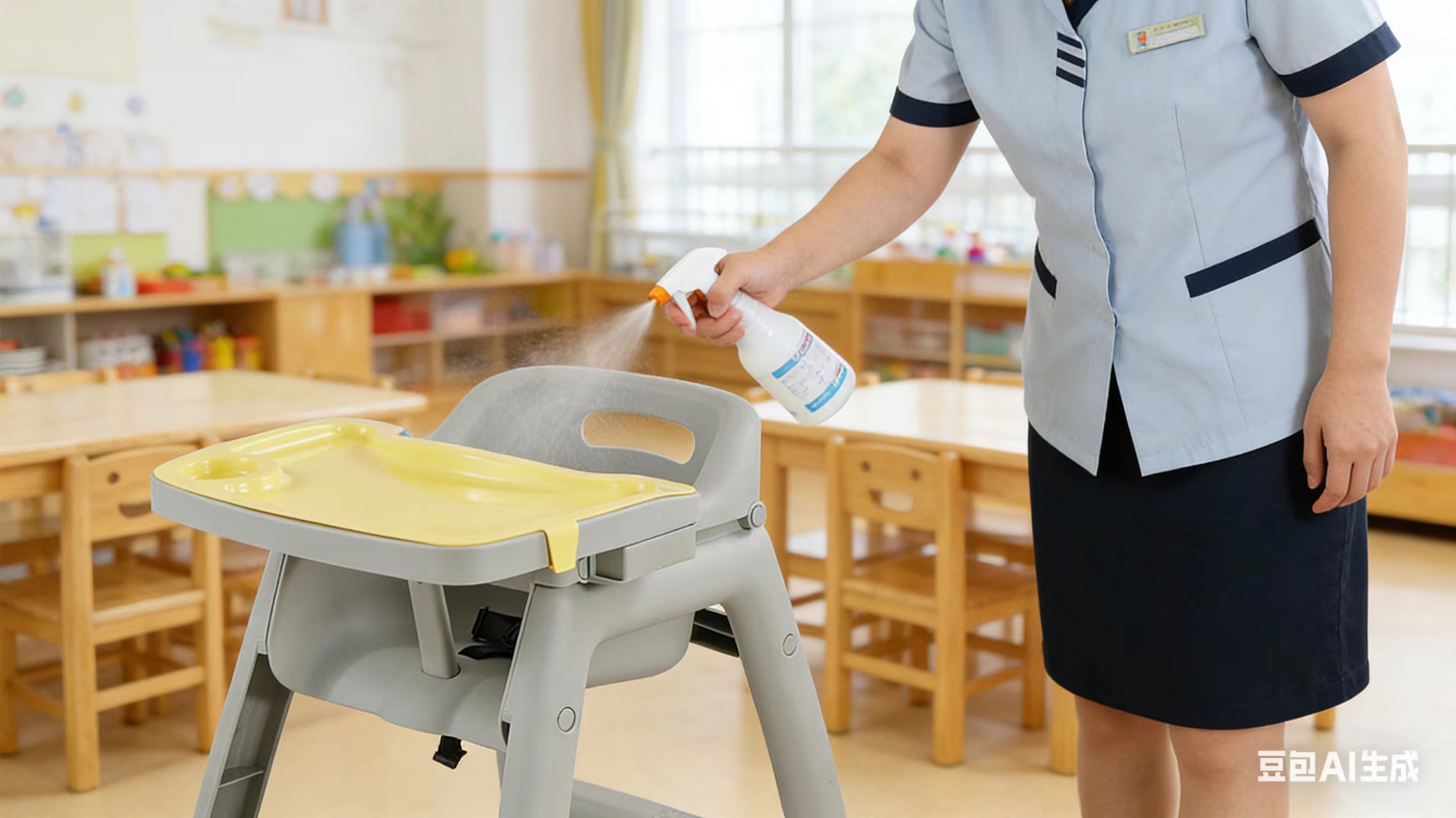
H3: Method 1 — Diluted Hydrogen Peroxide Wipe-Down (Daily Use)
Operational context: Post-meal cleaning between sessions in high-turnover nurseries
A 0.5%–1% hydrogen peroxide solution is one of the cleanest options available for food-grade kids plastic dining chair disinfection. After a 60-second contact time, it breaks down entirely into water and oxygen. No film. No residue. No rinse required.
Step-by-step application:
- Prepare 0.5% H₂O₂ solution in a labeled spray bottle
- Spray all chair surfaces — seat, back, armrests, tray, and leg joints
- Allow 60-second full contact time without wiping
- Wipe dry with a clean microfiber cloth
- Air dry 2 minutes before returning chair to use
This method meets EN 14476 surface disinfection requirements for childcare environments and is widely used in German and Dutch nursery chains.
H3: Method 2 — Steam Cleaning (Weekly Deep Cycle)
Operational context: Weekly full disinfection in maternal care centers and hospital pediatric units
Steam at 100°C eliminates bacteria, viruses, mold spores, and biofilm without any chemical contact. For safe disinfection of plastic kids chairs for nurseries, steam is the most thorough residue-free option available.
Operational notes for effective steam cleaning:
- Use a commercial steam cleaner with a flat nozzle attachment
- Hold nozzle 5–8 cm from surface — direct contact can stress chair joints
- Work systematically: seat → back → armrests → leg joints → stacking points
- Allow complete air dry before stacking or returning chairs to service
- Foshan Lingshan Ying chairs use food-grade PP rated to 80°C continuous — steam exposure at correct distance does not cause warping or surface degradation
H3: Method 3 — Hypochlorous Acid (HOCl) Spray (Between-Session Quick Clean)
Operational context: Fast turnover between meal sessions in kindergartens running 3+ seatings daily
Hypochlorous acid at 200 ppm is chemically equivalent to bleach in pathogen elimination — but it is pH-neutral, non-irritating to skin and mucous membranes, and leaves zero harmful residue on contact surfaces.
It is approved for food contact surface disinfection in the EU, USA, Japan, and South Korea — making it the most internationally accepted option for childcare plastic seating.
Turnover protocol:
- Spray, wait 30 seconds, wipe dry with microfiber cloth
- Total chair turnaround time: under 3 minutes
- Safe for immediate child contact after wiping — no secondary rinse needed
H3: Method 4 — Citric Acid Solution (Monthly Mineral and Biofilm Removal)
Operational context: Monthly maintenance cleaning in facilities with hard tap water
Mineral deposits and biofilm accumulate in chair joints over months of daily cleaning — particularly in regions where tap water hardness exceeds 200 ppm. Standard disinfectants do not remove mineral scale. Citric acid does.
A 3%–5% citric acid solution applied monthly keeps chair joints clean and prevents biofilm from establishing in surface micro-texture.
Application: Spray or wipe solution onto affected areas, allow 5-minute dwell time, scrub joints with a soft nylon brush, rinse with clean water, and air dry fully before use. Citric acid is food-safe and leaves no toxic residue after rinsing.
H3: Method 5 — UV-C Disinfection Cabinet (Overnight Cycle for Portable Chairs)
Operational context: Facilities using portable or stackable kids plastic dining chairs across multiple rooms
UV-C disinfection cabinets are now standard equipment in maternal care centers across Japan, South Korea, and Northern Europe. Chairs are loaded after evening cleaning, and a 20–30 minute UV-C cycle eliminates surface pathogens without any chemical application.
No residue. No contact time management. No staff exposure to disinfectant chemistry.
Customizable kids plastic dining chairs for maternal centers from Foshan Lingshan Ying feature smooth, unobstructed surface geometry — a deliberate design choice that maximizes UV-C exposure coverage across all chair surfaces, including underseat areas and leg joints.
H2: Application Scenarios — Where These Methods Are Used Globally
Foshan Lingshan Ying supplies kids plastic dining chairs to a wide range of childcare and maternal care environments across 30+ countries. Here is how different facility types apply these disinfection methods in practice:
- Nursery centers (0–3 years) — HOCl spray between every feeding session; weekly steam deep clean
- Kindergartens (3–6 years) — Daily H₂O₂ wipe-down; monthly citric acid joint maintenance
- Maternal and infant care centers — UV-C cabinet overnight cycle; HOCl for daytime quick turns
- Hospital pediatric dining areas — Steam cleaning meeting clinical hygiene standards; citric acid monthly
- Chain childcare franchises — Standardized HOCl protocol deployed consistently across all locations
- Hotel family dining and kids clubs — Daily H₂O₂ wipe-down between guest seatings
H2: Why Foshan Lingshan Ying Kids Plastic Dining Chairs Support All 5 Methods
The disinfection method is only as effective as the surface it is applied to. Chair material, surface finish, and structural design determine whether residue-free cleaning is achievable in daily operations — or just in theory.
H3: Certifications That Childcare Procurement Teams Require
| Certification | Standard Body | Market Relevance |
|---|---|---|
| FDA | US Food & Drug Administration | USA, Canada childcare compliance |
| LFGB | German Food and Feed Code | EU, Germany, Austria, Switzerland |
| ISO 9001:2015 | International Organization for Standardization | Global supplier qualification |
| RoHS / REACH | EU Chemical Regulation | EU import and institutional procurement |
Full certification documentation is provided for every order — ready for institutional procurement approval and facility licensing requirements.
H3: Factory Capacity and Custom Supply for Childcare Buyers
Foshan Lingshan Ying operates a 12,000 m² production facility in Foshan, Guangdong with the following supply capabilities:
- Monthly production capacity: 500,000+ plastic product units
- Export markets: USA, Germany, Japan, South Korea, Australia, UAE, and 30+ countries
- Clients served: 100+ overseas childcare institutions, hotel groups, and catering brands
- Customization options: Seat height, width, armrest profile, tray attachment, color by age group, logo embossing, non-slip foot pads
- MOQ: 500 units (standard models) / 1,000 units (custom mold)
- Lead time: 7–15 days (standard) / 18–25 days (custom mold from approved drawings)
FAQ: What Childcare Buyers Ask Before Purchasing Kids Plastic Dining Chairs
Q1: Are your kids plastic dining chairs certified safe for direct infant contact?
Yes. All chairs are produced using FDA and LFGB certified food-grade PP material. Material safety data sheets and third-party test reports are included with every shipment. Additional lab verification is available on request for institutional procurement approval.
Q2: Will daily disinfection damage the chair surface over time?
No. Food-grade PP is chemically stable against all five disinfection methods in this guide — including daily HOCl spray, weekly steam cleaning, and monthly citric acid treatment. Surface integrity and color hold through years of repeated cleaning cycles without cracking or degradation.
Q3: Can chair dimensions be customized for different age groups in our facility?
Full OEM/ODM customization is standard. Seat height, width, armrest design, tray attachment type, color coding by age group, and logo embossing are all adjustable. Custom mold development takes 18–25 working days from approved technical drawings.
Q4: What is the minimum order quantity for a first purchase?
Standard chair models: MOQ 500 units, lead time 7–15 days. Custom mold orders: MOQ 1,000 units, lead time 18–25 days from mold sign-off. Mixed model combinations are negotiable for first-time institutional buyers.
Q5: What documentation is provided for facility licensing and procurement approval?
Standard documentation package includes: commercial invoice, packing list, certificate of origin, FDA and LFGB material certificates, MSDS, and ISO quality certificate. Third-party SGS or Intertek lab reports are available as an add-on for facilities requiring independent verification.
Conclusion: The Right Kids Plastic Dining Chair Makes Safe Disinfection Operationally Realistic
Residue-free disinfection of kids plastic dining chairs is not complicated — but it requires the right chair material to work. Non-porous food-grade PP, smooth molded surfaces, and certified material safety are what allow HOCl spray, steam cleaning, and UV-C methods to perform as intended in real childcare operations.
Foshan Lingshan Ying has supplied certified food-grade plastic seating to 100+ overseas childcare institutions, maternal care centers, and hotel family dining operations across 30+ countries. Factory-direct pricing, full customization capability, and complete certification documentation make procurement straightforward for institutional buyers at any scale.
📩 Get Your Custom Kids Plastic Dining Chair Quote
Contact Foshan Lingshan Ying for a custom plastic product quote today!
Send your chair specifications, required certifications, and order quantity. Our export team responds within 24 hours with tailored product options and factory-direct pricing.
Foshan Lingshan Ying Plastic Products Co., Ltd. — FDA & LFGB Certified Plastic Products Manufacturer, Foshan, China.