Hotels don’t run on good intentions—they run on repeatable systems. The right commercial carts and janitorial tools for hotels reduce wasted trips, speed up room turnover, keep guest-facing areas polished, and lower safety risks in high-traffic spaces.
This guide explains the four rolling-workflow categories most hospitality teams rely on: Food Service & Clearing, Housekeeping & Linen, Floor Care & Safety, and Back-of-House Transport. If you’re sourcing for a hotel, resort, serviced apartment, or premium F&B venue, this is a practical place to start.
Quick Buyer Summary
A strong hotel cart program usually standardizes:
- Front-of-house clearing carts that support sorting (waste vs. cutlery), discreet containment, and quiet movement
- Housekeeping carts with a laundry bag that work as mobile workstations for consistent room turns
- Mop wringer systems matched to traffic volume (single-bucket for compact routes, double-bucket for high-traffic areas)
- Heavy duty utility carts sized by what your team moves daily (2-tier for bulky loads, 3-tier for mixed supplies)
1) Food Service & Clearing Carts (Front-of-House Efficiency)
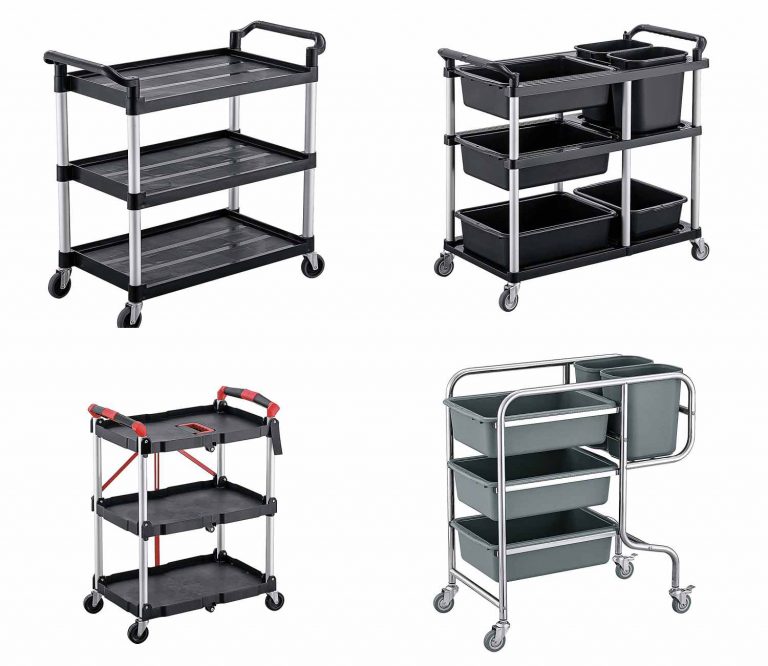
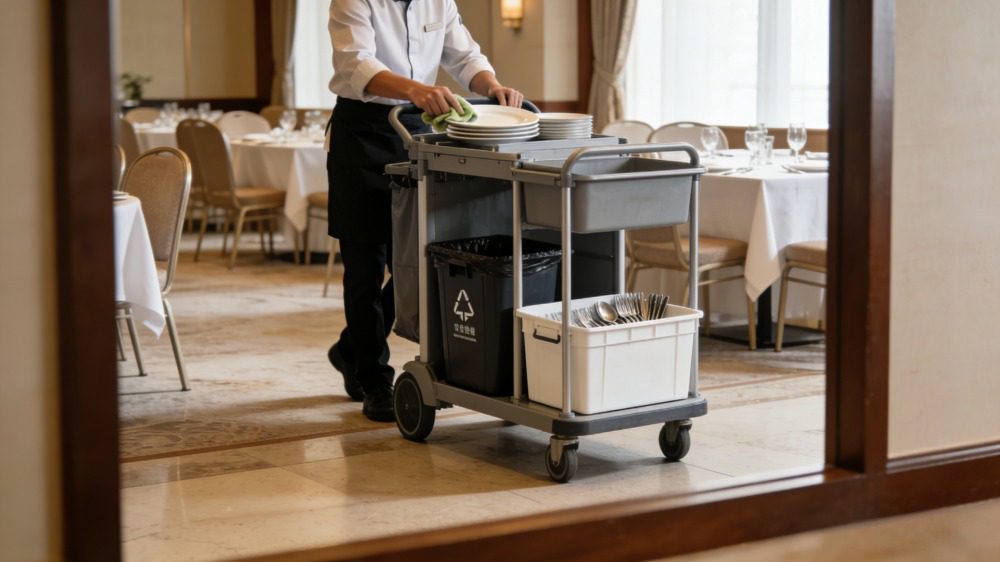
In restaurants, banquet halls, and room service routes, the goal is simple: clear and reset quickly without creating a messy guest experience. A well-designed clearing setup typically uses a commercial bussing cart with bins or a clearing trolley that supports separation (waste vs. cutlery), stable shelving for heavy loads, and optional tote systems for organized transport.
Front-of-house areas also demand “quiet professionalism.” Many properties choose non-marking casters so carts roll smoothly through dining rooms and corridors without leaving streaks or adding noise during service.
What to look for
- Sorting and separation at the point of clearing (waste, cutlery, glassware)
- Shelves that won’t flex under plated loads
- Quiet, non-marking casters for corridors and dining rooms
- Containment options (bins/totes/enclosed sides) to keep operations discreet
Related category links: Hotel Operations Essentials: Commercial Carts & Janitorial Tools
2) Housekeeping Carts & Linen Handling (Room Turnover Workflow)
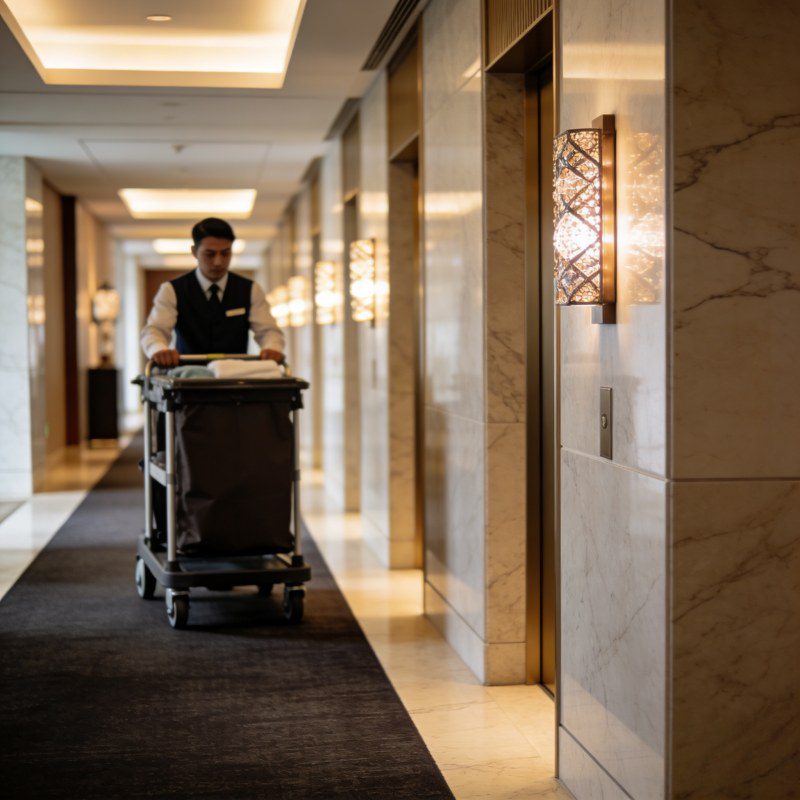
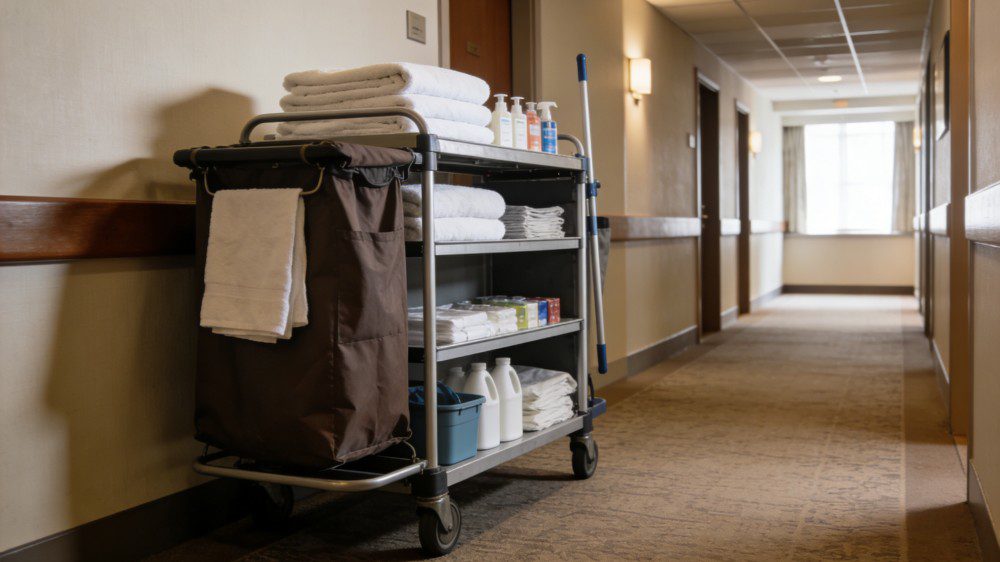
Housekeeping is where minutes turn into money. A cart that’s hard to push, poorly organized, or constantly running out of essentials slows the entire operation. Most hotels improve consistency with a mobile workstation approach: shelves for clean supplies, a dedicated bag for soiled linen, and a predictable restock routine.
For many teams, a hotel housekeeping cart with a laundry bag is the core of that workflow. When carts are standardized across floors, training is faster, restocking is simpler, and supervisors can spot issues immediately.
What to look for
- Clean/soiled workflow (shelves + laundry bag) that supports hygiene and speed
- Maneuverability in hallways, elevators, and tight turns
- Durable frames and wheels designed for daily use
- Easy-to-clean surfaces for routine sanitation
Related category links: https://lsyplastic.com/product-category/hotel-supplies/housekeeping-carts/
3) Floor Care & Safety (Risk Management)
Clean floors are not just cosmetic—they’re a safety system. High-traffic areas require tools that maintain cleaning performance, especially when water gets dirty fast. That’s why many facilities choose a double bucket mop wringer trolley: it helps keep rinse water separate from cleaning solution, improving results and reducing rework.
For smaller routes, storage-limited closets, or quick response needs, a single bucket mop wringer cart can be the better fit. Pairing your system with a commercial wet mop quick change setup reduces downtime when a mop head needs replacement during a busy shift.
What to look for
- Single vs. double bucket setups based on traffic level and cleaning standards
- Wringer type that matches your team’s routine (speed and ease of use matter)
- Faster changeovers (quick-change mop heads) to reduce downtime
- Stability and spill control to support slip-and-fall prevention
Related category links: https://lsyplastic.com/product-category/hotel-supplies/janitorial-cleaning-trolleys/
4) Back-of-House Utility Carts (Engineering, Storage, Daily Ops)
From maintenance teams to storerooms, back-of-house work needs carts that can take real load and real abuse. A heavy duty utility cart reduces lifting, prevents dropped items, and keeps teams moving.
As a simple rule: heavier bulky loads often suit 2-tier carts, while mixed supplies and tools often suit 3-tier carts. For engineering teams, a heavy duty 2 tier utility cart for warehouse and hotel maintenance is often the most stable choice for parts, chemicals (where permitted), or tool kits. If your daily routes involve mixed supplies, a 3 tier plastic utility service cart for facility operations can reduce trips by keeping items separated and easier to locate.
Many properties also standardize a commercial service cart for storeroom restocking to streamline inventory runs. And in guest-adjacent areas, choose a utility cart with non-marking casters for tile floors to protect surfaces and keep movement quieter.
What to look for
- Load stability and reinforced shelves for daily transport
- Wheel quality (quiet roll, non-marking, reliable swivel)
- Easy-to-clean surfaces for shared facility use
- Right tier count based on what you move most
Related category links: https://lsyplastic.com/product-category/hotel-supplies/restaurant-room-service-carts/
Why Commercial Grade Matters (Quick Buyer’s Comparison)
A cart’s true cost isn’t its price—it’s labor efficiency, downtime, and replacement cycles. Commercial-grade carts are built for higher loads, smoother rolling, and easier sanitation—so they tend to outperform consumer carts in hospitality environments.
Practical signs you need commercial-grade equipment
- Wheels fail, squeak, or flat-spot under daily use
- Shelves flex or carts feel unstable under real loads
- Staff avoid using the cart because it’s hard to push or noisy
- Cleaning takes longer because surfaces and corners are difficult to wipe
Commercial Grade vs. Consumer Carts: What Procurement Should Look For
Facilities buy carts for throughput, safety, and longevity—not just a low price tag. Here’s the practical difference:
| Feature | Consumer/Home Cart | Commercial-Grade Equipment |
|---|---|---|
| Wheels | Hard plastic (noisy, can mark floors) | TPR-style silent, non-marking casters for smoother rolling |
| Materials | Light PVC / thin metal | High-density plastic or stainless steel for daily use |
| Load handling | Low capacity, flexes under load | Designed for heavier loads and frequent trips |
| Hygiene | Hard corners, tricky to clean | Easier-to-wipe surfaces, better for routine sanitation |
| Uptime | More replacements and repairs | Longer service life, fewer operational interruptions |
Procurement tip: prioritize wheels, load handling, cleaning ease, and workflow fit (bussing vs. housekeeping vs. laundry). That’s where labor savings come from.
Takeaway: Standardize the “Carts People Touch Every Hour”
If you want faster turnover, cleaner guest-facing operations, and safer floors, start by standardizing the carts and tools your team uses on every shift. When rolling equipment matches the workflow—service, housekeeping, floor care, and back-of-house transport—efficiency stops being a goal and becomes the default.
FAQ
What is the difference between a bussing cart and a utility cart?
A bussing cart is designed for table clearing and often supports separation (waste and cutlery). A utility cart is a general transport cart for supplies, tools, and mixed loads across back-of-house routes.
What casters are best for hotel corridors and dining rooms?
Hotels typically prefer quiet, non-marking casters to reduce noise and protect floors, especially on tile, vinyl, or polished surfaces.
Single bucket vs double bucket mop wringer: which is better for hotels?
A double bucket mop wringer trolley is usually better for high-traffic areas because it helps separate rinse water from cleaning solution. A single bucket mop wringer cart works well for compact routes and storage-limited spaces.
How do I choose a housekeeping cart for faster room turnover?
Look for a hotel housekeeping cart with a laundry bag, shelves for clean items, easy maneuverability in hallways and elevators, and durable wheels designed for daily use.
2-tier vs 3-tier utility cart: what should maintenance teams buy?
Choose a 2-tier cart for heavier bulky loads and maximum stability. Choose a 3-tier cart when you need better organization for mixed supplies and want to reduce trips.
Why do commercial-grade carts cost more than consumer carts?
Commercial carts are built for frequent daily use—better load stability, smoother rolling, easier cleaning, and fewer breakdowns that cause downtime.