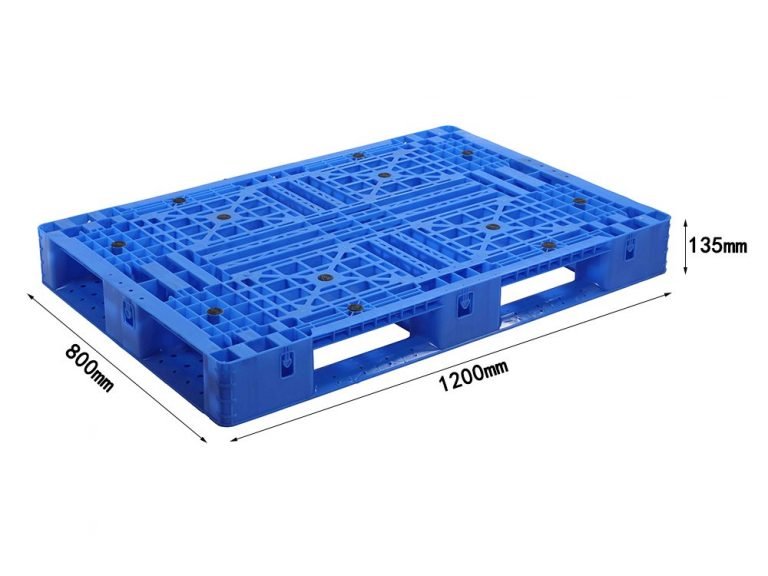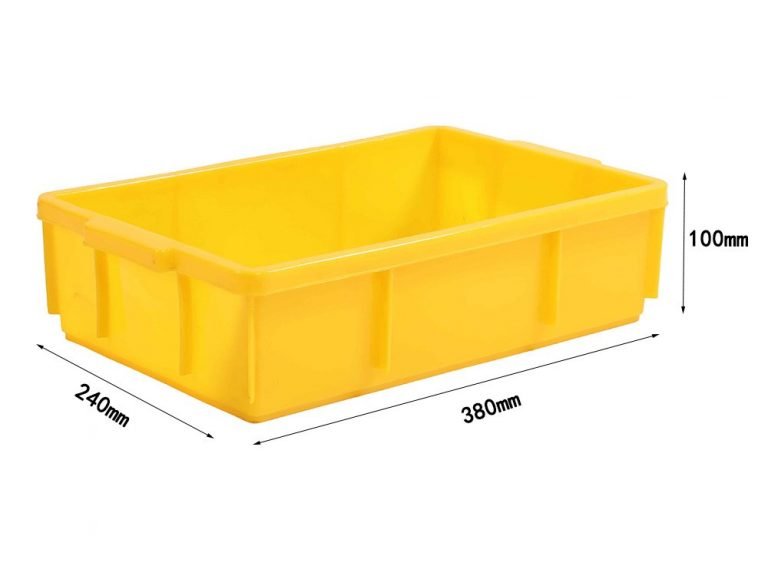
Recycled content in plastic pallets and crates is not one thing. Regrind (post-industrial, PIR) is the factory’s own scrap, ground and fed back into the same process; PCR (post-consumer recycled) is material recovered from products that have already been used by an end customer. The two carry different mechanical performance, different documentation and, in food-contact applications, completely different legal status. If your purchase order only says “recycled material”, you will get regrind by default — and you will not be able to prove any percentage to your own customer.
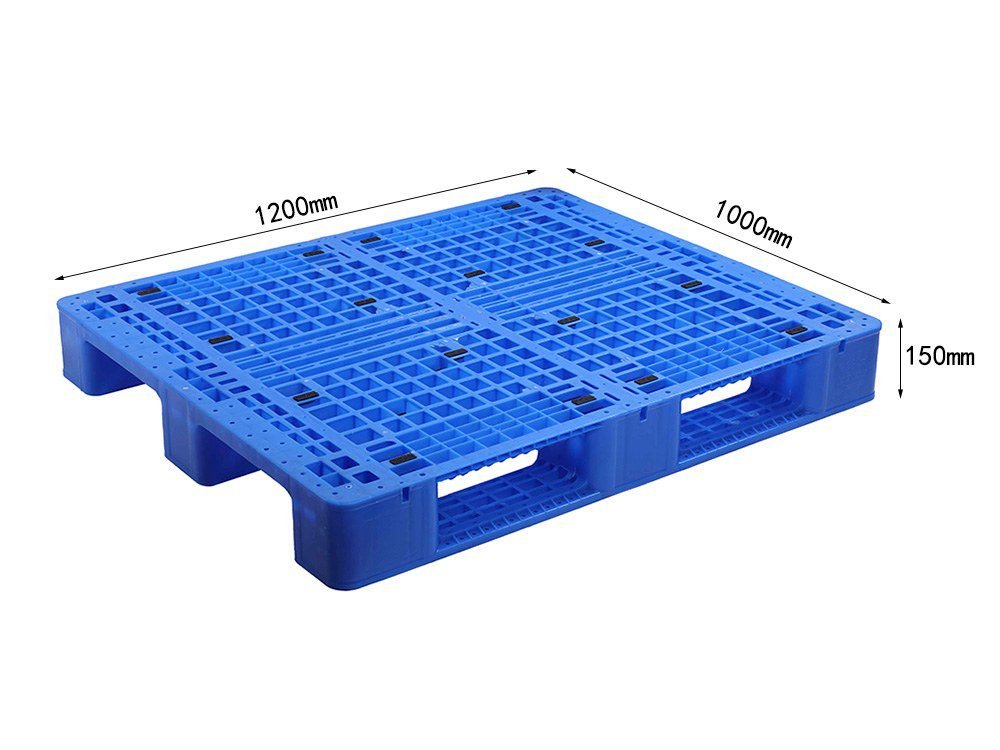
This guide sets out what each term means, what recycled content does to a pallet or crate in service, where the food-contact rules draw the line, and how to write a claim you can actually verify.
Four terms buyers mix up
| Term | What it is | Typical use in crates and pallets |
|---|---|---|
| Virgin resin | Newly polymerised HDPE or PP, no recyclate | Food contact, ESD, colour-critical, high-load structural parts |
| Regrind / PIR (post-industrial) | Sprues, runners and rejects from the moulding process, ground in-house | Non-food industrial crates, pallet blocks, general warehousing |
| PCR (post-consumer) | Resin recovered from products used and discarded by end consumers, then washed and re-pelletised | Non-food pallets and crates, black or grey parts, sustainability programmes |
| Ocean-bound / ocean-recovered | PCR sourced from waste collected near coastlines, with a defined collection radius | Marketing-led programmes, usually with third-party certification |
Note the wording trap: “recyclable” and “recycled” are different claims. A virgin HDPE pallet is 100% recyclable and contains 0% recycled content. Both statements can be true on the same product, and buyers regularly accept one when they meant the other — a distinction that also shapes most plastic pallet sustainability programmes.
What recycled content does to a pallet or crate in service
Recycled HDPE is not a drop-in replacement for virgin resin. Chain length shortens each time the polymer is processed, and contamination accumulates. The practical effects, in order of how often they matter to buyers:
- Impact strength falls. A crate moulded with a high regrind ratio cracks at the corners sooner under the same drop test. This is the single biggest service-life risk and the reason structural parts are usually capped at 20–30% regrind.
- Colour is no longer controllable. Mixed PCR feedstock produces grey, black or muddy tones. Anything outside dark colours is effectively off the table unless you use a certified single-stream PCR.
- Odour and contamination. PCR from mixed post-consumer streams can carry residual odour. For closed environments — food storage, hotel housekeeping, clean rooms — this is often the first objection.
- ESD performance becomes unreliable. Conductive and dissipative grades depend on a controlled carbon black or additive network. Recyclate of unknown origin makes surface resistivity unpredictable, so anti-static containers should be specified in virgin material.
- UV stability drops. Outdoor wheelie bins and yard pallets need a fresh stabiliser package; recycled resin already carries degraded additive residue.
Food contact: where the line is
This is the part that gets buyers into trouble. In the European Union, recycled plastic intended for food contact must come from a recycling process authorised under Regulation (EU) 2022/1616, and the converter must be able to show the material’s provenance and the process it went through. In the United States, recycled plastic for food contact is assessed case by case against FDA guidance, and the supplier carries the burden of demonstrating that the recycling process removes contamination.
The practical consequences:
- For crates and bins that directly contact food, assume virgin material unless your supplier produces a documented, compliant recycled stream. Regrind from your own closed production loop is the usual exception, and even that needs a written declaration.
- For pallets, totes and crates that only carry packaged goods, recycled content is normally acceptable and is where most programmes sit.
- For anything exported to the EU with a food-contact claim, ask for the declaration before the sample, not after.
How to verify a recycled content claim
A percentage on a datasheet is a claim, not evidence. Four things make it checkable:
- A material declaration per batch. Resin grade, recyclate type (PIR or PCR), percentage by weight, and the supplier of the recyclate.
- Traceability to a standard. EN 15343 is the European standard for plastics recycling traceability and assessment of recycled content; EuCertPlast certification is the common audit scheme behind it. A supplier claiming 30% PCR should be able to name the recycler and the certificate.
- Mass balance disclosure. Many programmes account for recycled content at site level rather than per part. That is legitimate under ISO 14021 self-declared environmental claims if it is disclosed — but it means a specific pallet may not physically contain 30% recyclate. Ask which model applies.
- Mechanical test data on the recycled grade. Impact and load data measured on the actual recycled compound, not copied from the virgin datasheet.
Cost and supply reality
Recycled content is not automatically cheaper. Clean, single-colour, food-grade PCR commands a clear premium; mixed dark PCR for industrial parts can trade at or near virgin parity, which is why pallet recycling and end-of-life routes are worth planning at the buying stage. Two commercial points follow: recycled content is easier to secure if you accept dark colours, and the percentage is easier to hold if you commit to an annual volume rather than spot orders.
Writing recycled content into the purchase order
Vague clauses produce vague material. A workable clause covers six items:
- Type and percentage: “Minimum 30% post-consumer recycled HDPE by weight, remainder virgin HDPE. Post-industrial regrind not counted toward the 30%.”
- Colour allowance: “Colour to be black; shade variation between batches acceptable within the approved range.”
- Exclusions: “Recyclate not permitted in load-bearing corner blocks” or “not permitted in any part with a food-contact claim.”
- Documentation: batch declaration plus recycler certificate supplied with shipping documents.
- Verification: right to request a third-party test on a retained sample, at buyer’s cost, once per year.
- Change control: no change of recyclate source or percentage without written approval, with 30 days’ notice.
What LSY Plastic supplies
We mould HDPE pallets, turnover crates, ventilated produce crates and food storage bins at our Foshan factory, and we quote recycled content honestly: virgin material for food contact and ESD, controlled regrind for industrial parts, and PCR where the application and colour allow it. We will tell you when a requested percentage is not achievable in a given mould, rather than accept the order and substitute material later.
Frequently Asked Questions
Is regrind the same as recycled content?
No. Regrind is post-industrial scrap from the moulding process, counted as PIR. Post-consumer recycled (PCR) material comes from products already used by end customers. Most certification schemes and most brand-owner sustainability targets count PCR, and treat regrind separately or exclude it.
Can recycled plastic pallets carry the same load as virgin ones?
Usually with a derating. A pallet with 30% PCR in a well-designed mould can meet the same dynamic and static ratings as virgin, but the supplier should confirm it with test data on the recycled compound. Beyond about 50% recyclate, expect reduced impact strength and a shorter service life.
Why can’t I get a white crate with 50% PCR?
Because mixed post-consumer feedstock cannot be lightened to white without heavy pigment loading, which adds cost and weakens the part. Light colours need a single-stream, sorted PCR supply that is scarce and expensive. That is why most recycled pallet programmes standardise on black or grey.
Does recycled content affect food safety compliance?
It can. In the EU, recycled plastic for food contact must come from a process authorised under Regulation (EU) 2022/1616; in the US it is assessed case by case against FDA guidance. For direct food contact, specify virgin material unless the supplier provides documented compliance for the recycled stream.
How do I prove recycled content to my own customer?
Ask for a per-batch material declaration naming the recyclate type and percentage, the recycler, and a traceability certificate such as EN 15343 or EuCertPlast. Disclose whether the figure is calculated per part or by mass balance across the site — both are defensible, but only if stated.
Specify the material, not just the product
Send LSY Plastic your application, load requirement and the recycled content you need to declare, and we will confirm what is achievable in the mould, in which colour, and with what documentation. Samples are supplied at cost, and overseas orders ship as full containers. For load ratings and sizes, see our plastic pallet FAQ; for order minimums, read the MOQ, sample and FCL shipping policy.
WhatsApp: +86 19311059570 · Email: fstyx01@lsyplastic.com