Navigating the toy aisle often feels overwhelming for many parents. Indeed, a complex framework of international rules hides behind every safe toy. These regulations specifically prevent chemical and physical hazards. Therefore, understanding children’s plastichttps://lsyplastic.com/product/baby-chair/ safety certification brings immense peace of mind. Furthermore, this knowledge empowers you to make highly informed purchasing decisions. Here is a structured overview of the world’s most rigorous safety standards. First, we will answer the most common questions parents ask. Finally, we will show how Foshan Lingshangying Plastic Products Co., Ltd. actively helps brands achieve total compliance.
🇪🇺 EN71 (Europe): EU EN71:Europe’s Gold Standard for Toy Safety
Moving to European regulations, the EN71 standard sets a remarkably high bar for chemical safety. Specifically, EN71-3 focuses heavily on the migration of heavy metals. It accurately simulates what happens if a child ingests a plastic piece. Consequently, it forms a crucial part of children’s plastic safety certification.
Turning to specific concerns, here is how EN71 addresses pressing parental questions regarding chemical exposure:
- How does EN71 compare to American standards? Both standards remain incredibly strict. However, EN71 pioneers chemical migration testing. Specifically, testers check for 19 distinct heavy metals.
- How can I tell if a toy contains harmful phthalates? Toys passing this children’s plastic safety certification must exclude restricted phthalates. Consequently, legitimate CE-marked toys remain entirely safe.
- Is the surface paint lead-free? EN71-3 specifically tests surface coatings. Therefore, certified toys ensure no lead scrapes off during play.
- Does a “new plastic” smell mean the toy is toxic? Not necessarily. However, a pungent smell often indicates volatile organic compounds (VOCs). Fortunately, EN71 strictly limits these harmful emissions.
- Do toys degrade and release toxins in the sun? Premium standards require UV-stabilized plastics. As a result, these materials remain chemically stable over time.
🇺🇸 ASTM F963 (USA): Physical Durability in Children’s Plastic Safety Certification
Turning to the United States, regulators rely heavily on ASTM F963. This standard strictly regulates lead and dangerous chemicals. In addition, it features grueling physical “use and abuse” tests. Therefore, it ensures toys survive chaotic playrooms. Ultimately, it represents a vital children’s plastic safety certification.
Moving to physical hazards, let’s look at how ASTM F963 tackles them:
- What is ASTM F963? It acts as the mandatory gold standard for US toys. Moreover, it dictates everything from flammability to structural integrity.
- How do standards test for choking hazards? ASTM F963 uses a specialized “small parts cylinder.” If a toy fits entirely inside, testers immediately ban it for toddlers.
- What if my child swallows a broken piece? Choking remains a severe physical danger. However, ASTM’s chemical rules ensure the plastic will not leach acute toxins internally.
- How do factories prevent sharp edges? ASTM mandates strict sharp edge testing. Testers run toys along a specialized tape. If the toy cuts the tape, the factory must fix the mold.
- What age grading fits hard versus soft plastics? ASTM guidelines reserve soft plastics for infants. Conversely, they grade rigid plastics for older toddlers.
🇨🇳 GB 6675 (China): Holistic Material Integrity for Children’s Plastic Safety Certification
Moving to Asian markets, China’s national standard, GB 6675, aligns very closely with ISO international rules. It requires the mandatory CCC mark. Furthermore, it places a massive emphasis on phthalate restrictions and overall material purity. Thus, it provides a robust children’s plastic safety certification.
Turning to material types, here is how GB 6675 addresses common questions:
- Is the Chinese GB 6675 standard reliable? Yes, absolutely. It acts as a legally enforced standard. Moreover, regulators strictly ban harmful plasticizers and heavy metals.
- Are inexpensive overseas toys safe? They remain safe only if they carry verifiable. Otherwise, uncertified toys often cut dangerous corners.
- Are PVC toys safe if labeled “phthalate-free”? Yes. PVC acts as a durable plastic. Meanwhile, GB 6675 strictly enforces the use of safe, non-toxic alternative plasticizers.
- What is the difference between food-grade and toy-grade plastic? Food-grade plastic safely contacts consumables. Meanwhile, toy-grade plastic ensures physical durability and skin safety.
- Are BPA-free plastics completely safe for babies? Yes, provided they pass broader chemical tests. Furthermore, the plastic must also exclude heavy metals entirely.
🏭 The Factory Floor: Guiding Brands Through Children’s Plastic Safety Certification
Turning to manufacturing, standards only work if factories actively uphold them. At Foshan Lingshangying Plastic Products Co., Ltd., we act as your dedicated contract manufacturing partner. We actively help clients navigate the complex children’s plastic safety certification process. Here is exactly how we build children’s plastic safety certification into every product.
1. Selecting Compliant Raw Materials
Moving to raw materials, you cannot mold a safe toy from compromised plastics. Therefore, we guide our clients in choosing the right resins. This guarantees successful.
- Target Market Matching: If you target Europe, we source materials that strictly pass EN71. Alternatively, for the US market, we ensure full ASTM compliance.
- Banning Recycled Scrap: We strictly prohibit unverified recycled plastics. Indeed, these materials often harbor unknown, dangerous chemicals. This ruins your children’s plastic safety certification.
- Colorant Safety: We rigorously vet all masterbatches. Consequently, we guarantee they remain 100% lead-free.
2. Matching Production Processes
Turning to production, the manufacturing process must remain flawless. Thus, we tailor our production techniques to meet specific demands.
- Eliminating Sharp Edges: We utilize high-precision CNC-machined molds. This effectively prevents “flash”—razor-sharp slivers of excess plastic.
- Thermal Stability: We precisely control injection molding temperatures. As a result, our high-grade plastics withstand boiling or UV sterilization without degrading.
3. Coordinating Third-Party Inspections
Moving to testing, achieving requires official, independent validation. We do not just manufacture toys. Instead, we actively manage the children’s plastic safety certification testing logistics.
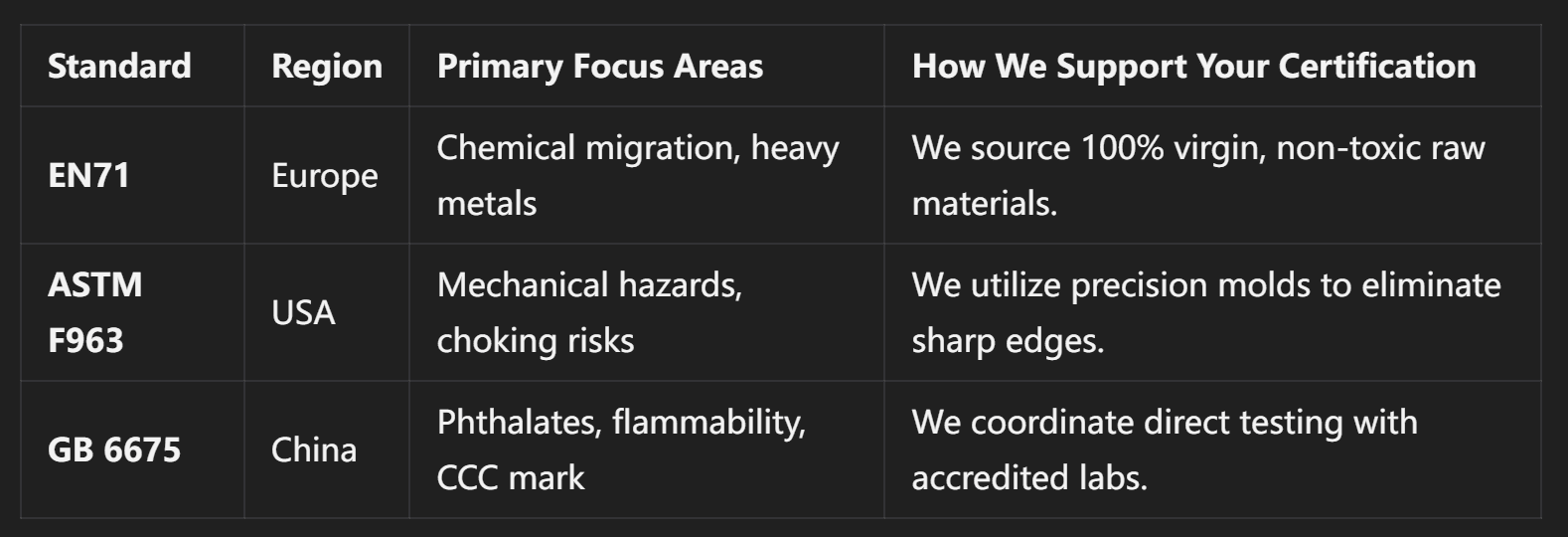
Standard Comparison & Factory Support Overview
- Lab Coordination: We partner directly with accredited third-party labs like SGS and Intertek.
- Sample Preparation: Next, we prepare and submit the exact production samples required for testing.
- Documentation Support: Finally, we help you compile the final compliance reports. This ensures you can confidently display the CE, CPC, or CCC marks
💡Trusting the Certification Process: Safety You Can Count On
Turning to the final takeaway, protecting children requires a global effort. By understanding EN71, ASTM F963, and GB 6675, parents can shop with total confidence. Meanwhile, brands need a highly reliable manufacturing partner. At Foshan Lingshangying, we seamlessly integrate rigorous material selection, precision molding, and lab coordination. Therefore, we ensure your products achieve flawless children’s plastic safety certification every single time.