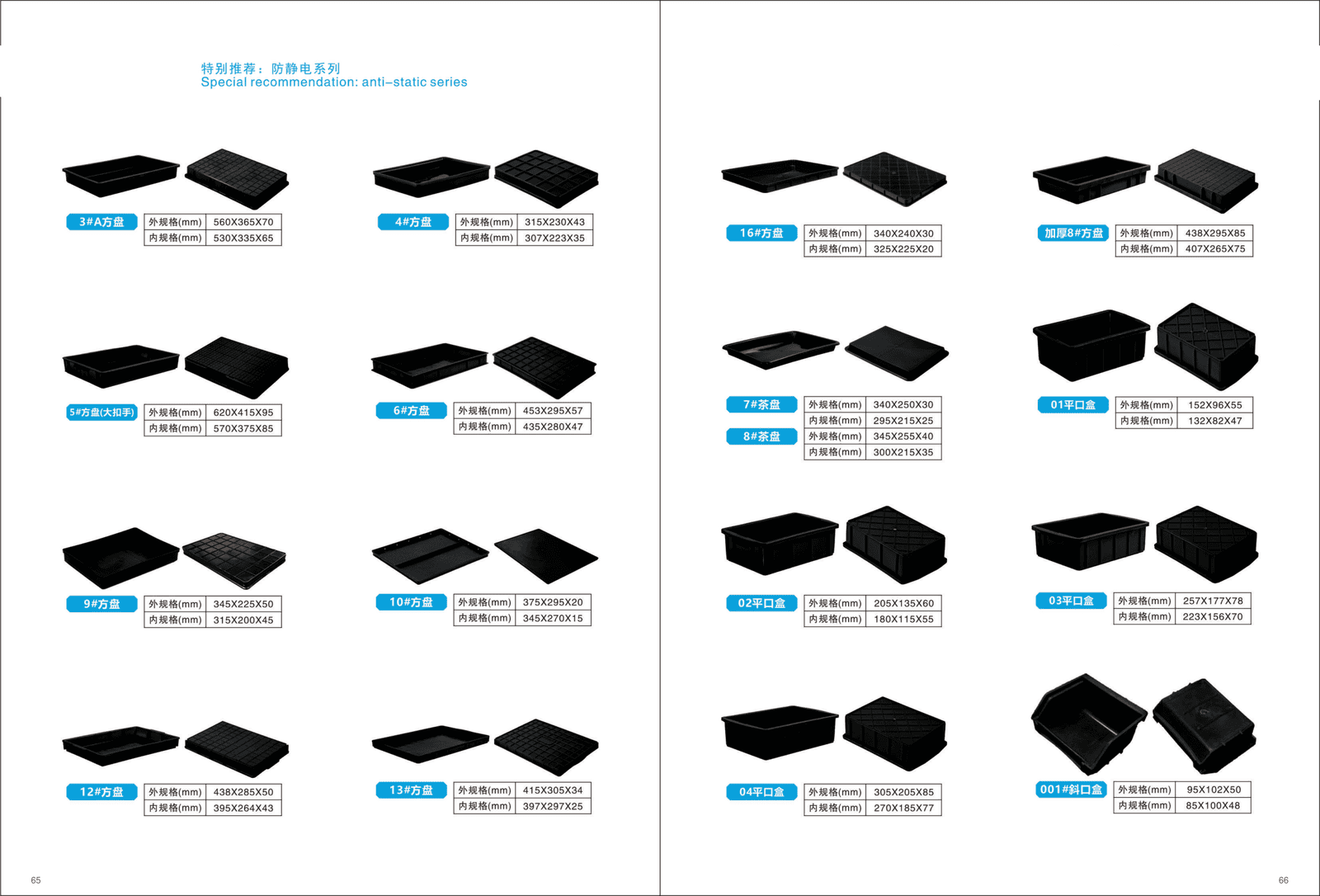
Use ESD turnover boxes to move boards and use ESD trays to present them. That is the shortest useful answer. Turnover boxes carry work in progress between stations, protect assemblies in storage and survive the transport leg; trays hold components, boards or assemblies in a fixed position so a machine, an operator or a magazine can handle them repeatably. Most electronics manufacturers need both, and the specification mistakes come from using one where the other belongs. This guide sets out surface resistivity classes, footprints, materials and the compliance documents to collect before you order. For the classification basics, start with our guide to anti-static, conductive and dissipative plastic bins.
What each container actually does on the line
ESD turnover boxes
A turnover box is a logistics container. It moves material between processes, protects it during storage, and usually nests or stacks when empty. It is judged on three things: protection during movement, volume efficiency, and how well it interfaces with racks, carts and conveyors.
Typical uses: board storage between SMT and through-hole assembly, kitting of components to a workstation, moving sub-assemblies to test, and packing finished product for internal transport.
ESD trays
A tray is a presentation container. It fixes the position of each item so that a machine or an operator can pick it up in a known place, every time. Trays rarely travel on their own; they stack in magazines, feed machines, or sit on a workbench.
Typical uses: bare board handling through SMT, component presentation at pick-and-place feeders, in-circuit test fixtures, and stacked storage of populated boards.
Surface resistivity: matching the container to your control plan
| Class | Surface resistivity | Typical use |
|---|---|---|
| Conductive | 10³ to 10⁵ Ω/sq | Trays and magazines where fast charge decay matters; sensitive component presentation |
| Dissipative | 10⁶ to 10⁹ Ω/sq | Most board handling boxes, work-in-progress containers, general assembly |
| Antistatic | 10⁹ to 10¹² Ω/sq | Packaging and short-term protection; not a substitute for a dissipative container |
| Insulative | Above 10¹² Ω/sq | Not acceptable for ESD protected areas |
Match the class to what the container touches. Boxes that hold populated boards and travel between buildings are usually specified dissipative, which bleeds charge without the fast discharge of a conductive surface. Trays feeding sensitive components are often specified conductive. Whichever you choose, the number must be verified on the actual moulded part, not taken from a resin datasheet.
Side-by-side comparison
| Decision | ESD turnover box | ESD tray |
|---|---|---|
| Primary role | Move, store, protect | Present, position, stack in magazines |
| Depth | Deep, 100 to 400 mm typical | Shallow, 20 to 120 mm typical |
| Internal geometry | Open cavity, optional dividers | Fixed compartments, slots or pegs |
| Load type | Mixed parts, sub-assemblies, bagged items | Bare boards, single components, uniform assemblies |
| Handling interface | Manual, cart, conveyor, pallet | Magazine, feeder, test fixture, bench |
| Empty volume | Should nest to cut return space | Should stack to a fixed pitch |
| Typical material | Dissipative PP or HDPE compound | Conductive PP, ABS or PS compound |
| Custom tooling value | High — footprint and divider layout drive efficiency | Very high — compartment geometry must match the part |
Footprints and interface standards
Most electronics operations standardise on Euro footprints for boxes because they divide evenly into pallets and racking:
- 600 x 400 mm — the workhorse for board transport and inter-building movement.
- 400 x 300 mm — workstation level, fits shelving and benches easily.
- 300 x 200 mm — small parts, kitting, single assemblies.
Trays follow the machine or the board, not the pallet. Get the board outline drawing and the magazine or fixture dimensions before designing a tray. Two millimetres of clearance at the board edge can mean the difference between a tray that loads automatically and one that needs an operator to seat each board by hand.
Stacking pitch and magazines
Trays that go into magazines must stack to a repeatable pitch, usually defined by the magazine slot spacing. Specify the pitch, not just the tray height — a tray that stacks at an inconsistent height jams magazine loaders. This is one of the most common production problems with generic trays and one of the strongest arguments for custom tooling.
Material, cleaning and service life
- Permanent conductive compounds — carbon-loaded PP or ABS. Performance is stable over time and does not depend on humidity, which matters in dry cleanroom environments.
- Antistatic additives or coatings — cheaper, but performance can migrate or wash off. Avoid where the container is cleaned regularly.
- Cleanroom grades — for ISO Class 6 to 8 environments, specify low outgassing and low particle shedding, and confirm the grade is compatible with your cleaning agents.
- Heat resistance — trays that pass through reflow-adjacent processes or wash equipment need a grade rated for the actual peak temperature, not the average.
Avoid cleaning ESD containers with aggressive solvents unless the material supplier confirms compatibility. Many out-of-specification containers found in audits were damaged by cleaning rather than by use, and performance loss is invisible until boards start failing.
Building an ESD container standard
- List every point where a board or component is stored, moved or presented.
- Assign each point a role: move, store or present.
- Choose the class — conductive, dissipative or antistatic — from your ESD control plan for that role.
- Fix footprints to a small number of standard sizes to simplify racks, carts and shelving.
- Specify nesting for boxes and a fixed stack pitch for trays.
- Require verification reports with each delivery, and re-test periodically.
Keeping the standard small is the point. Every extra container size adds racking, cart and training cost, and every unverified container is an audit finding waiting to happen.
Custom ESD containers and OEM supply
Where a tray must match a specific board outline, or a box must fit an existing rack, custom tooling is usually the cheapest route over a two to three year horizon. Custom moulds also let you emboss part numbers, logos and ESD classification markings permanently into the container.
LSY Plastic has molded ESD containers, anti-static trays, turnover boxes and plastic pallets for electronics manufacturers since 1991, running Japanese imported machines from 180T to 2500T with an in-house mould workshop. Our ESD range covers boxes, trays, pallets and component bins, and we supply OEM customers including BYD, OPPO, vivo and Delice. Our wider ESD pallet range is covered in the ESD plastic pallets for SMT and cleanroom handling guide.
Send us a board drawing or a sample tray and we will propose compartment geometry, material class, stacking pitch and tooling lead time.
Request an ESD container proposal
Tell us your board size, the machine or magazine the tray interfaces with, your required resistivity class and your annual volume. We will come back with a drawing, material recommendation, verification method and MOQ.
WhatsApp: +86 19311059570
Email: fstyx01@lsyplastic.com
Related reading: anti-static vs conductive vs dissipative bins, ESD pallets for electronics manufacturing, and about LSY Plastic.