
Produce loses freshness on a clock that starts at harvest. Everything after picking — field heat removal, pre-cooling, cold storage, transport — is a race to slow that clock, and the crate the produce sits in decides whether the cold chain works or just looks like it does. A solid crate in a cold room is an insulated box: cold air washes the outside while the inside stays warm for hours. This guide covers how ventilated plastic crates actually preserve produce, the hole pattern trade-offs, sizing by product, and the workflow details that get missed. For washing and hygiene, see our crate cleaning and sanitizing guide.
Why ventilation is the whole game
Harvested produce keeps respiring: it consumes sugars and oxygen, releases heat, and loses moisture. The warmer it stays, the faster this runs. Cooling from harvest temperature (often 25 to 35°C) to storage temperature (0 to 10°C for most products) roughly halves the respiration rate for every 10°C dropped.
The constraint is how fast that heat leaves the crate:
- Solid crate — heat escapes only through the walls by conduction. The produce in the centre of a full solid crate can still be near field temperature a full day later.
- Ventilated crate in still air — convection through the holes speeds cooling, but slowly.
- Ventilated crate in forced-air cooling — a fan pulls cold air through the stacked crate column; cooling time drops from a day to under an hour for many products.
This is why packhouses standardise on ventilated crates: they make forced-air pre-cooling possible, and pre-cooling is the highest-value hour in the entire produce chain.
Hole patterns: the engineering trade-off
| Pattern | Open area | Cooling | Strength | Best products |
|---|---|---|---|---|
| Small distributed perforations | 15–25% | Even, moderate | Good | Leafy greens, herbs, beans |
| Vertical slotted sides | 20–30% | Fast, vertical flow | Moderate | Tomatoes, peppers, stone fruit |
| Large open grid | 30–40% | Very fast | Lower — needs ribs | Root vegetables, citrus |
| Base plus side ventilation | 20–30% | Best under forced air | Moderate | Mixed packhouse use |
Three design rules follow from the table:
- Open area above ~35% costs more strength than it buys cooling. The airflow gain flattens while the stacking load drops steeply.
- Aligned holes matter for stacked airflow. When crates stack, the holes should line up vertically so air can pass through a full column, not just one crate.
- Hole edges must be smooth. A burr on a ventilation hole is a bruising point on every piece of fruit that touches it.
Sizing crates to the product
Crate depth is a bruising decision. Weight pressing from above travels down through the produce column, and deep crates of delicate product self-destruct:
- Shallow (100–150 mm) — berries, grapes, herbs, leafy greens.
- Medium (200–300 mm) — tomatoes, peppers, cucumbers, stone fruit.
- Deep (300–400 mm) — potatoes, onions, carrots, citrus, apples.
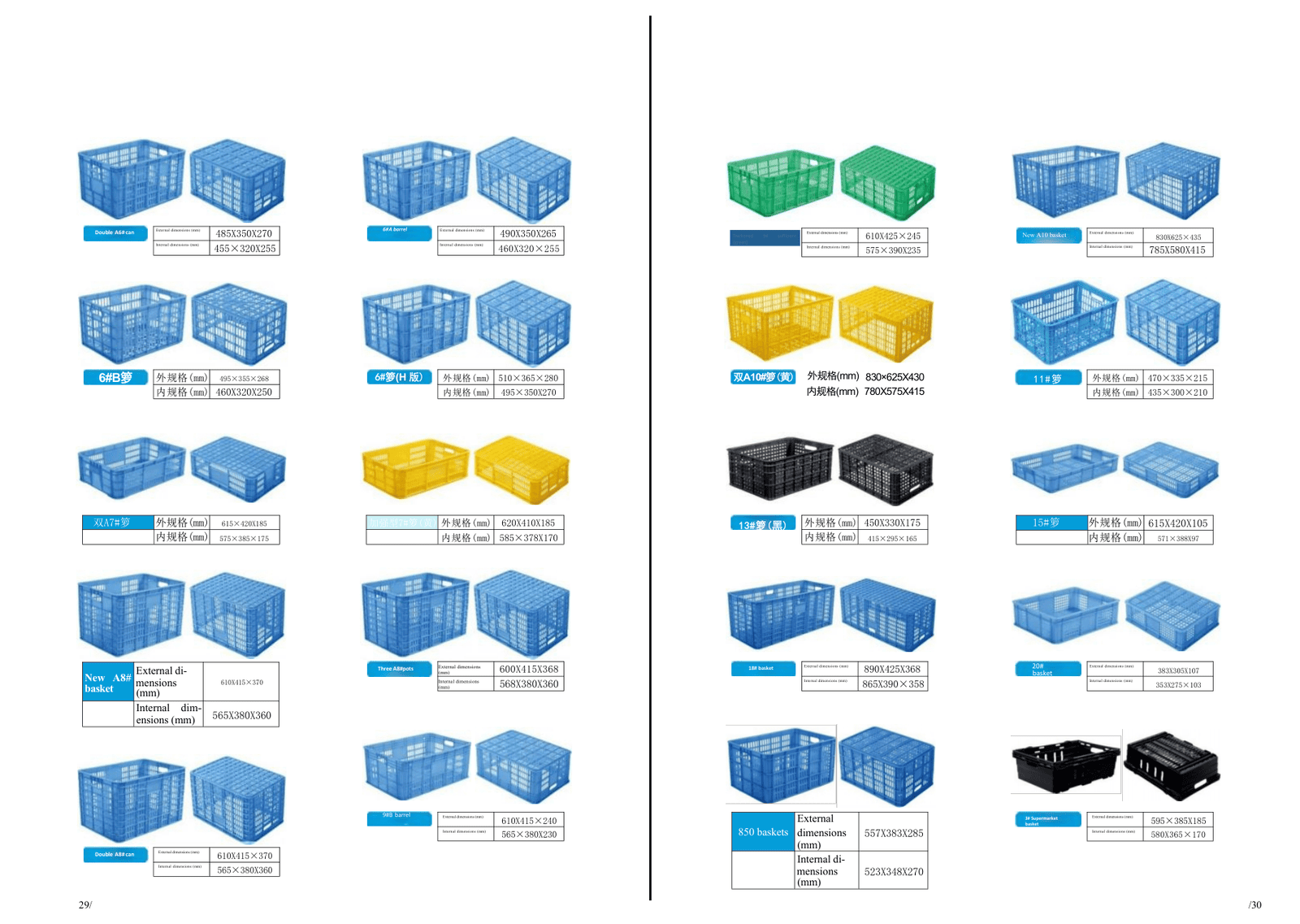
Also weigh a full crate before standardising: a deep crate of root vegetables can exceed 20 kg and create manual-handling problems at the grading line. The common 488L to 600L ventilated crate formats suit bulk field handling, while smaller Euro-format crates suit packed produce in dispatch.
Cold room workflow that wastes less than it saves
- Pre-cool before stacking in the cold room. A dense stack of warm ventilated crates blocks its own airflow; forced-air cool first, then stack for storage.
- Leave flue gaps between stack columns — 50 to 100 mm — so the cold room air can circulate through the stack faces.
- Never mix warm and cooled produce in one stack. Warm crates reheat their neighbours.
- Wash and dry crates between lots. Ventilation holes trap soil and organic residue, which re-inoculates the next load. Our crate hygiene guide covers wash-line settings.
- Rotate stock by crate colour or label — first in, first out depends on the crate being identifiable at a glance.
Material and durability notes
Produce crates work hard: wet docks, forklift knocks, daily washing, UV on the loading apron. Specify:
- HDPE for cold and impact — freezers, outdoor yards, rough handling. See our HDPE vs PP material guide for the resin logic.
- Food-grade virgin resin with certification for any product touching the produce surface. Recyclate is fine for field crates, not for packed food.
- UV stabiliser if crates live outdoors between seasons.
- Rated stacking load with holes in mind — a ventilated crate should publish its own stacking rating, not inherit the solid version’s.
Procurement checklist
- Match hole pattern to product fragility and cooling method (still air vs forced air).
- Verify stack alignment: holes line up when nested for airflow.
- Check published open area percentage and stacking load rating.
- Confirm food-contact resin certification for packed produce.
- Size depth by product, then weigh a full crate for manual handling limits.
- Order 5 to 10% spares — ventilated crates are the ones that get stolen for other jobs.
Ventilated crates from a moulding factory
LSY Plastic injection-moulds ventilated produce crates from 488L to 600L formats plus Euro-standard crates in Foshan, on Japanese-imported machines from 180T to 2500T with an in-house mould workshop. Because we cut the moulds, hole patterns, rib placement and stacking geometry are engineered to your product and cooling method. We supply produce growers, packhouses and distributors worldwide, alongside OEM customers including BYD, OPPO, vivo and Delice.
Get a produce crate proposal
Tell us your products, crate sizes, cooling method (cold room or forced air) and washing setup. We will propose hole pattern, depth format and resin specification with stacking load data.
WhatsApp: +86 19311059570
Email: fstyx01@lsyplastic.com
Related reading: cleaning and sanitizing plastic crates, nestable vs stackable containers, and HDPE vs PP material guide.