Every hotel purchasing manager eventually faces the same fork: a stainless steel service cart that looks premium and outlasts everything, or a moulded plastic trolley that costs a fraction of the price and never rusts. Sticker price makes stainless look like the safe choice and plastic look like the budget choice. Over a five-year ownership window, the ranking often flips. This guide breaks the comparison into the five cost drivers that actually move a total cost of ownership (TCO) calculation for a 300-room property.
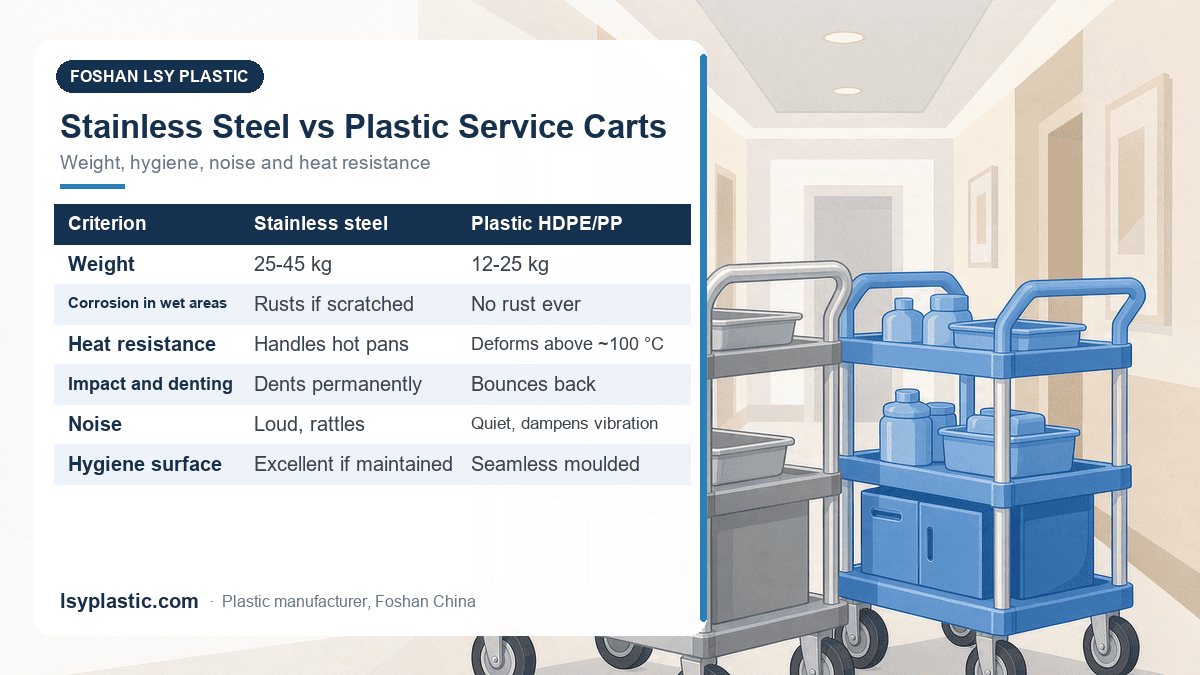
All data points below are based on the hotel cart range built by FOSHAN LSY Plastic, a 35-year injection moulding source in Foshan, China, running Japanese presses from 180 to 2,500 tons with a self-owned mold workshop.
1. Purchase price: stainless runs 2-3x higher
For comparable deck size and configuration, a stainless steel hotel cart typically costs 2 to 3 times more than its moulded plastic counterpart. On a 300-room property equipping 40 to 60 housekeeping and room-service carts, that multiplier alone can consume the budget difference of an entire housekeeping department refit. The question is never “can we afford stainless” — it is whether the extra spend comes back within five years.
2. Weight, noise and labour: plastic wins the daily grind
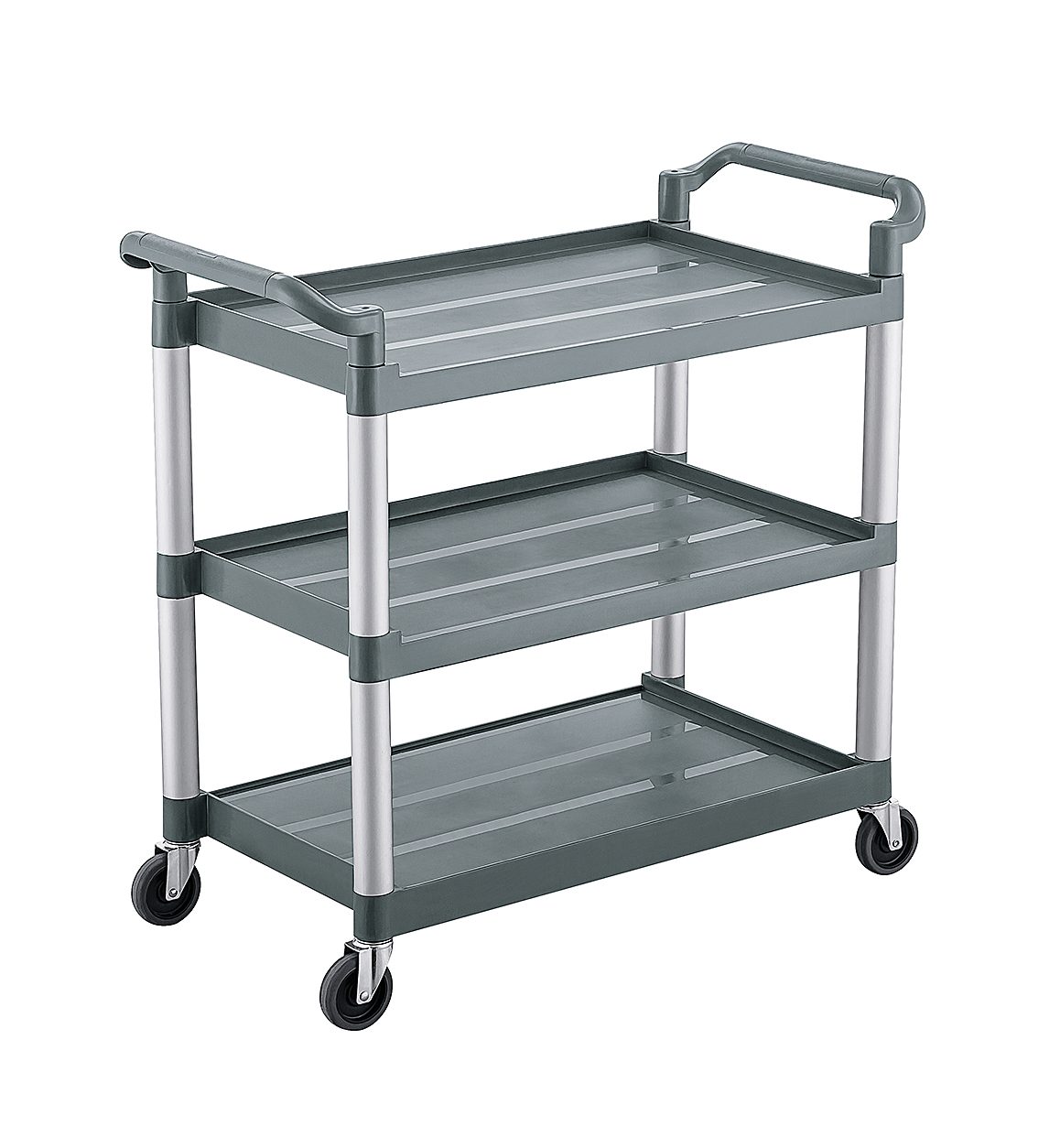
A housekeeping cart crosses the guest corridor 30 or more times per day. Moulded plastic shells are lighter, so attendants push less mass through a full shift — that translates directly into lower fatigue and fewer wheel-bearing failures. Plastic also dampens vibration: no metal-on-metal rattle over thresholds and elevator sills, which matters in any property that markets itself as quiet. Stainless frames are stiffer and handle heavy banquet loads, but for the standard housekeeping loop, plastic chassis deliver the same work with less noise and less wear on casters.
3. Corrosion and environment: know your building
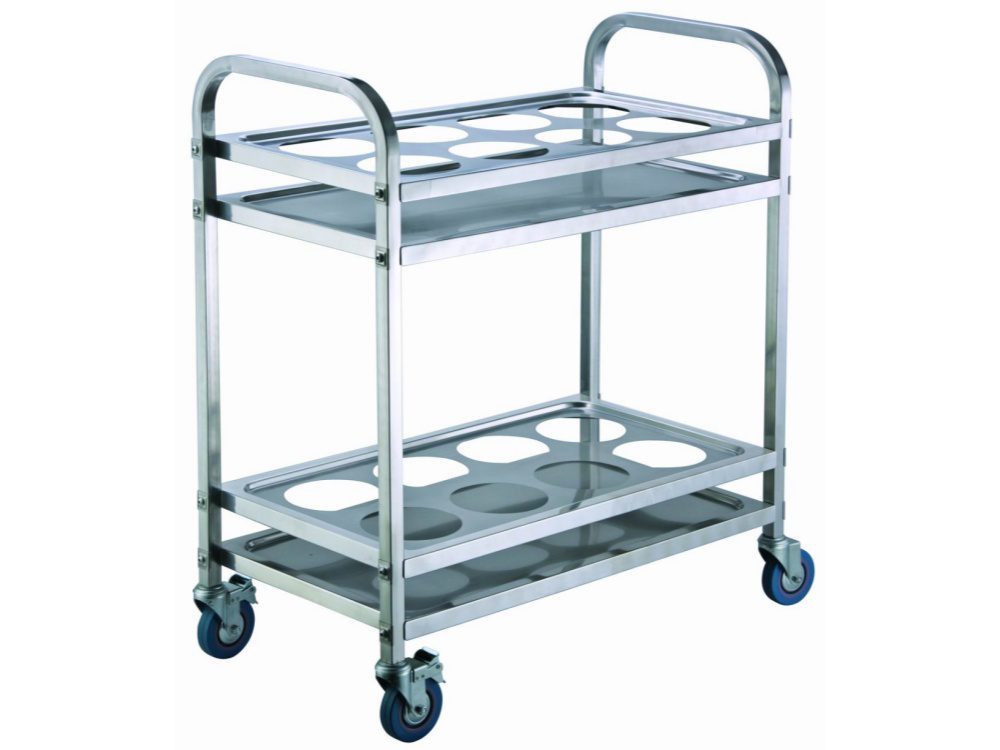
Stainless steel is “stainless”, not stain-proof. In humid housekeeping corridors, chlorinated pool decks, and coastal resorts with salt-laden air, weld seams and scratched areas on stainless frames start to show rust bloom within one to three years — and the fix is polishing labour, not a warranty claim. Moulded HDPE and PP panels are immune to rust by material: they shrug off cleaning chemicals, wet linen and poolside humidity. This is the single biggest reason resort operators in Southeast Asia and the Middle East trend toward plastic carts.
4. Maintenance and replacement: panels vs polish
Maintained properly, a quality plastic hotel cart lasts 7 to 10 years — well beyond the five-year window this guide evaluates. When a plastic shelf or panel does crack after a severe impact, it is a bolt-on replacement part from the factory’s own mold stock, not a welding job. Stainless carts need periodic polish to stay presentable, and a dented or rusted panel usually means panel swap plus surface rework. In both cases the factory you buy from matters: LSY keeps its own tooling for the 8001, 8002, 8003, 8005 and 922 cart series, so replacement shells and shelves stay available for years.
5. The five-year TCO verdict
- Purchase price: plastic 1x, stainless 2-3x
- Rust maintenance: plastic none, stainless polishing labour in humid or coastal sites
- Impact repair: plastic bolt-on panel swap, stainless rework or replacement
- Service life: plastic 7-10 years maintained, stainless comparable but appearance-driven
- Daily handling: plastic lighter and quieter, stainless stiffer under heavy load
For most 300-room properties, moulded plastic trolleys win the five-year TCO on every line except raw load capacity. The rational split: plastic for the 80% of carts doing housekeeping and room-service loops, stainless for a small number of heavy-duty back-of-house and banquet units. That mix is exactly what LSY’s catalogue supports — from the 8001/8002/8003 housekeeping and service series to the stainless 8201/8209 range. See the full hotel and hospitality carts guide for the complete decision framework.
FAQ — stainless steel vs plastic hotel trolleys
Do you supply samples before we commit to a container?
Yes — samples are supplied at cost price so your housekeeping team can test fit, weight and wheel behaviour on your own floors. Domestic orders in China carry no MOQ; overseas orders ship by full container load (FCL).
How long does a plastic hotel trolley actually last?
With routine caster inspection and cleaning, a moulded plastic hotel cart lasts 7 to 10 years. Prompt replacement of a cracked shelf or panel — a bolt-on part, not a repair — keeps the chassis in service across that full window.
Can you match our hotel chain’s branding and colour?
Yes. LSY offers OEM/ODM for hotel carts: custom colours, logo printing and branded panels, with in-house mold development at the Foshan factory so chain-wide configurations stay consistent across repeat orders.