The most expensive misunderstanding in pallet buying is a single number. A supplier quotes “4000 kg”, the buyer hears “4000 kg capacity”, and the pallet goes onto beam racking where it deflects, creeps, and eventually fails — because 4000 kg was the static rating and the racking rating was a quarter of it.
What each rating actually measures
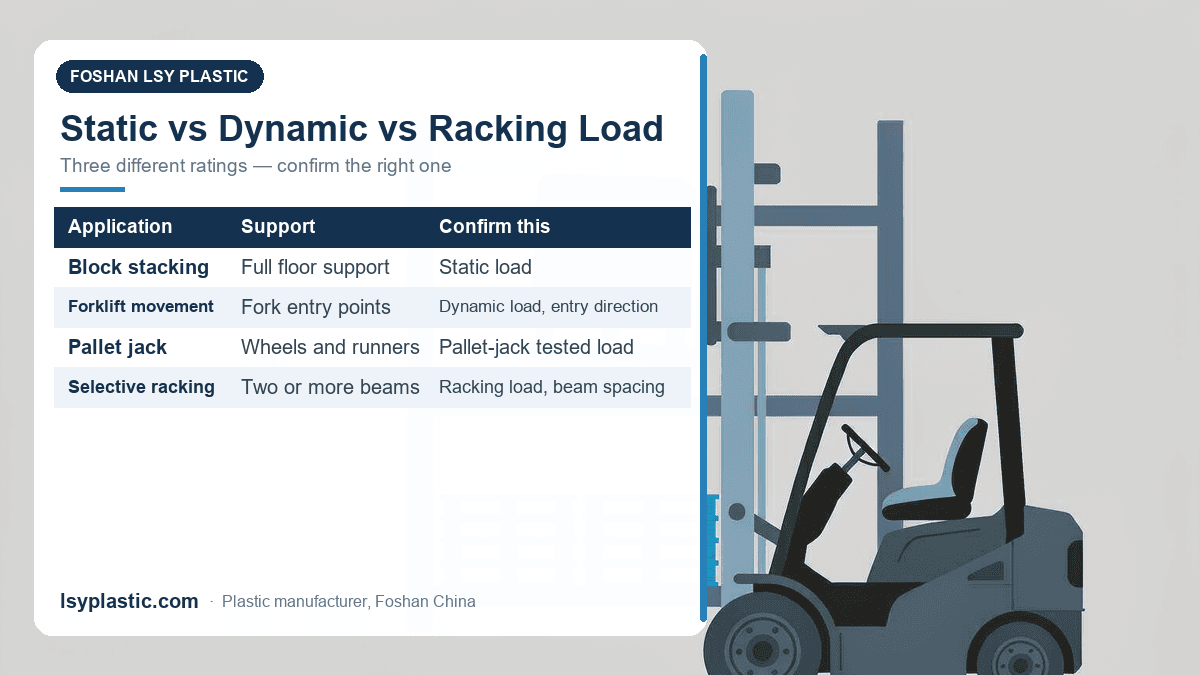
| Rating | What the load does | How the pallet is supported | Typical relationship |
|---|---|---|---|
| Static load | Sits still, stacked, floor-standing | Continuous support across the bottom deck | Highest number |
| Dynamic load | Moves — forklift, pallet truck, in transit | Supported on forks, subject to impact and flex | Roughly 1/2 of static |
| Racking load | Sits on two beams only, unsupported in the middle | Two edges, span in between, for a sustained period | Roughly 1/3 to 1/4 of static |
The reason for the gap is structural, not marketing. Floor-standing, the bottom deck rests on the floor and the load path runs straight down through the feet. On racking, the pallet spans a gap: the beams support two edges and the middle of the deck has to carry the load in bending. Bending deflection over weeks is what fails a racked pallet — not a single overload event.

Time is part of the rating
A pallet loaded to its racking rating for a day behaves differently from one left at that load for six months. Plastics creep — they deform slowly under sustained stress. A specification for long-term racked storage should be given with the duration, and the honest answer from a manufacturer will be a lower number for a longer dwell.
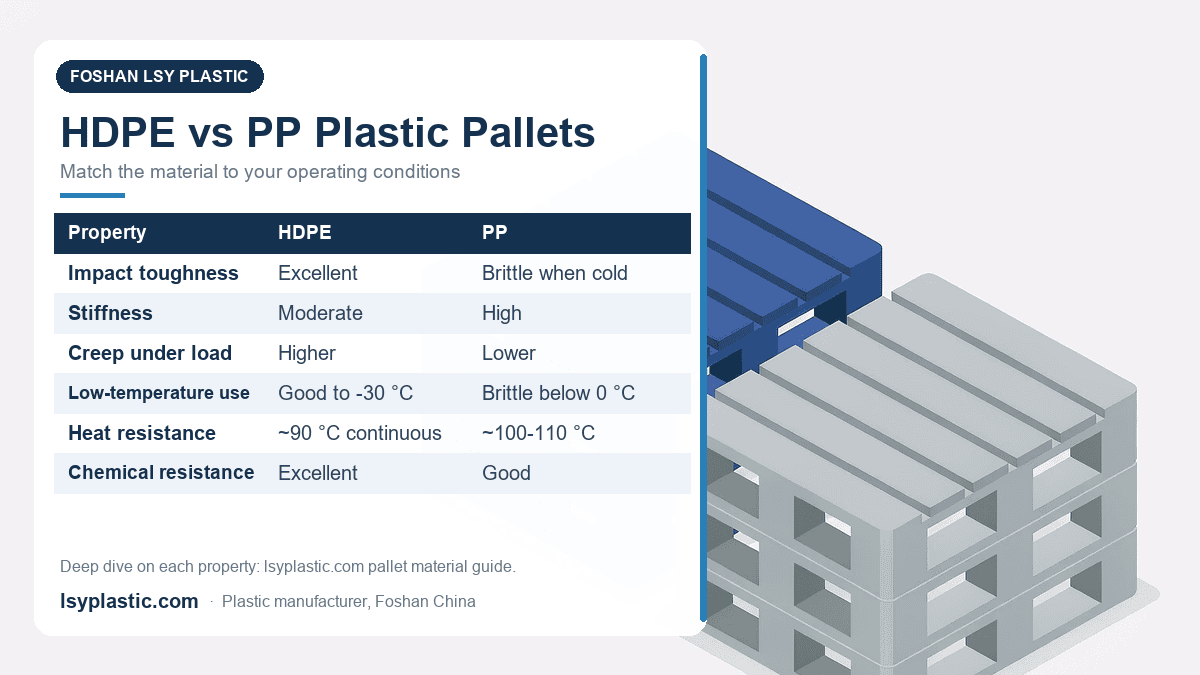
Temperature moves the number too. A pallet that holds its rating at ambient can behave very differently at -25°C, where PP in particular loses impact strength. Cold-chain racking needs the rating quoted at the service temperature, not at room temperature.
How to specify properly
Instead of asking “what is the capacity”, send the supplier the actual conditions. Five answers are enough:
- How is it supported? Floor, beams, or moved. This single answer picks the column in the table above.
- How heavy, and how is the weight distributed? A uniformly distributed 800 kg and an 800 kg point load in the centre are not the same problem.
- How long does it stay loaded? Hours, weeks or months changes the creep allowance.
- At what temperature? Ambient, chilled, or frozen.
- What handles it? Forklift tines, a pallet truck, or an automated shuttle — each loads the pallet differently.
A manufacturer who answers those five with three numbers has actually engineered the pallet. One who answers with a single number has quoted a catalogue.
What the ratings are tested against
Pallet load testing is standardised — ISO 8611 sets out test methods for pallet strength, stiffness and durability, covering bending, stacking and impact. When a supplier quotes ratings, the useful question is which test method and which support condition the number came from. A rating from a standardised bending test with declared support conditions is comparable between suppliers; a number with no method behind it is not.
Where buyers get caught
Two patterns recur. The first is the racking failure described above — a static number applied to a racking application. The second is the reverse over-specification: buying a heavy-duty racking-rated pallet for a floor-stacking operation where half the material cost would have done. Both are solved by answering the five questions before ordering rather than after.
FOSHAN LSY Plastic moulds pallets across the range — light duty export, heavy duty rackable, cold-chain HDPE and ESD conductive — on machines from 180T to 2500T. Ratings are quoted per support condition. Export orders ship full container load, samples are charged at cost, and domestic Chinese orders carry no minimum quantity.
FAQ
What is the difference between static and dynamic load rating?
Static rating is for a pallet sitting still fully supported on the floor, typically stacked. Dynamic rating covers the pallet in motion — lifted, transported, subject to impact — and is normally about half the static figure because the support is narrower and the loading is less even.
Why is the racking rating so much lower?
On racking only two edges are supported and the deck spans the gap in bending, for a sustained period. That combination of bending stress and long dwell time is far more demanding than resting on a floor, so the safe working load is a fraction of the static figure.
Can I use a pallet’s static rating for racking if I load it lightly?
Only if the supplier has given you a racking rating and you are under it. Static and racking are different tests with different support conditions; a light load is still spanning a gap, and creep over months is what eventually fails the pallet.
Does cold storage change the rating?
Yes. Plastics lose impact strength at low temperature, and PP more than HDPE. Ask for the rating at your service temperature and specify the resin accordingly for freezer applications.