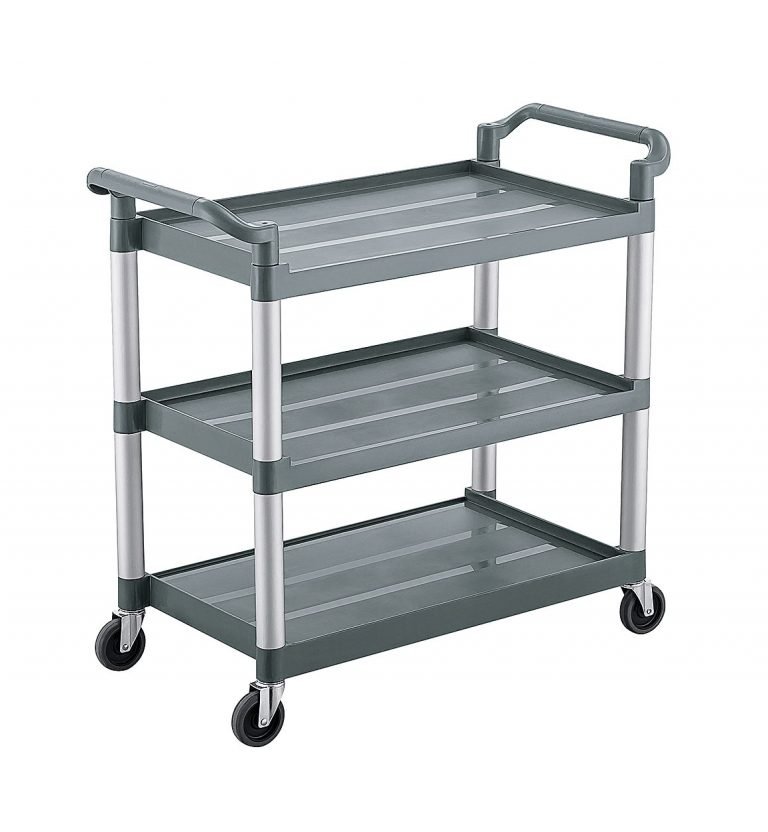
Request a quotation for the same cart under three different names and you may receive three different quotations — or three different products. The wheeled cart that carries guest suitcases from the curb to the room is called a hotel luggage cart in North American and Gulf procurement documents, a bellman cart or bellhop cart by hotel operations teams, and a luggage trolley across much of Asia, Africa and the UK. None of these names is wrong. For buyers sourcing from Chinese factories, knowing which name maps to which structure — and writing dimensions into the RFQ — is what prevents the wrong cart from arriving in your container.
FOSHAN LSY Plastic is a 35-year injection moulding factory in Foshan, China, running Japan-imported presses from 180 to 2,500 tons with a self-owned mould workshop. Its hotel service trolley series — models 861, 862M and 863 — is ordered under several of the names below, which is why the spec sheet matters more than the label.
The name map: one cart, many names
Hotel luggage cart is the most common term in RFQs from North America and the GCC. It describes the tall, upright trolley with a base deck, vertical uprights and horizontal rails for stacking suitcases of different sizes.
Bellman cart, bellhop cart, bell cart — bell-desk jargon from hotel operations. In strict usage, a bellman cart is the flatter, single-deck or two-deck version that a porter pushes one-handed from the vehicle drop-off to the room.
Luggage trolley — the default term in the UK, India, Southeast Asia and much of Africa. One caution: in airport contexts “luggage trolley” also refers to the stainless push carts inside terminals, so add the word “hotel” when searching or you will attract airport-equipment suppliers.
Baggage cart, baggage trolley — frequent in airline, cruise and resort procurement; same equipment, different paperwork.
Housekeeping cart is not the same product. It is the linen-and-amenity workhorse with bagged covers, shelves and a mop bag. If a supplier quotes a housekeeping cart against a luggage-cart RFQ, the container contents will be wrong — a costly mistake that a two-line spec would have caught.
Specs behind the names
Names vary by market; dimensions do not lie. A full-size hotel luggage cart typically measures 950–1,100 mm long, 600–700 mm wide and 1,500–1,800 mm tall, with a load capacity of 120–250 kg — enough for 8 to 15 standard suitcases plus a garment bag. The compact bellman-style version runs 850–1,000 mm long, 500–600 mm wide and 900–1,100 mm tall, rated 80–150 kg for 3 to 6 bags.
Construction follows the same pattern across both: decks and side panels in HDPE or PP moulded parts, frames in powder-coated steel or stainless steel, and 5-inch swivel rubber-tired casters that carry the cart across lobby marble-to-carpet transitions without marking the floor. Full size, material and branding details are covered in the hotel luggage cart and bellman cart buying guide.
Names that get mixed up in searches
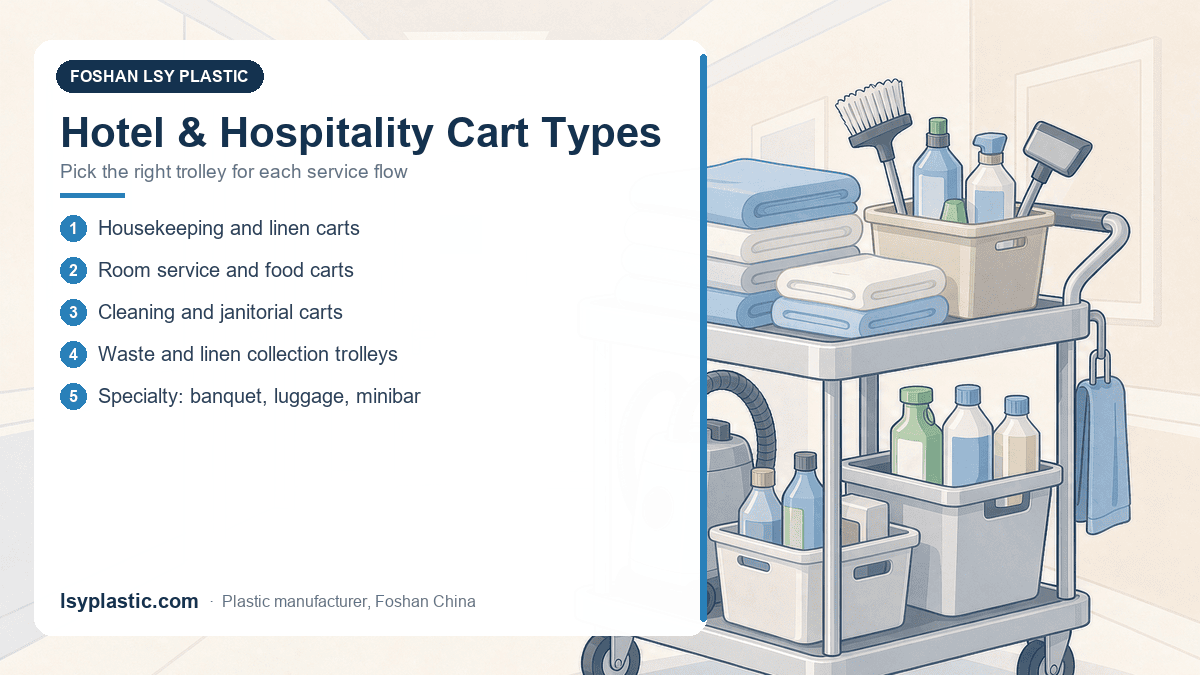
Three neighbours cause the remaining confusion. Room service carts carry covered trays and are judged by hygiene and quiet rolling, not suitcase rails. Platform trolleys are flat-deck warehouse carts with no uprights. Folding utility carts collapse for storage on staff floors. The hotel and hospitality carts guide maps every cart type to the department and workflow it belongs to, so you can shortlist before you quote.
Write the RFQ by dimensions, not by name
Whichever name your market uses, put these in the enquiry: deck length and width, overall height, load capacity, number of tiers, deck and panel material, frame material, caster diameter and type, and whether wall bumpers are required. Attach a photo of the cart you have in mind. A factory can quote accurately from those numbers even if your local name for the cart is unique to your region. For the material decision behind the frame, the plastic luggage cart vs bellman trolley comparison breaks down where each structure earns its keep.
Sourcing These Products? Buy Direct from the Factory
LSY Plastic has been an injection moulding manufacturer in Foshan, China for over 35 years. We supply hotels, restaurants and warehouses worldwide at factory-direct prices, shipped by full container load (FCL).
Buying in volume? For the same quantity, we commit to the best price on the market.
Frequently Asked Questions
Do you charge for samples?
Samples are supplied at cost price — the sample itself is not free, and courier freight is on the buyer’s account. The sample cost can be referenced against the following bulk order.
What is the minimum order quantity?
Domestic (China) orders ship by courier or logistics with no MOQ. Overseas orders ship as full container load (FCL), and cart models can be mixed within the container.
Can we add our hotel brand to the carts?
Yes — OEM branding and custom panel colors are supported for project volumes. Confirm the artwork and color standard before the production schedule is locked.
Related: MOQ, samples and FCL shipping policy — how we supply overseas buyers, including container loading volumes.