Search demand for ESD warehouse requirements keeps growing, and most of it comes from electronics buyers who have been told “your storage area must be ESD-safe” without anyone explaining what that means in practice. The requirements are not mysterious — they come from two documents, ANSI/ESD S20.20 and IEC 61340-5-1, and they translate into a short list of physical changes: zone the area, specify the right resistance class for everything that touches product, and test on a schedule. Here is what each requirement means when you are buying plastic pallets, containers and trays for that space.
1. Zone the Area First
The starting requirement is organizational. An ESD-protected area (EPA) is any defined zone where unpackaged ESD-sensitive items are handled. In a warehouse this is usually the receiving shelf, the picking face and the staging lane — not the whole building. Both S20.20 and IEC 61340-5-1 require that all items entering the EPA are either grounded, dissipative, or kept outside the sensitivity threshold of the products handled. Practically, that means you draw the boundary, mark it, and then control what crosses it: ordinary painted pallets and corrugated boxes stay outside; qualified ESD storage equipment goes inside. See our ESD containers complete guide for how the product families map onto an EPA.
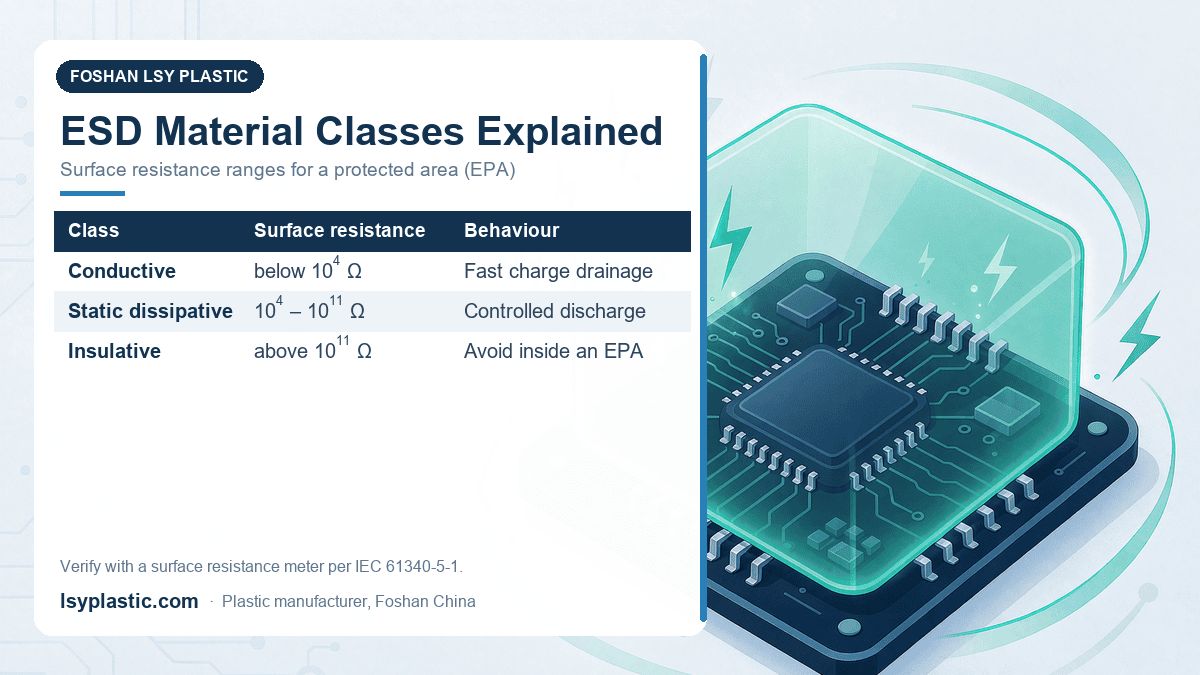
2. Keep Every Storage Surface in the Right Resistance Window
Once the zone exists, every surface that touches components must sit in a defined resistance range. For plastic storage equipment the working windows are:
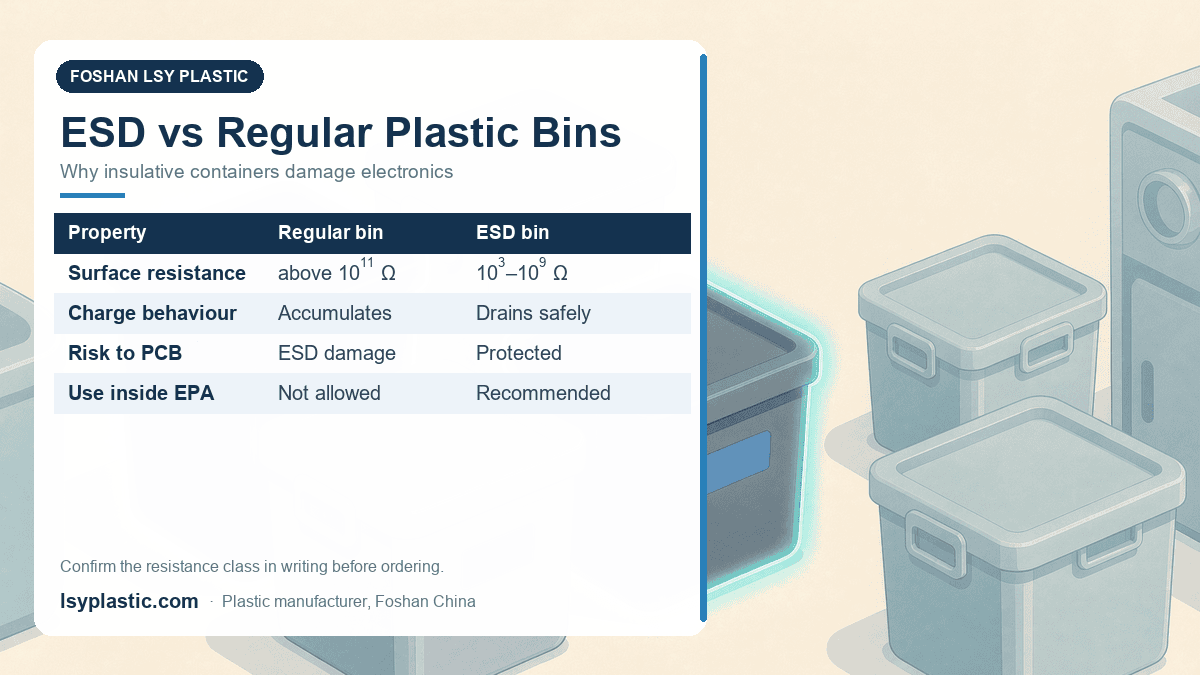
- Conductive class: 10³–10⁵ Ω on pallets; for containers, conductive grades read 10⁴–10⁶ Ω.
- Static-dissipative class: 10⁵–10⁹ Ω on pallets, and 10⁶–10⁹ Ω on containers and trays.
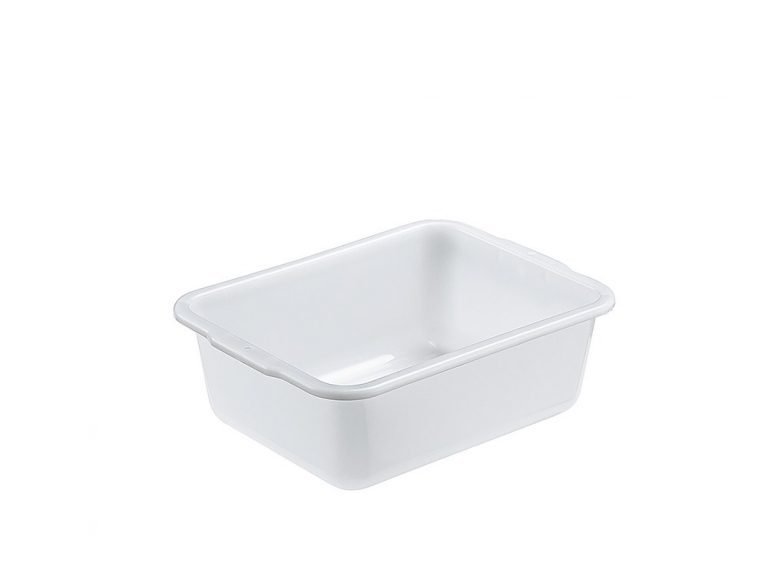
The key requirement is consistency: a conductive tote stacked on a dissipative pallet is a hybrid nobody can defend in an audit, so keep every storage surface in the same resistance class. Material matters too — the conductive path must come from the compound itself. Our EU-series boxes, for example, are injection molded from conductive PP with the additive distributed through the wall (10⁴–10⁶ Ω), not sprayed on as a coating that a few wash cycles would strip. Compare the options in our ESD plastic pallets guide.
3. Match Load Physics and Footprints
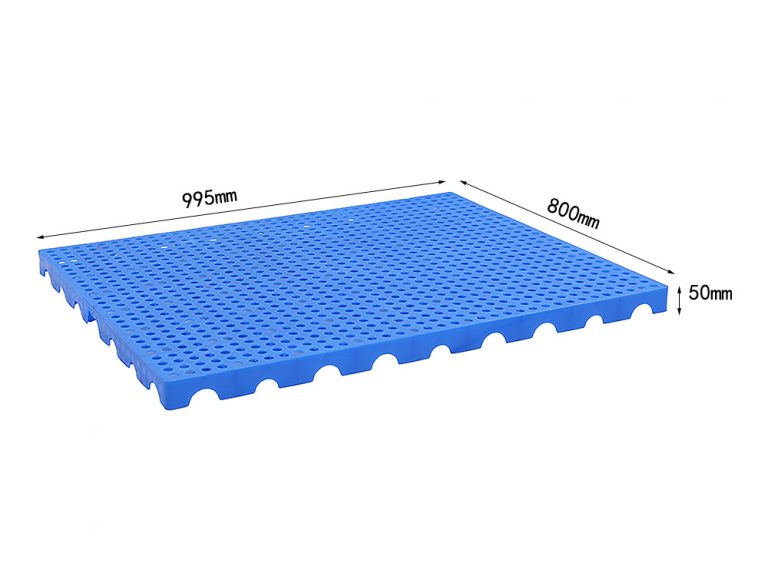
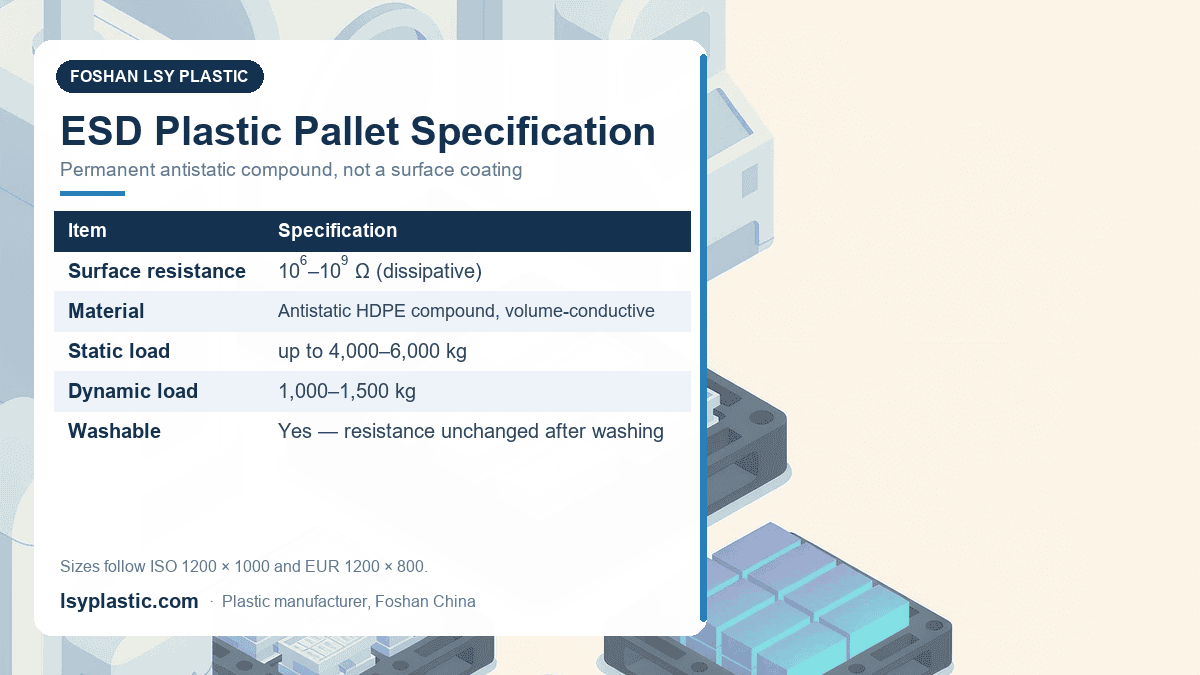
ESD qualification does not relax mechanical requirements. Static, dynamic and racking load ratings are specified the same way as standard pallets — if pallets go into selective racking, they still need a racking rating and inspection. Footprints should close the loop with your container system: Euro footprints of 300×200, 400×300 and 600×400 mm stack cleanly onto 1200×800 and 1200×1000 mm pallets, which is exactly how the EU series is sized, in eight models from EU2311 to EU4633. A warehouse where bins, trays and pallets share one footprint grid moves less air (fewer double-handling touches) and generates less risk.
4. Test on a Schedule, Keep Records
Resistance is not a “set and forget” property. Auditors assessing your warehouse against S20.20 will ask for records, and the test method is ANSI/ESD STM11.11: a surface resistance meter with 2.27 kg parallel bar electrodes 25 mm apart, placed on the container wall away from ribs and edges. Shielding and charge-decay checks (ANSI/ESD S11.31 family) apply where containers ship sensitive assemblies. Two rules from our testing and maintenance guide matter most: demand batch test data from the factory at purchase, and re-test after your cleaning process — a dissipative pallet measuring above 10⁹ Ω after washing no longer meets its class and should be reassigned to non-EPA duty.
Related guide: China plastic factory audit checklist.
5. The Short Checklist
- EPA boundary marked; unqualified pallets and packaging stay outside.
- Pallets, bins and trays in one resistance class, molded-in conductive or antistatic compound.
- Footprints matched to a single pallet grid (300×200 / 400×300 / 600×400 mm).
- Batch test certificates at purchase; STM11.11 re-tests on a schedule and after cleaning.
- Records kept where the auditor can see them.
Meet those five and your warehouse satisfies S20.20 and IEC 61340-5-1 without drama — and your components stay protected between every test cycle. If you are equipping a new EPA from scratch, start with the EU-series ESD conductive boxes and build the pallet layer around them.