UK buyers searching for plastic storage box manufacturers uk or plastic food containers wholesale uk are usually comparing two things: buying from a UK distributor’s stock, or importing direct at container volume. This page is for the second case — what the specification must meet, what the landed cost is made of, and where quotes usually go wrong.
Direct import versus UK distribution
UK distribution wins when you need a few hundred units this month, or when the item is a catalogue product several stockists carry. Direct import wins when your annual volume on one line fills a meaningful share of a container, when you need a size or print run that local stock does not carry, or when you want one specification held constant across several sites. The break-even is freight per piece: once a line ships efficiently, the distributor margin costs more than the freight.
What the specification has to meet
This is where the UK differs from most markets. Three things come up repeatedly:
- BS EN 840 for mobile waste containers. If you are buying wheeled bins for kerbside or commercial collection, the relevant European standard series covers dimensions, design and performance requirements including lid and handle strength, wheel and axle durability, and resistance to tipping. Combi-lift side pins — the lifting comb geometry that lets a collection vehicle empty the bin — must match the vehicle. A bin that does not match the lifting comb is unusable regardless of how well it is made.
- UKCA and CE marking. Product marking requirements differ between Great Britain and Northern Ireland, and the applicable rules depend on the product category. Confirm what your product actually requires before the goods ship, not at the port.
- Food contact. Food-contact plastics sold in the UK must comply with the applicable food contact materials legislation, and you should hold a supplier declaration for the specific resin and application. “Food grade” on its own is not a declaration.
Pallet sizes: which standard you are buying into
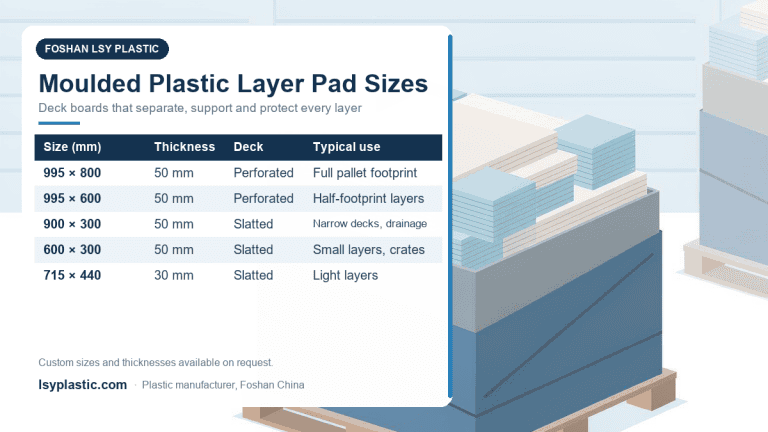
UK warehousing commonly runs on the 1200 x 1000 mm footprint, while much of continental Europe runs on 1200 x 800 mm (the Euro pallet). If your racking, your customers’ racking or your trailer configuration was built around one of them, the other will waste floor space and, in the case of racking, may not sit safely on the beams at all. Confirm the footprint before ordering, then check the load rating you actually need — a pallet that only ever sits on the floor does not need a racking rating. Full detail: plastic pallet sizes and dimensions and static, dynamic and racking load capacity.
What sets the price
- Shot weight in grams. The dominant driver. Resin is most of the ex-works cost, and two products with the same external dimensions can differ by 40% in weight.
- Resin grade. Virgin PP and HDPE for food contact and outdoor use; regrind blends acceptable for dry indoor storage only.
- Container utilisation. Nestable and collapsible designs ship far better than rigid assembled ones. Freight per piece is where the real comparison happens.
- Additives and finish. UV stabiliser for outdoor use, flame-retardant packages where a specification demands it, matched colour and printing.
- Mould amortisation. Standard sizes are already tooled; a genuinely new dimension carries a tooling charge.
Product by product
Plastic storage boxes and food containers
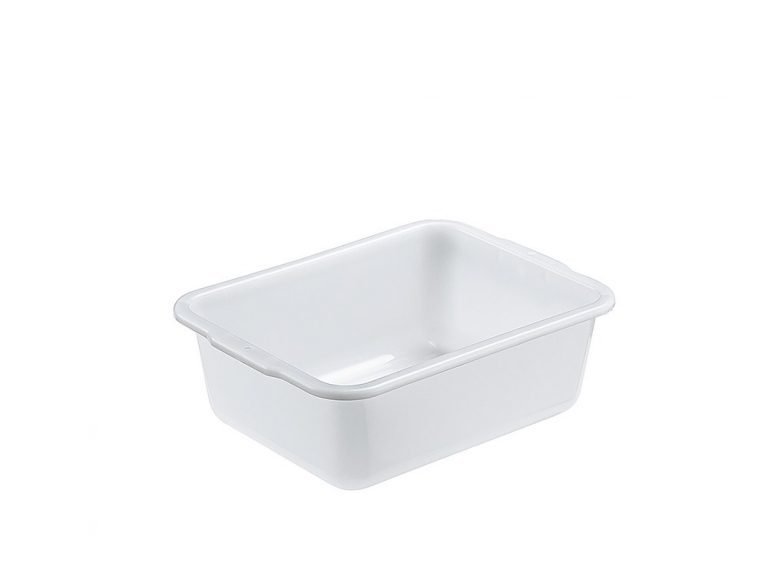
Price follows volume, wall thickness and lid design. The specification questions that change the resin choice: ambient or hot fill, chilled or freezer, and whether the container goes through a commercial dishwasher repeatedly. Food-contact lines are produced in virgin PP or HDPE — see how to choose industrial plastic crates and containers for the structural side.
Waste bins and wheeled bins
For wheeled units, check the lifting comb compatibility and the wheel and axle specification before you look at the price. For static commercial bins, the mechanism drives cost: pedal bins need a rated linkage, swing-top bins need a balanced lid. Outdoor units need UV stabiliser — see outdoor plastic trash bins 120L and 240L. Colour-coded bodies for waste segregation are usually no extra if you accept standard colours.
Crates
Wall thickness and whether they nest, stack or fold. Vented designs use less resin at the same footprint and suit produce; solid walls suit hardware and parts. See collapsible versus rigid crates.
Landed cost: what the invoice does not show
- Incoterm. Confirm whether you are quoted FOB, CFR or CIF. On a full container this is not a rounding difference.
- HS classification. Most plastic transport and packing articles fall in Chapter 39. Your broker should confirm the exact commodity code, because duty is assessed against it.
- Customs duty and import VAT. Duty at the applicable rate on the commodity code, and import VAT on the customs value. Import VAT is recoverable if you are VAT-registered, but it is cash flow you need to plan for.
- Port and inland. Felixstowe, Southampton or London Gateway handling and documentation, then inland distribution.
- Post-Brexit formalities. An EORI number is required, and customs declarations are mandatory rather than the previous EU movement rules. Use a broker for the first shipment.
Comparing two quotes
- Get the shot weight in grams from every supplier.
- Get the pieces per 40HQ. A lower unit price that ships fewer pieces is not cheaper landed.
- Get the resin grade named — “high quality plastic” is not a specification.
- Get wheel, axle and hinge ratings on anything with moving parts.
- Get the same Incoterm from all suppliers.
Ordering notes
- Export orders ship full container load (FCL). We do not split containers for export.
- Samples are charged at cost and credited against a confirmed order. For UK buyers this matters: a sample of the exact moulding is the cheapest way to verify comb compatibility and lid fit before committing to a container.
- Domestic China orders have no minimum order quantity.
- VAT special invoice (fapiao) adds 13%.
- Confirm your marking and declaration requirements before production, not at the port.
FAQ
Will your wheeled bins fit UK collection vehicles?
Tell us the lifting comb standard your collection vehicle uses and we will confirm compatibility before you order. This is the single most common cause of a wheeled bin order going wrong, and it is unrelated to build quality.
Do you hold UKCA or CE documentation?
Requirements depend on the product category and the destination within the UK. Tell us the product and the end use and we will tell you exactly what applies rather than giving a generic answer.
What is the minimum for a custom size?
Existing sizes carry no tooling charge. A genuinely new dimension carries a mould cost or is amortised across the first order. Tell us the size and we will tell you which case you are in.
Can I mix several lines in one container?
Yes, and for a first order it is usually the right approach — one freight and one clearance event across several lines.
Importing to other markets
The same product families ship to these markets. Freight, clearance and specification notes differ by destination: