Buying commercial high chairs for restaurants is not the same purchase as buying one chair for a family. A hotel breakfast room, a chain restaurant or a resort group orders by the container, and the questions that decide the order are operational: how many units survive a Saturday brunch rush, which build stores in the space you have, and what paperwork protects you if a guest asks. Here is how to get the order right.
1. Size the fleet from peak covers, not monthly covers
High chairs sit idle most of the day, then all get used at once — sizing off average covers is how operators end up short every weekend. Take your busiest two-hour window, count tables seated at the same time, and apply the share that request a chair. A 180-seat room filling to 150 at Sunday brunch, with roughly one table in eight asking, needs about 19 chairs at once. Add 25–30% for chairs mid-clean, broken or parked at the host stand and you are ordering 24–26 units, not 12.
The same number drives storage. Each unit stands on a 61×58 cm base, so 24 chairs parked in a lobby alcove need real floor area, not a shelf. If back-of-house space is the binding constraint, that should change the model you buy.
2. Choose the build that fits your storage, not your décor
Two builds cover most demand; what matters at fleet scale is how they store between services.
- B01 / 601 thickened dining chair — rigid one-piece shell, 61×58×73 cm, packed one piece per carton at 66×59×26 cm. Best where you can park chairs in a stack or along a wall.
- 602 thick flip-type — same thickened wall with a flip configuration that collapses the footprint out of service. Best where chairs must disappear during dinner service or between banquet functions.
Both are moulded from thickened, high-density food-grade PP with a one-piece seat and back. At fleet scale that matters more than styling: fewer joints, no crevices for food to sit in, and a surface that wipes clean instead of being scrubbed.

3. Decide tray strategy before you decide quantity
Tray choice changes how fast a table turns, so it belongs in the procurement decision, not the accessories budget.
Both the 601 tray (yellow/green) and the 602 tray (yellow/white) are double-layer builds with a removable top layer. When a child finishes, staff lift the soiled top layer to the wash-up; a clean surface is already underneath, so the chair re-seats immediately. In a room turning covers every 45 minutes, that is one chair serving three families in a brunch service instead of two.
Order tray versions where the chair stands free — buffet lines, quick-service, hotel breakfast rooms. Where chairs pull up to the table edge, the no-tray version keeps the child closer to the family and removes a component that has to be cleaned.
4. Wheels or fixed base
Wheels let one staff member move a row of chairs without carrying them; fixed bases give the widest stance and never roll when a child pushes off the table. Hotels and banquet rooms with multi-use space take wheels on part of the fleet; restaurants with a fixed plan take fixed bases plus two or three wheeled units for the terrace.
5. The paperwork to request with the quotation
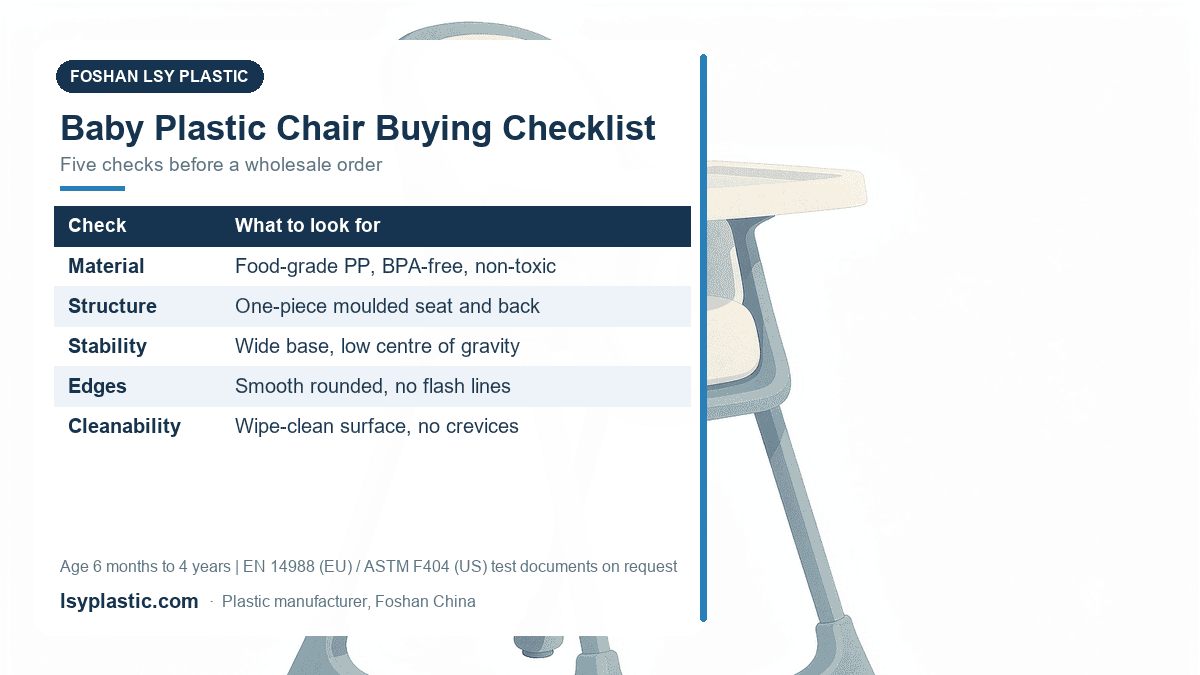
Ask for test documentation against the children’s high chair standards of your market — EN 14988 in the EU, ASTM F404 in the United States — issued for the exact model and configuration you are buying, not for a sibling product. A tray version and a no-tray version are different articles. Where you also need general children’s product compliance, EN 71, ASTM and GB 6675 documentation is the parallel set; our guide to children’s plastic safety certification explains how those standards divide up. Request a food-grade PP and BPA-free declaration too — children chew the seat edge more than any lab test simulates.
6. Plan the container off the carton, not the chair
Shipping is calculated on the packed carton: 66×59×26 cm per unit, one piece per carton, which is 0.101 m³. Build quantity from that figure plus your forwarder’s pallet allowance, and confirm mixed loads early — fleet orders often combine trays and chairs, and the cartons do not stack to the same height.
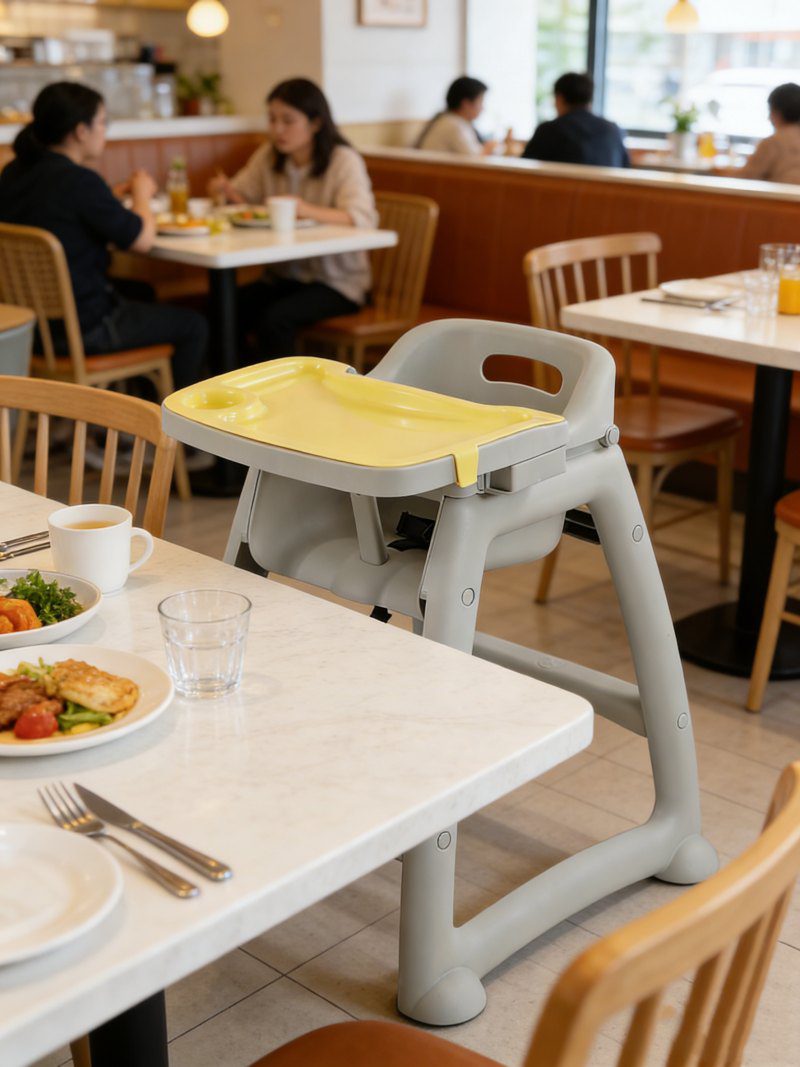
7. A short specification checklist
- Quantity sized on peak simultaneous demand plus a 25–30% buffer.
- Rigid 601 where floor area exists, flip-type 602 where it does not.
- Double-layer removable tray on the units that stand free of the table.
- Wheels only on the share of the fleet that actually moves.
- EN 14988 or ASTM F404 report per model and configuration; food-grade PP declaration.
- Carton cube confirmed at 0.101 m³ per unit before the container is booked.
Get those six right and the fleet runs for years without a mid-service shortage or a stability complaint. For the product logic behind these models, read our complete guide to baby plastic chairs, and check the specification sheet for the commercial stackable high chair before you request a quotation.