
Lithium-ion cells are electrostatic-sensitive devices. A discharge as low as 100 volts can damage the solid-electrolyte interphase, reduce cycle life, or trigger thermal runaway. In battery assembly — cell sorting, tab welding, module stacking and pack testing — every container must be engineered for electrostatic control. This guide explains ESD tray and turnover box specs for battery manufacturers.
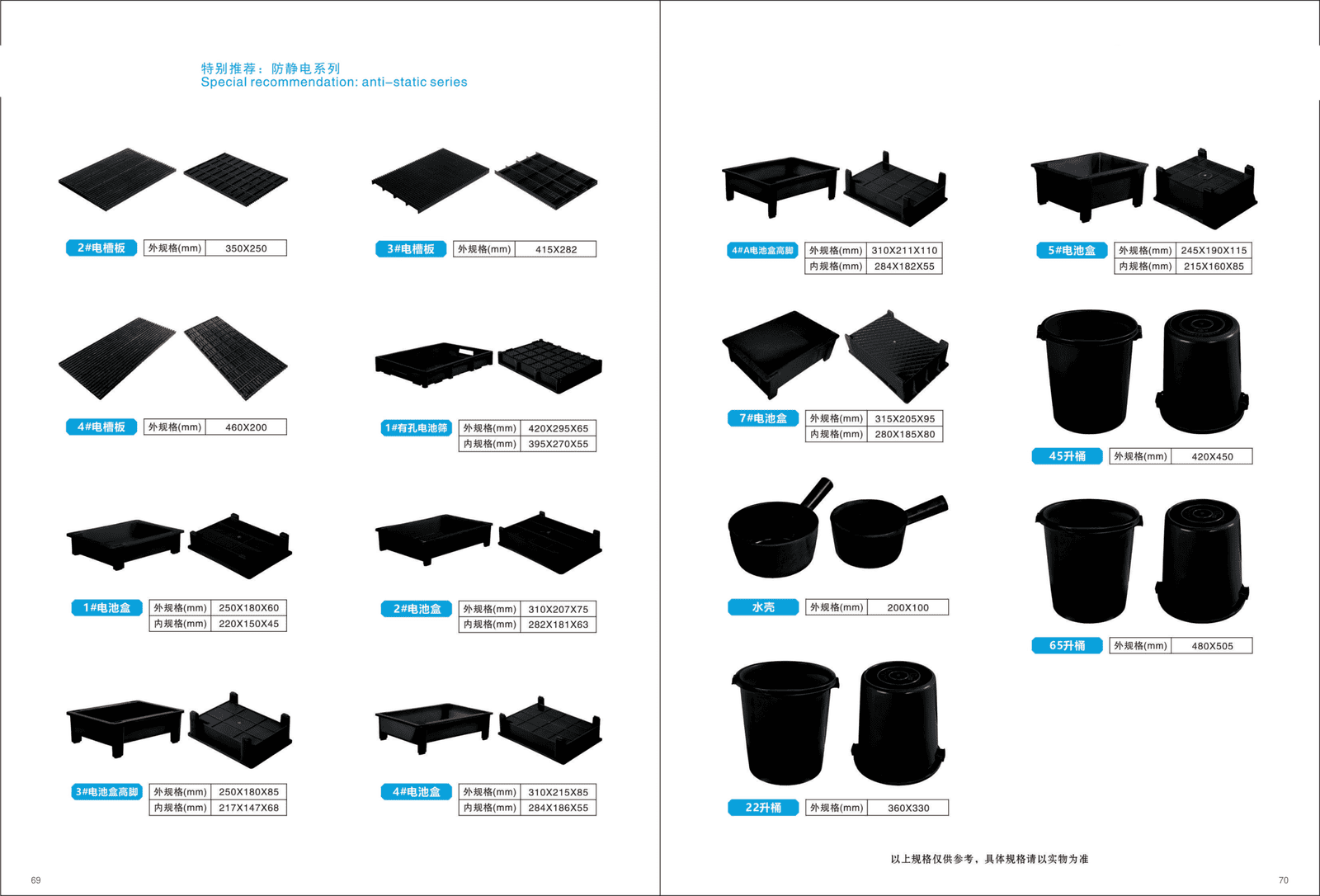
LSY Plastic supplies anti-static ESD trays, turnover boxes and layer pads to electronics and battery factories across Asia and the Middle East, including tier-one automotive battery customers. All ESD products are injection-moulded in-house on 180 to 2,500 ton presses at the 20,000 m² Foshan facility.
1. Surface resistance: the number that matters
Battery assembly needs dissipative containers — surface resistance 10⁶–10⁹ ohms. Conductive bins (10³–10⁶ ohms) spark during insertion; insulative bins (>10¹¹ ohms) trap charge. LSY compounds trays and boxes for 10⁶–10⁹ ohms, tested per IEC 61340-5-1.

2. Tray or turnover box: match the container to the process step
ESD trays are shallow, open containers used for single-layer cell handling, visual inspection and automated pick-and-place. A tray for 18650 or 21700 cells typically holds 50 to 100 cells in CNC-machined pockets with 0.3 mm positional tolerance. ESD turnover boxes are deeper, lidded containers used for module transport between welding, testing and pack-assembly stations. A 300 x 200 x 150 mm box carries 5 to 8 modules with divider slots to prevent contact.
LSY trays run from 200 x 150 mm up to 600 x 400 mm; turnover boxes match EU and Asian logistics footprints (300 x 200, 400 x 300, 600 x 400 mm) for direct conveyor and AGV integration.
3. Why battery assembly is harder than PCB handling
Battery cells are cylindrical, heavy (up to 70 g per 21700 cell) and carry a residual charge. The container must resist mechanical abrasion from 1,000+ daily cycles, electrolyte vapour, temperature swings to 45 °C, and conductive dust from laser welding. Standard ESD compounds crack within six months under this load. LSY uses glass-fibre-reinforced PP with a carbon-nanotube dissipative layer at 0.8 mm wall thickness, giving a 24-month service life without resistance drift beyond 10⁹ ohms.
4. Layer pads for battery pack palletising
Once modules are assembled into packs, the packs are palletised for transport to the vehicle assembly plant. A moulded plastic layer pad between each tier prevents pack-to-pack contact, absorbs vibration, and maintains stack stability during ocean freight. LSY layer pads for battery packs are cut to 995 x 600 mm or 995 x 800 mm to match standard pallet footprints, with a static load rating of 1,500 kg.
5. Material grades: PP, PE and speciality compounds
| Material | Resistance range | Best for | Lifespan |
|---|---|---|---|
| PP + carbon black | 10⁵–10⁷ ohms | Turnover boxes, general handling | 18–24 months |
| PP + CNT dissipative | 10⁶–10⁹ ohms | Trays, precision cell handling | 24–36 months |
| PE + carbon fibre | 10⁴–10⁶ ohms | Heavy module transport | 12–18 months |
6. What to specify on your purchase order
- Surface resistance: 10⁶–10⁹ ohms, tested per IEC 61340-5-1, certificate included
- Footprint: match your conveyor, AGV and pallet grid (common: 300 x 200, 400 x 300, 600 x 400 mm)
- Wall thickness: ≥0.8 mm for trays, ≥1.2 mm for turnover boxes
- Divider slots: specify cell diameter (18650, 21700, 4680) or module dimensions
- Coating: clear dissipative coating on contact surfaces, not bulk-doped only
- Requalification interval: request retest protocol every 12 months
LSY Plastic moulds the full range of ESD containers, trays and pallets for electronics and battery manufacturing. Samples are at cost price; overseas orders ship FCL. Domestic China orders carry no MOQ. Quote: fstyx01@lsyplastic.com or WhatsApp +86 19311059570.
FAQ — ESD trays for battery assembly
What surface resistance should ESD containers have for lithium battery handling?
Dissipative range: 10⁶–10⁹ ohms. LSY tests every batch to IEC 61340-5-1 and supplies a certificate.
Do you supply samples for battery assembly line trials?
Yes — samples are supplied at cost price so the buyer can verify fit, surface resistance and durability on their own line. Domestic orders in China carry no MOQ; overseas orders ship by full container load (FCL).
How long do ESD trays last in continuous battery assembly use?
LSY PP + CNT trays last 24–36 months without resistance drift beyond 10⁹ ohms. Standard carbon-black compounds degrade within 12–18 months under battery-assembly loads.
What surface resistance should ESD containers have for lithium battery handling?
Dissipative range: 10⁶ to 10⁹ ohms. Conductive containers drain charge too fast and can spark; insulative containers trap charge. LSY tests every batch to IEC 61340-5-1 and supplies a test certificate.
Do you supply samples for battery assembly line trials?
Yes — samples are supplied at cost price so the buyer can verify fit, surface resistance and durability on their own line. Domestic orders in China carry no MOQ; overseas orders ship by full container load (FCL).
How long do ESD trays last in continuous battery assembly use?
LSY PP + CNT dissipative trays last 24 to 36 months in continuous duty without resistance drift beyond 10⁹ ohms. Standard carbon-black compounds typically degrade within 12 to 18 months under the mechanical and thermal load of battery assembly.


