Bakery crates fail for one of two reasons: they trap steam, or they do not fit the bread. Crates that seal in heat soften crusts and grow mould within a day; crates that are the wrong size waste a third of the pallet space on every delivery round. This guide covers the four specification decisions that matter for bread and bakery distribution — ventilation, food-contact material, internal dimensions, and stacking and freight economics — plus the cleaning and traceability rules that food safety auditors check. For the wider container picture, see our plastic totes vs cardboard boxes comparison.
Why bakery logistics has different crate requirements
Bread leaves the oven at 90 °C or higher and is usually packed within 30 to 60 minutes. A bakery crate therefore has to handle three things at once: residual heat, ongoing moisture release, and a product that deforms under load. Most general-purpose distribution crates are designed for ambient, dry goods and simply do not account for the first two.
The practical consequence is that bakeries often buy crates twice. They start with a cheap solid-wall crate to control cost, then discover crust softening, condensation on lids, and mould complaints from retail customers, and end up replacing the whole fleet with ventilated food grade crates within a year. Specifying correctly the first time is cheaper than the second purchase.
Ventilation: the single most important specification
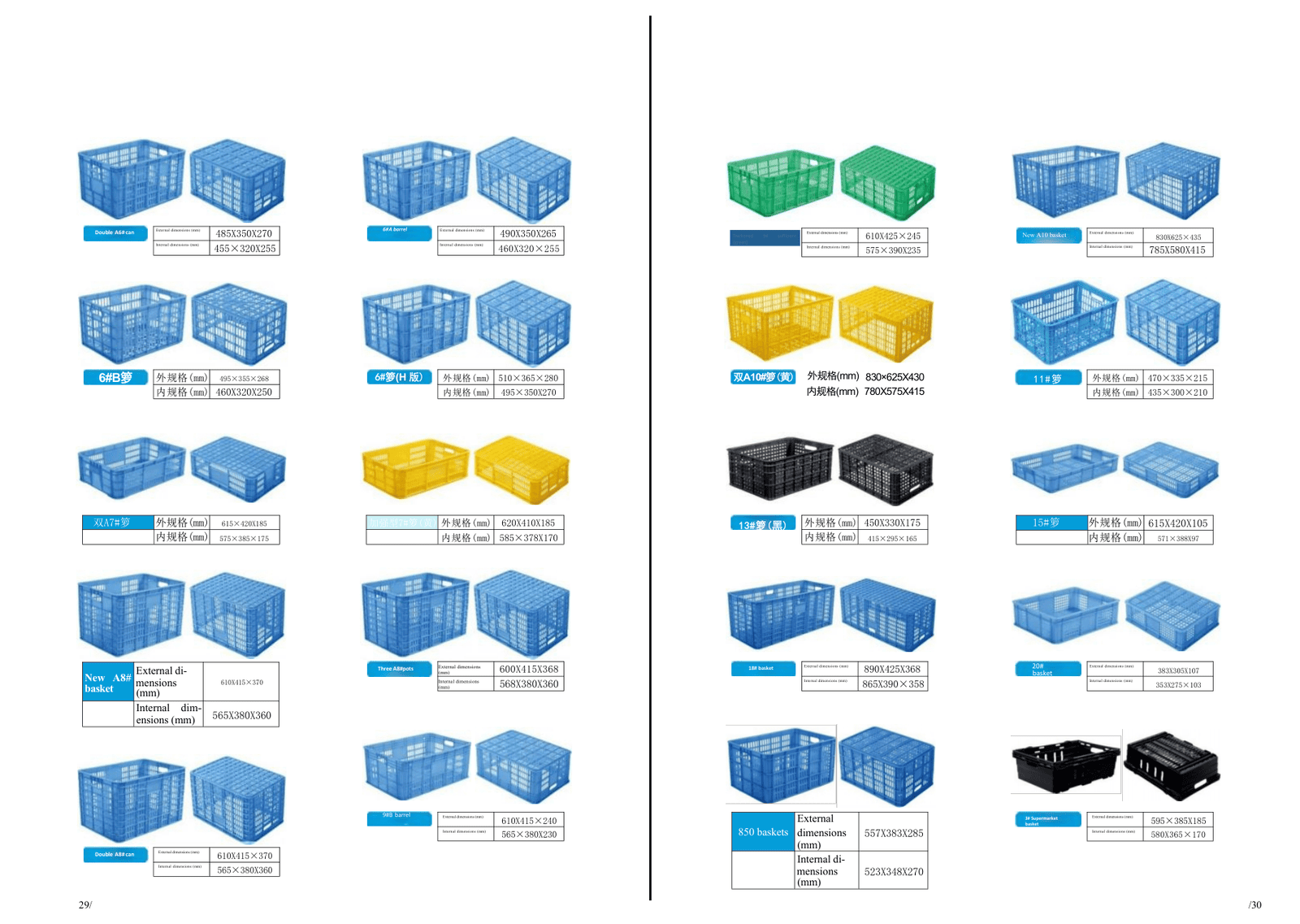
Ventilation is not a single yes-or-no feature. Crates sit on a spectrum between fully sealed (best for long-term dry storage) and fully open (best for cooling and washing). For bread, aim for the middle.
| Crate type | Airflow | Best use | Watch out for |
|---|---|---|---|
| Solid wall, solid base | None | Packaged dry goods, chilled storage | Condensation under bread; slow drying after wash |
| Ventilated walls, solid base | Moderate | Sliced bread, buns, pastries on racks | Crumb leakage through side slots |
| Ventilated walls and base | High | Hot bread straight from the oven, cooling rooms | Small items can fall through base slots |
| Open mesh / stack-and-nest bakery crate | Maximum | Cooling trays, high-volume fast turnover | Less structural rigidity for tall stacks |
A practical rule from the factory floor: if product is loaded within one hour of baking, use ventilated walls and a ventilated base. If product has already cooled to room temperature, ventilated walls with a solid base give the best balance of airflow and crumb containment.
The lid question
Lids seal in moisture and are the most common cause of soggy bread complaints. Where a lid is required for hygiene during open-vehicle delivery, choose a vented lid or leave a substantial air gap between the lid rim and the crate wall. Fully sealed lids only make sense for wrapped, ambient bread travelling short distances.
Food contact material and compliance
Bakery crates are in direct contact with unpackaged food, so material choice is a compliance issue, not a cost issue.
- Virgin food grade HDPE — the standard for bakery crates. Tough, tolerates repeated washing, handles temperatures from frozen storage to hot-filled product.
- Food grade PP — stiffer and clearer, useful where crates also go through dishwashers or hot wash tunnels. Slightly more brittle in cold rooms.
- Recycled content — acceptable for logistics crates in non-food contact layers only. Do not accept recycled material in a crate that touches unwrapped bread.
Ask your supplier for a declaration of compliance for food contact, a migration test report, and the material grade reference. A serious injection molding factory will also tell you which machine and mould produced the batch, which matters when a retail customer audits your supply chain.
Sizing: match the crate to the bread, not the other way round
Two dimensions decide everything:
Footprint. The 600 x 400 mm Euro footprint is the default for bakery distribution because it divides evenly into 1200 x 800 mm and 1200 x 1000 mm pallets, giving 100% pallet utilisation. Odd footprints leave dead space on every pallet, every truck, every shipment.
Internal depth. Measure the product, not the tray. A standard sliced loaf needs 110 to 140 mm. Unsliced artisan loaves, baguettes loaded at an angle, and bun packs in bags typically need 180 to 250 mm. Always compare the internal depth stated in the technical drawing rather than the nominal outer height.
Wall thickness and stack strength
Thin walls save material cost but limit stack height. For bakery crates stacked four high on a pallet, a 2.0 to 2.5 mm wall with properly ribbed corners holds shape in a warm truck. Below 1.8 mm, crates bow under load and the stack leans, which is a delivery liability. Rib design matters as much as thickness — a ribbed base and reinforced corner columns carry vertical load far better than a uniform thicker wall.
Stacking, nesting and freight economics
The return trip is where bakery crate fleets make or lose money. Empty crates occupy truck volume that could be carrying product, so nesting ratio is a direct freight cost line.
| Feature | Effect on your cost |
|---|---|
| Nesting ratio 1:3 to 1:4 | Return legs can move 3 to 4 times more empties per truck |
| Stackable in use, nestable when empty | Most efficient option for daily delivery rounds |
| Fixed stack-only design | Cheaper unit price, higher transport cost — rarely the right choice |
| Uniform crate fleet | Simpler pallet patterns and faster loading |
For a distributor running 20 crates per delivery point, moving from a non-nesting crate to a 1:4 nesting crate can cut empty-running transport volume by around 70%. That saving usually outweighs the per-unit price difference within the first year.
Cleaning, drying and traceability
Bakery crates are washed daily, and a crate that holds water in its ribs will still be wet when it is reloaded. Look for:
- Smooth internal surfaces with no sharp internal corners where dough residue collects.
- Drainage in the base so crates air-dry standing upright.
- Colour coding by route, product line or allergen zone — the same discipline described in our guide to colour-coded crates for warehouse 5S and inventory control.
- Suitable for tunnel washers at 60 to 85 °C. Confirm the heat deflection temperature of the grade, not just the resin family.
Where crates cross between nut-containing and nut-free lines, colour coding plus an embossed or hot-stamped logo is the simplest audit-proof traceability method. Embossing is added during molding at almost no cost, which is one reason to have crates made to your own tool rather than buying generic stock.
Making bakery crates to your own specification
Off-the-shelf crates force compromises on depth, ventilation pattern and branding. Custom molding lets you set the internal dimension to your exact loaf, place ventilation where your cooling process needs it, and emboss your logo and allergen markings directly into the mould.
LSY Plastic has molded plastic crates and containers since 1991 from our Foshan factory, running Japanese imported machines from 180T to 2500T with our own in-house mould workshop. That combination matters for bakery customers: you get tooling, material selection and volume production from one source, with a 20,000 m² warehouse holding finished stock for repeat orders.
OEM and ODM projects start with a technical drawing review. Send us your bread dimensions, pallet footprint and washing temperatures and we will come back with a recommended crate specification, MOQ and tooling lead time.
Next step: get a specification, not just a price
Send your bread and tray dimensions and your pallet footprint, and we will return a crate specification with internal dimensions, ventilation layout, material grade, nesting ratio and freight volume per 40 foot container.
WhatsApp: +86 19311059570
Email: fstyx01@lsyplastic.com
Related reading: ventilated plastic crates for produce, how to clean and sanitise plastic crates, and reusable plastic turnover boxes.