
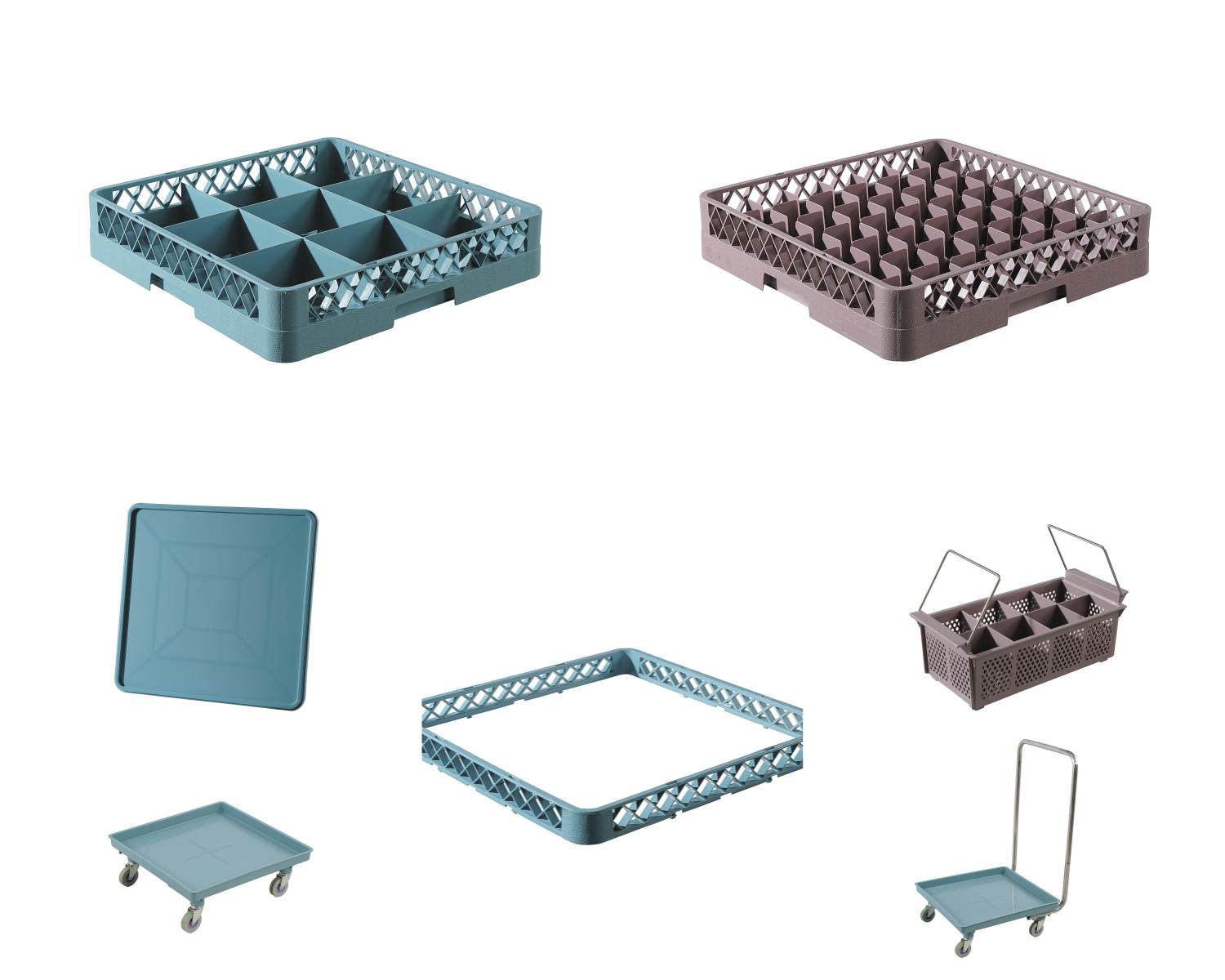
Glass racks and cup trays are sized backwards: you choose the machine, then the wash cycle, and only then the rack. Most dishwashing bottlenecks in hotels come from racks that do not match the machine opening, pegs that do not match the glass profile, or too few racks to keep the conveyor fed. This guide sets out the footprints, peg layouts, extender configurations and rack counts that keep a hotel or restaurant dishwashing bay running at rated throughput, plus the material and compliance points to confirm before you order in volume.
Why rack sizing decides your dishwashing throughput
A conveyor or pass-through dishwasher is rated in racks per hour, not glasses per hour. If your glasses sit loose in a rack that is too large, the machine runs at its rated rack count but washes fewer glasses per cycle. If the rack is too small for your wash bay opening, staff handle two racks where one would do, doubling labour and halving throughput.
Three numbers determine the correct rack:
- Machine opening — the internal width, depth and height of the hood or tunnel.
- Peg pitch — the centre-to-centre distance between pegs, which must exceed the widest part of the glass base.
- Stack height — the tallest glass, plus a minimum of 15 to 20 mm clearance, which decides whether you need an extender.
Standard footprints and where each is used
| Footprint | Typical machines | Best for |
|---|---|---|
| 400 x 400 mm | Compact undercounter glasswashers | Bars, coffee stations, small cafes |
| 500 x 500 mm | Pass-through hood machines, rack conveyors | Hotel restaurants, banqueting, large bars |
| 600 x 400 mm | Conveyor and flight machines, Euro footprint | High volume banqueting and central wash-up |
| 500 x 500 mm with extender | Hood machines with tall chamber | Wine glasses, tall tumblers, champagne flutes |
Because a 600 x 400 mm rack stacks on the same footprint as a Euro produce crate or an attachment lid tote, mixed operations can move glass racks and food storage crates on the same trolley and the same pallet — a small detail that simplifies back-of-house logistics considerably. It is also why we mould both product families on the same 180T to 2500T machine range.
Cup trays, compartment racks and peg racks: choosing the layout
Racks are sold by compartment count and peg count, and the two are not interchangeable.
Compartment racks
Fixed compartments, usually 16, 25 or 36, separate each item so nothing touches during the wash cycle. Compartment racks suit cups, tumblers and bowls, and are the right choice where chipping is a real cost. The trade-off is inflexibility: a 25 compartment rack that fits your tumbler will not fit a wider mug.
Peg racks
Individual pegs can be removed, added or repositioned, so one rack handles several glass profiles. Peg racks suit beverage operations with a mixed glass inventory and are the standard in hotel bars. Buy a rack with more peg positions than you currently need — spare positions cost nothing to leave empty and save a purchase later.
Extenders and glass heights
An extender frame raises the effective height of the rack so the upper part of a tall glass is supported rather than left unsupported above the machine’s spray arms. Add an extender when the tallest glass exceeds roughly 180 mm, and always check that the combined rack plus extender still clears the hood. Sectional extenders are useful in mixed operations: fit them only where tall glasses sit.
Material, temperature and compliance
| Requirement | Specification |
|---|---|
| Material | Food grade polypropylene (PP) or high density polyethylene (HDPE) |
| Continuous wash temperature | 70 to 90 °C; confirm heat deflection temperature of the specific grade |
| Chemical resistance | Stable against alkaline detergents and chlorine-based sanitisers |
| Load behaviour | Rated to carry a full load of glasses at 90 °C without bowing |
| Documentation | Food contact declaration of compliance; material grade reference |
Two failure modes show up repeatedly in hotel kitchens. First, racks made from low grade or heavily recycled material change shape after a few months of hot cycles — the base bows and pegs lean, which chips glassware. Second, racks specified at 60 °C service temperature are put through an 85 °C sanitising cycle and soften. Both are solved at the specification stage by stating the actual maximum temperature of the wash cycle, not the average.
Planning rack count and storage
Rack count is a capacity calculation, not an afterthought:
- Count the items washed during your busiest hour.
- Divide by the items your chosen rack holds per cycle to get racks per hour.
- Add the racks sitting in the machine and the racks drying.
- Add 15 to 20% spare for breakage, damage and peak events.
A 200 room hotel with a 120 seat restaurant and a banqueting hall for 300 covers typically ends up in the 150 to 250 rack range across bar, restaurant, banqueting and room service stations. Racks should nest or stack when empty — non-nesting racks consume storage space that back-of-house never has enough of. Colour coding by outlet, the same discipline used for commercial recycling bin colour coding, makes it obvious at a glance which outlet owns which rack.
Rack trolleys and floor handling
Racks only save labour if they move efficiently. Confirm that:
- Rack footprints match your existing housekeeping and service cart shelving, so full racks transfer without re-stacking.
- Trolleys carry a full rack stack without bowing; a standard rack trolley holds 8 to 12 racks.
- Loaded trolleys roll over stainless kitchen floors, drainage grates and ramps without rack vibration — casters with soft tread are the usual recommendation.
What to inspect when the first rack order arrives
Before you commit a full fleet, run a two week trial on five racks and check five things:
- Dimensional fit. Load a full rack into the machine and confirm 10 to 15 mm of clearance all round. Racks that scrape the hood damage both.
- Peg retention. Remove and refit pegs several times. They should click positively and not loosen after twenty wash cycles.
- Base deflection. Photograph the base from the side while empty, then again after fifty full wash cycles. Visible bowing means the grade is too soft for your cycle temperature.
- Glass marking. Check that no glass leaves a residue mark where it contacts the rack, which points to a peg profile or material that holds detergent.
- Stack stability. Stack eight loaded racks on a rack trolley and roll it over a floor drain or threshold. Movement here shows up as chipped glassware within weeks.
Any of these failing is a specification conversation, not a warranty conversation — which is easier to have with a factory that moulds the rack than with a reseller that buys it.
Custom cup trays and OEM glass racks
Generic racks rarely match a specific glass or machine exactly. Custom molding lets you set the peg pitch to your tallest glass, the compartment size to your widest cup, and the rack depth to your tunnel opening, with your outlet name embossed into the frame.
LSY Plastic has molded glass racks, cup trays and dishwashing accessories at our Foshan factory since 1991, with Japanese imported injection machines from 180T to 2500T and our own mould workshop. Hospitality customers typically start from a sample of the actual glassware: send us three glasses and your machine’s opening dimensions, and we will return a drawing with peg layout, rack height and extender recommendation.
Request a rack specification for your dishwashing bay
Tell us your machine opening, the tallest glass you wash, and how many covers you serve per hour. We will come back with rack footprint, peg or compartment layout, extender requirement, material grade and MOQ.
WhatsApp: +86 19311059570
Email: fstyx01@lsyplastic.com
Related reading: cup trays and parts bins, housekeeping cart procurement checklist, and cleaning and sanitising plastic crates.