1. Overview
LSY Multi functional toolboxs series covers:
- Oblique mouth boxes (open front bins)
- Parts bins (small plastic parts boxes with or without pegs)
- Flat mouth boxes (closed small storage boxes)
- Battery boxes (plastic battery storage boxes)
They are widely used as small parts organizers, workshop parts bins, component storage boxes and battery storage boxes.
2. Material
- Oblique mouth / parts / flat mouth boxes: PP (polypropylene), tough, impact resistant, easy to stack, some with pegs to be combined on racks or panels.
- Battery boxes: food-grade PP or HDPE, non-toxic, odorless, leak-proof, some with perforations for ventilation and moisture control.
3. Typical Applications
- Oblique mouth boxes:For electronic components, fasteners, small tools; open-front design makes picking easy without removing the box.
- Parts bins:Mounted on racks or workstations for production line material supply, enhancing picking efficiency and inventory visibility.
- Flat mouth boxes:For stationery, cosmetics, medical disposables (e.g. cotton swabs, needles). Better closure for dust and moisture protection.
- Battery boxes:For AA/AAA cells, lithium batteries and other small batteries; optional ventilation helps heat dissipation and moisture control.
1. Flat Mouth Boxes (Flat Mouth Storage Box)
| Model | Outer Size (mm) | Inner Size (mm) | Description |
|---|---|---|---|
| 01 Flat Box | 152×96×55 | 132×82×47 | Small flat storage box |
| 02 Flat Box (Red) | 205×135×60 | 180×115×55 | Red box for classification |
| 03 Flat Box | 257×177×78 | 223×156×70 | Medium flat box |
| 04 Flat Box | 305×205×85 | 270×185×77 | Larger flat box, desk / lab use |
2. Oblique Mouth Boxes & Parts Bins
2.1 Oblique Mouth Boxes (Open Front Bins)
| Model | Outer Size (mm) | Inner Size (mm) | Description |
|---|---|---|---|
| 01 Oblique Box | 95×102×50 | 85×100×48 | Small open front bin |
| 02 Oblique Box | 143×125×67 | 126×107×65 | Medium open front bin |
| 03 Oblique Box | 172×102×80 | 159×97×75 | Taller bin, small parts |
| 04 Oblique Box | 195×125×87 | 184×110×80 | Medium-large open front bin |
| 05 Oblique Box | 230×155×120 | 215×140×115 | Deep bin for larger parts |
| 08 Oblique Box | 174×134×82 | 163×117×78 | Compact but deep open front box |
2.2 Parts Bins (With Insert Columns / Pegs)
| Model | Outer Size (mm) | Inner Size (mm) | Features |
|---|---|---|---|
| F1 Parts Bin | 190×125×80 | 153×98×74 | For 4 insert pegs, mountable on panel |
| F2 Parts Bin | 255×150×117 | 217×130×110 | 4 insert pegs, medium bin |
| F3 Parts Bin | 335×200×140 | 290×180×130 | 4 insert pegs, large parts bin |
| F5 Parts Bin | 455×294×168 | 415×270×160 | 4 insert pegs, deep bin |
| F6 Parts Bin | 510×345×185 | 475×310×175 | 6 insert pegs, extra large bin |
| 10# Parts Bin | 280×124×140 | 255×100×130 | 4 insert pegs, tall narrow bin |
| 11# Parts Bin | 402×157×155 | 370×135×150 | 4 insert pegs, long narrow bin |
| 12# Parts Bin | 485×244×180 | 440×207×175 | With iron ears (handles), higher load |
3. Battery Boxes & Cable Trough Plates
3.1 Battery Boxes
| Model | Outer Size (mm) | Inner Size (mm) | Description |
|---|---|---|---|
| 1# Battery Box | 250×180×60 | 220×150×45 | Flat battery storage box |
| 2# Battery Box | 310×207×75 | 282×181×63 | Medium battery box |
| 3# Battery Box (High Foot) | 250×180×85 | 217×147×68 | Raised bottom, better ventilation |
| 4# Battery Box | 310×215×85 | 284×186×55 | Medium-deep battery box |
| 4#A Battery Box (High Foot) | 310×211×110 | 284×182×55 | High-foot design, increased clearance |
| 5# Battery Box | 415×282 | – | Large battery or tools box |
| 5# Battery Box (Green) | 245×190×115 | 215×160×85 | Green, for easy identification |
| 7# Battery Box | 315×205×95 | 280×185×80 | Deep box, multi-purpose |
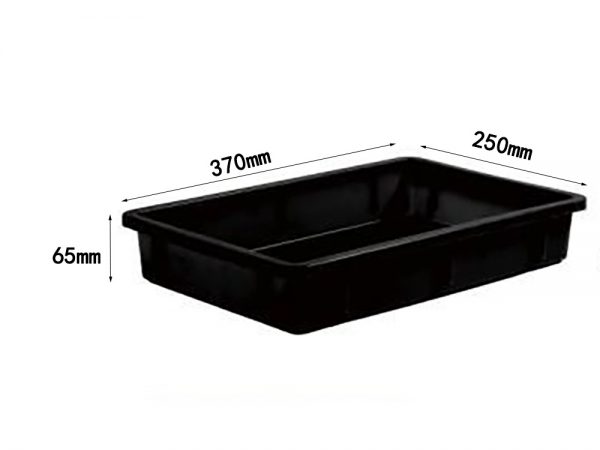
| 1# Battery Screen (With Holes) | 420×295×65 | 395×270×55 | Perforated battery tray for drainage & ventilation |
3.2 Cable Trough Plates (Electrical Trays)
| Model | Outer Size (mm) | Notes |
|---|---|---|
| 1# Cable Trough | 350×98×13 | With slots for inserting parts bins |
| 2# Cable Trough | 350×250 | Mounting plate |
| 3# Cable Trough | – | For electrical distribution |
| 4# Cable Trough | 460×200 | Larger cable management plate |
4. FAQ – Oblique Mouth Box / Parts Box / Battery Box
Q1: What is the advantage of oblique mouth (open front) boxes?
A: Open front boxes allow operators to pick parts directly without pulling out the bin. They are ideal for shelf-front storage, Kanban racks and workstations, improving picking speed.
Q2: What are the insert columns (pegs) used for on parts bins?
A: The pegs allow the bin to be:
- Mounted on perforated panels or rail systems
- Locked onto shelves to prevent sliding
They are widely used in assembly lines, maintenance workshops and tool rooms.
Q3: How should I choose between a flat box and a parts bin?
A:
- Flat boxes: Better for closed storage, dust protection, and general household/office use.
- Parts bins (open front / with pegs): Better for industrial small parts, frequent access and visual management.
Q4: Are battery boxes leak-proof and suitable for corrosive liquids?
A: Battery boxes are made from PP/HDPE and are liquid-resistant, but they are mainly intended for dry battery storage. For strong acids/alkalis or electrolyte liquids, dedicated chemical-resistant containers are recommended.
More from LSY Plastic
Browse the full Industrial Logistics & Material Handling Series range, or read our guide: One-Way Export Pallets vs Reusable Pallets: Which to Ship in Containers. Factory-direct MOQ and FOB quotes within 24 hours.
How these crates are moulded
Wall gauge first — a crate that only ever carries empty returns does not need the same gauge as one that carries wet produce.
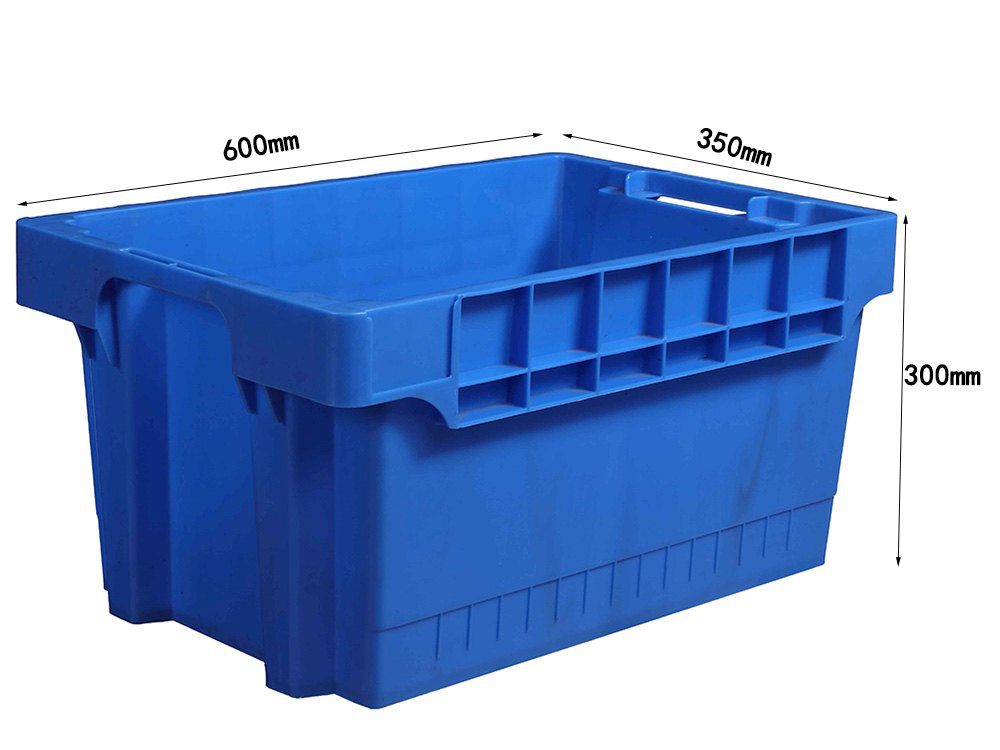
Storage boxes and totes are judged on lid fit and stack stability. The mould tolerance at the rim decides whether a stack stays put on a shelf or walks itself apart over a season.
Where buyers actually use these crates
Wall gauge first — a crate that only ever carries empty returns does not need the same gauge as one that carries wet produce.
Warehouses, stockrooms, homes and workshops use lidded totes where open shelving loses things: seasonal stock, spare parts, documents, components, personal issue items.
Ordering, wall gauge and container cube
Samples are charged at cost, because crate tooling runs the same cycle as production. A sample lets you check the wall gauge, the handle feel, and whether the box nests or stacks the way your line expects. Domestic orders have no minimum quantity; export crate orders ship as full container loads (FCL).
Vented and solid-wall crates are drop-tested and stack-tested at elevated temperature before release. A stack of loaded crates sitting in a hot warehouse is the hardest thing the moulding ever has to survive, and it is where thin-wall boxes fail first.
Multi Functional Toolboxs — Confirm the external footprint against the pallet or shelf it sits on; crates are bought to a footprint, not to a litre figure.
For the full selection logic behind this product family, see our storage container guide.
FAQ
Are samples free?
Samples are charged at cost, not given away.
What is the minimum order quantity?
Domestic orders have no minimum. Export orders ship as full container loads (FCL).
Can you produce to our drawing?
Yes — LSY runs its own mould workshop and adapts tooling to customer drawings or samples.
Multi-compartment organisers for parts and tools
An organiser box only works if the compartment layout matches what goes inside. The common failure is buying by external size, discovering the longest item does not fit any single compartment, and ending up with a box used as a single open tub.
Layout before capacity
Decide the largest single item first, then build the layout around it. Adjustable dividers buy flexibility but cost rigidity and usually let small parts migrate between compartments when the box is moved — fixed compartments are better where contents are consistent.
Lid versus open top
A lid protects contents in transit and lets boxes stack, which matters in a vehicle. An open top is faster to work from at the bench. Most workshops run open-top boxes in the workshop and lidded boxes in the van.
Material and load
Check base stiffness with compartments loaded — a box that is fine empty can bow in the middle with metal parts in it, and a bowed base makes compartments bind. Reinforced bases and ribbed walls are what prevent that.
Frequently asked questions
Can I configure the compartments?
Fixed and adjustable layouts are available. Fixed is better if contents stay the same; adjustable suits a changing mix but lets small parts migrate.
Does the lid lock?
Latching lid models are available, which matters for transport. Confirm the latch design if the box travels in a vehicle.
How much weight will the base take?
Check the loaded behaviour rather than the rating alone — metal parts concentrate load in single compartments and a flexible base bows.
Ordering notes: wall gauge, venting and packing
Wall gauge first — a crate that only ever carries empty returns does not need the same gauge as one that carries wet produce.
- Colour. Send a RAL or Pantone reference rather than a colour name. Stock colours ship faster; custom shades carry a minimum quantity per colour.
- Export packing. Overseas orders ship as full container loads (FCL). Loose cartons are not consolidated for export.
- Samples. Samples are supplied at cost price plus freight, not free of charge.
- Lead time. Stock colours from existing moulds run a few weeks from deposit and artwork confirmation. Custom colour or new tooling adds time and is confirmed in writing with the quotation.
- Documentation. Commercial invoice, packing list and bill of lading as standard; certificate of origin where the destination requires it.
Related reading: plastic crates guide.
Where these crates ship
Crate and box containers from this line go mostly to Vietnam, Bangladesh, Kenya, South Africa. Crates are bulky and light, so freight is quoted on container cube rather than weight — export orders move full container load, and samples are charged at cost.