A well-organized hotel room service cart can reduce delivery time by 30-50% and significantly improve guest satisfaction. The essential components of a room service cart include heat-retaining tray covers, beverage holders, condiment organizers, and flatware dispensers. This guide covers everything hotel F&B managers need to know about selecting, equipping, and organizing room service carts for maximum efficiency.
What Is a Hotel Room Service Cart?
A room service cart is a mobile serving unit designed to transport meals, beverages, and service items from the kitchen to guest rooms. Unlike banquet service carts (which serve large-scale events), room service carts are designed for individual or couple-sized meal delivery. For large-scale banquet setups, see our banquet service cart guide.
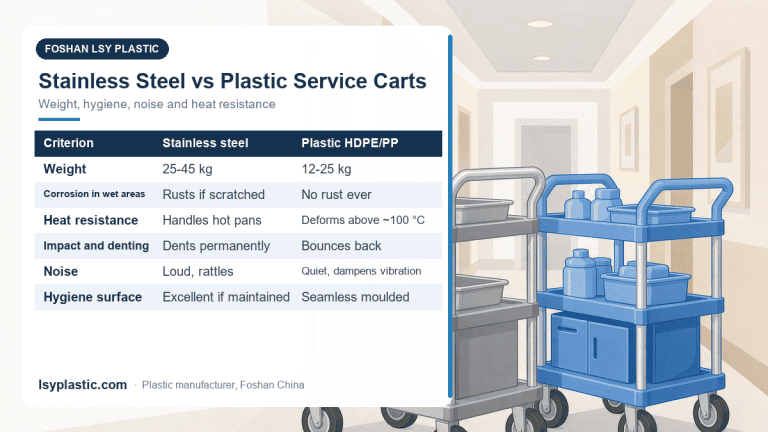
Modern plastic room service carts offer several advantages over traditional metal carts:
- Lighter weight (8-15 kg vs 20-30 kg for metal), reducing staff fatigue
- Quieter operation—plastic wheels and surfaces dampen noise in guest corridors
- Stain and corrosion resistant—no rust from spilled beverages or acidic foods
- Easier sanitization—smooth plastic surfaces clean faster than textured metal
- Lower cost—typically 40-60% cheaper than stainless steel equivalents
Types of Room Service Carts
| Cart Type | Shelves | Dimensions (mm) | Best For | Load Capacity |
|---|---|---|---|---|
| Compact 2-Tier | 2 | 700 × 450 × 850 | Single guest meals, breakfast service | 40-50 kg |
| Standard 3-Tier | 3 | 800 × 500 × 950 | Couple dining, full dinner service | 60-80 kg |
| Oversized 3-Tier | 3 | 900 × 600 × 1000 | Family rooms, suite service | 80-100 kg |
| Folding Service Cart | 2-3 | 800 × 500 × 900 | Storage-saving, seasonal operations | 50-60 kg |
Essential Room Service Cart Equipment
1. Tray System
Trays are the foundation of room service cart organization. Most carts accommodate 2-4 standard service trays (typically 400×300mm or 450×350mm). Key considerations:
- Material: Food-grade PP or ABS trays with raised edges to prevent sliding
- Non-slip surface: Textured bottom or rubber mats keep plates stable during transport
- Color coding: Use different tray colors for different meal periods (blue for breakfast, white for lunch, black for dinner)
- Stackability: Trays should stack neatly when not in use to save cart space
2. Heat Retention System
Food temperature is the #1 complaint in room service delivery. Meals must arrive above 60°C for hot dishes and below 4°C for cold items. Equipment options include:
- Dome covers: Insulated plastic or metal domes that trap steam and maintain food temperature for 15-20 minutes
- Heat packs: Gel-based or chemical heat packs placed under plates for extended warmth (30-45 minutes)
- Insulated base pads: Foam-filled pads on cart shelves that reduce heat transfer to the cart frame
3. Beverage Holder System
Beverages require secure holding during transport to prevent spills:
- Cup holders recessed into the cart top shelf (typically 4-6 positions)
- Wine bottle clips or brackets on side rails
- Coffee carafe mounts with tilt-lock mechanisms
- Thermal carafes that maintain beverage temperature for 60+ minutes
4. Condiment and Utensil Organizer
A disorganized condiment setup slows delivery and looks unprofessional. Equip your cart with:
- Drawer or caddy for flatware (forks, knives, spoons in separate compartments)
- Napkin holder mounted on cart frame
- Condiment tray with individual slots for salt, pepper, sugar, creamer, butter
- Menu and bill holder on the cart handle
Tray Organization: Step-by-Step Setup
Proper tray layout ensures efficient delivery and professional presentation:
Breakfast tray layout:
- Place main plate (eggs, meat, starch) center-left
- Place toast/bread basket top-right
- Place fruit bowl or yogurt top-left
- Place juice glass and coffee cup in designated holders on cart top
- Place condiments (butter, jam, sugar) along the front edge
- Place flatware rolled in napkin on the right side
Dinner tray layout:
- Place appetizer plate top-left (small plate, 200mm)
- Place main course center (large plate, 280-300mm)
- Place dessert plate bottom-right (medium plate, 230mm)
- Place bread plate top-right with butter knife
- Place wine glass in beverage holder on cart
- Arrange flatware: fork left, knife right, dessert spoon above plate
- Place bill/check folder on cart handle shelf
For housekeeping cart organization tips that complement room service workflows, see our housekeeping cart organization guide and our commercial cleaning cart buying guide.
Room Service Cart Wheel and Mobility Features
Wheels are the most overlooked component of room service carts, yet they directly affect delivery speed, noise levels, and staff safety:
| Wheel Type | Diameter | Noise Level | Carpet Performance | Locking |
|---|---|---|---|---|
| Standard rubber | 100mm | Medium | Fair | Yes |
| Non-marking rubber | 100-125mm | Low | Good | Yes |
| Polyurethane | 125mm | Very low | Excellent | Yes |
| Swivel with brake | 100-125mm | Low | Good | Yes (dual) |
For corridor use, we recommend 125mm polyurethane swivel wheels with dual-locking brakes. These provide quiet operation, smooth carpet navigation, and secure parking during room delivery.
Sanitization and Food Safety on Room Service Carts
Room service carts must be sanitized between each use to prevent cross-contamination. Key protocols:
- Wipe-down between deliveries: Use food-safe sanitizer on all contact surfaces
- Daily deep clean: Remove trays and clean all cart surfaces with hot water (60°C+) and detergent
- Weekly inspection: Check wheel bearings, hinge mechanisms, and tray rails for wear
- Material choice: Plastic carts with smooth surfaces sanitize faster than textured metal carts
Our commercial kitchen sanitization guide provides detailed cleaning protocols applicable to all food-contact surfaces.
Choosing the Right Room Service Cart: Buying Checklist
- Match cart size to your room count: 1 cart per 25-30 rooms for full-service hotels
- Check corridor width: Ensure cart width + staff walking space fits your narrowest corridor (minimum 900mm clear)
- Select wheel type: Polyurethane for carpet corridors, non-marking rubber for hard floors
- Verify tray compatibility: Ensure cart shelves accommodate your existing tray sizes
- Consider folding options: Folding carts save 70% storage space during low-occupancy periods
- Check load capacity: Calculate maximum tray + food + beverage weight; choose cart rated 25% above that
- Color and aesthetics: Match cart color to hotel brand standards; neutral colors (white, grey, black) are most versatile
For a comparison of different hotel cart types, see our luggage cart vs bellman trolley guide and explore the full range of hotel carts in our hotel hospitality carts hub.
Need reliable hotel service carts? Browse the Restaurant & Room Service Carts collection and request a quote.
Frequently Asked Questions
How many room service carts does a hotel need?
A general rule is 1 cart per 25-30 guest rooms for hotels offering full room service. Budget 1 cart per 50 rooms for limited-service properties offering breakfast-only room service.
Plastic vs metal room service carts: which is better?
Plastic carts are lighter, quieter, easier to sanitize, and 40-60% cheaper. Metal carts offer a more premium appearance for luxury properties. For most 3-5 star hotels, plastic carts provide better value and operational efficiency.
How long should food stay on a room service cart?
Hot food should be delivered within 10 minutes of plating. With insulated dome covers, food remains above 60°C for 15-20 minutes. Beyond 20 minutes, quality degrades significantly.
Need Custom Plastic Pallets, Containers, or Hotel Carts?
At LSY Plastic, we’ve been manufacturing high-quality injection-molded plastic products for over 35 years. From HDPE pallets and food-grade containers to hotel service carts and ESD bins, we deliver factory-direct pricing with OEM customization.
Contact us today:
- WhatsApp: +86 19311059570
- Email: fstyx01@lsyplastic.com
- Website: lsyplastic.com
Our team responds within 24 hours with detailed quotations and technical specifications.