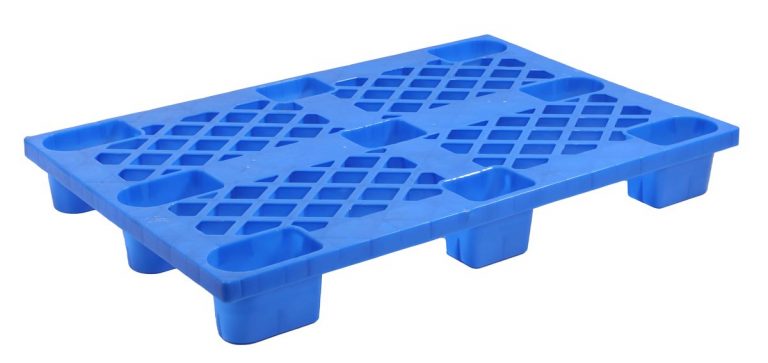
Every plastic pallet on the market carries a load rating — “static 6,000 kg, dynamic 1,200 kg, racked 1,000 kg” — printed on a data sheet or stamped into the deck. Most buyers take those numbers at face value. The problem is that load ratings are only as meaningful as the test method behind them. Two pallets can both claim “1,200 kg dynamic” while one was tested to ISO 8611 with a full report and the other was estimated by a salesperson. This guide explains the two pallet test standards that matter — ISO 8611 and ASTM D1185 — what they actually measure, and how to read a test report like a buyer who has been burned before.
1. Why Pallet Test Standards Exist
Pallets are safety-critical handling equipment: a pallet failure under load can injure workers, damage goods, and stop a warehouse line. Standards exist so that manufacturers, buyers and regulators speak the same language about load capacity. They define:
- How a test load is applied (point loads, distributed loads, racking conditions)
- How long loads are held
- What counts as failure (crack, permanent deflection, breakage)
- How results are reported
For a full picture of how pallet structures affect real-world performance, start with our plastic pallets hub and the how to choose plastic pallets guide.
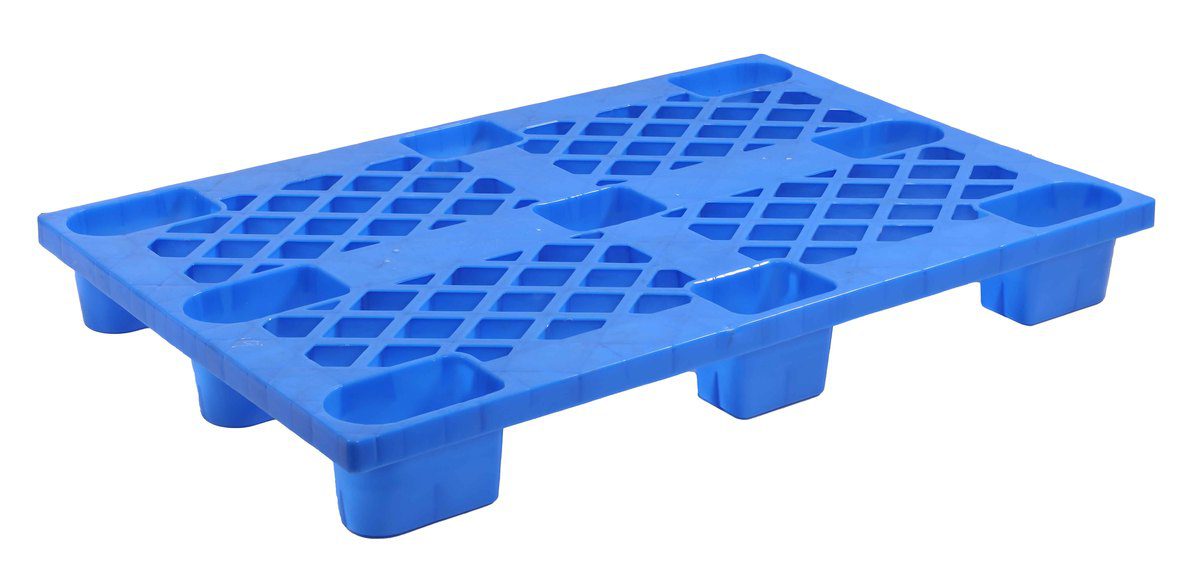
2. ISO 8611: The International Pallet Load Testing Standard
ISO 8611 (full title: Pallets for materials handling — Flat pallets) is the international benchmark. Part 1 covers test methods; Part 2 covers performance requirements for new pallets; Part 3 covers maximum working loads. It is the standard most export-oriented manufacturers cite because it is recognized across Europe, Asia, the Middle East and much of the global logistics industry.
The core tests in ISO 8611 include:
| Test | What it measures | Typical duration / load |
|---|---|---|
| Static load bending | Deck deflection and recovery under a static load | Load held for a set period, deflection measured |
| Dynamic load (forklift/transport) | Behavior under moving loads and vibration | Simulated transport cycles |
| Racking / racked load | Performance when supported on rack rails | Load applied between supports, creep measured |
| Impact tests | Resistance to forklift strikes and drops | Corner and edge impacts |
| Shear / corner drop tests | Structural integrity under asymmetric loads | Corner drops from defined heights |
ISO 8611 also defines how the maximum working load is derived from test results using safety factors — which is why two identical-looking pallets can have different published ratings. If a supplier cannot produce an ISO 8611 test report, the numbers on the data sheet are opinions, not measurements.
3. ASTM D1185: The North American Standard
ASTM D1185 (Standard Test Methods for Pallets and Related Structures) is the equivalent standard most commonly used in North America. It covers similar ground — static load, dynamic load, and racking — but with its own test procedures and acceptance criteria. Buyers importing into the US or Canada, or selling to US retail chains (which often enforce their own pallet specs on top of ASTM), should expect D1185 documentation.
Key differences to be aware of:
- ASTM D1185 uses a 6-point load for racking tests (three support beams) in some configurations, while ISO 8611 specifies its own support geometry — results are not always directly comparable.
- Acceptance criteria for deflection and recovery differ between the two standards.
- Many US retailers (including grocery chains with GMA-style specs) layer their own requirements on top of ASTM D1185 — check the buyer’s pallet specification sheet, not just the standard.
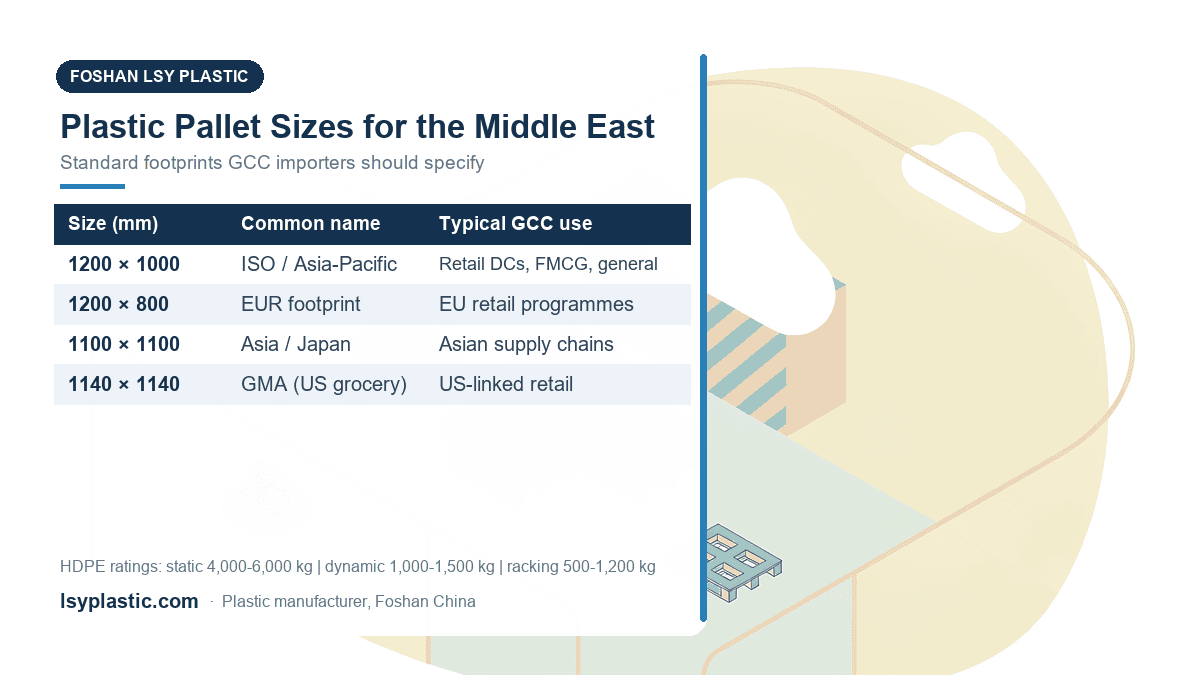
If you export to the US, pair the test report with the sizing guidance in our pallet sizes and dimensions guide, since US pallet footprints (48 x 40 in / 1,200 x 1,000 mm) differ from EUR pallets.
4. Static vs Dynamic vs Racked Load: What Each Number Means
Load ratings get misquoted more than any other pallet figure. The three numbers are not interchangeable:
| Rating | Meaning | Typical use |
|---|---|---|
| Static load | Maximum weight a pallet can support when stationary, load evenly distributed | Stored on the floor, stacked 2–3 high |
| Dynamic load | Maximum weight while being moved by forklift or pallet jack | Transport and handling |
| Racked load | Maximum weight when supported only on rack rails (load-bearing edges) | Rack storage in warehouses |
Dynamic and racked loads are the figures that matter for warehouse operations, and they are always lower than static. If a supplier only quotes a static load, ask for the other two. For a deeper look at how racked load interacts with rack design, see our racking safety and load capacity guide.
5. How to Read a Pallet Test Report
When you request a test report, verify these five things before trusting it:
- Standard cited — ISO 8611-1/-2/-3 or ASTM D1185 must appear explicitly, with the test date.
- Test laboratory — third-party lab (SGS, TÜV, Intertek, or a national metrology institute) carries more weight than in-house results.
- Sample condition — results apply to the exact pallet model and resin formulation tested; a “similar” model is not the same.
- Failure mode — did it fail by cracking, permanent deflection above limit, or splintering? The mode tells you how it will fail in real use.
- Safety factor — how the maximum working load was derived from test results.
Also relevant: the pallet weight guide explains how pallet self-weight affects shipping cost, and cost-per-trip analysis shows why a well-tested pallet usually out-earns a cheap untested one.
6. Common Misconceptions About Pallet Testing
- “All 1,200 kg pallets are equal.” No — one may have passed ISO 8611 racking, the other may be a static-load-only estimate. Demand the report.
- “Testing is only for heavy loads.” Light loads still benefit: racked storage of a 300 kg product on an untested pallet can cause creep failure over months.
- “Plastic pallets never break.” They crack under impact if the wrong resin or thin-wall design is used. Testing exposes that.
- “In-house testing is fine.” Useful for development, but buyers should require third-party reports for safety-critical specs.
7. FAQ: Pallet Load Testing
Do I need ISO 8611 or ASTM D1185? For global export, ISO 8611 is the most widely recognized. For North America, ASTM D1185 (or a retailer’s layered spec) is expected. Many export manufacturers test to both.
Can plastic pallets handle more load than wood? Plastic pallets typically have lower static ratings than hardwood but better consistency and no moisture-related degradation. The plastic vs wood comparison covers this in detail.
How do I verify a supplier’s load rating? Ask for the third-party test report, confirm the model and resin match the report, and if the application is critical, request a sample for your own load test before committing to a container order.
Does cold storage change the tested ratings? Yes — ISO 8611 tests at 23°C. For freezer applications, request cold-condition testing. See our plastic pallets for cold storage guide.
8. Buy Pallet Pallets Tested, Not Estimated
LSY Plastic manufactures plastic pallets tested to ISO 8611 and ASTM D1185 standards in our Foshan factory, with third-party test documentation available for every export model. We publish real load ratings — static, dynamic and racked — and will walk you through the reports before you order. Contact us to request test documentation for the pallet models you are considering.
Ready to compare options? Browse our Plastic Pallets range for plastic pallets.