Using plastic pallet racking safety guidelines correctly prevents warehouse accidents, product damage and costly downtime. While plastic pallets offer advantages in hygiene, weight and durability, they behave differently under rack loading than traditional wood or steel pallets. This guide explains load capacity limits, rack configuration requirements and daily safety checks for operations using plastic pallets in selective racking systems.
Why Racking Safety Matters for Plastic Pallets
Plastic pallets are engineered for specific load conditions. Exceeding rated capacities, using incorrect rack configurations or ignoring damage signs can lead to:
- Pallet deflection and permanent deformation
- Product falls from elevated rack positions
- Beam connector failure under point loads
- Forklift impacts caused by pallet flexing
- Injury to warehouse personnel
Understanding the relationship between pallet design and rack geometry is essential for safe storage.
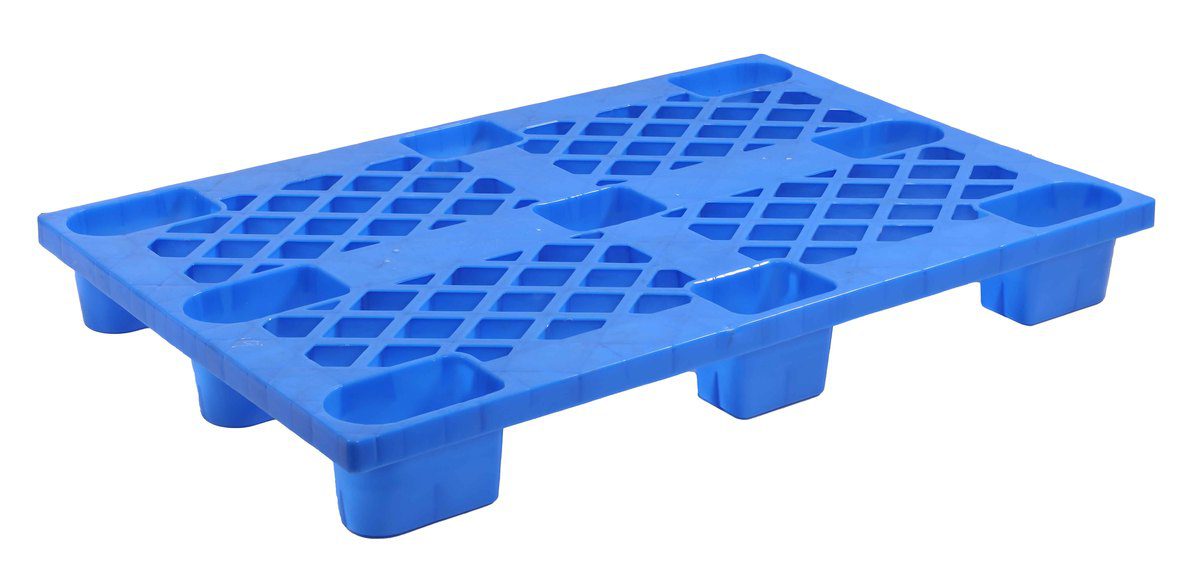
Types of Load Ratings
Plastic pallets carry three distinct load ratings. Confusing these is a common cause of rack accidents:
| Load Type | Definition | Typical HDPE Pallet Rating |
|---|---|---|
| Dynamic Load | Maximum load during forklift transport | 1,000–2,000 kg |
| Static Load | Maximum load when pallet rests on flat ground | 3,000–6,000 kg |
| Rack Load | Maximum load in unsupported racking (edge or center) | 500–1,500 kg |
Critical rule: Always use the rack load rating, not the dynamic or static rating, when calculating safe storage in elevated racking. Rack load is typically 40–60% of dynamic load capacity.
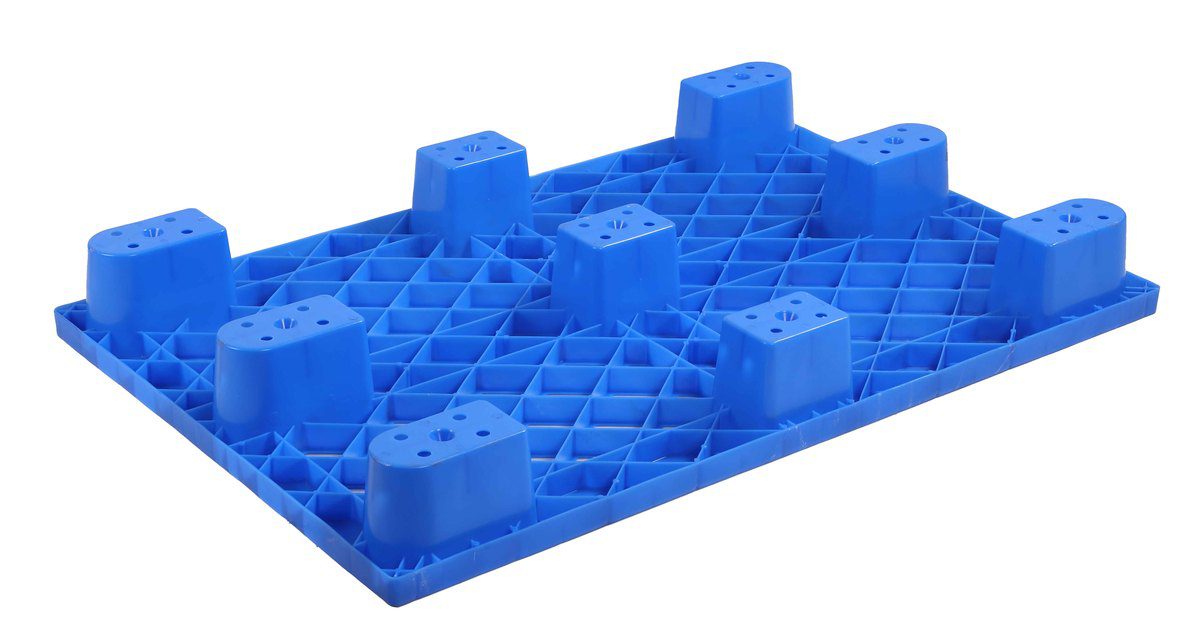
Rack Load Capacity by Pallet Style
Not all plastic pallets perform equally in racking. The bottom structure determines how load transfers to rack beams:
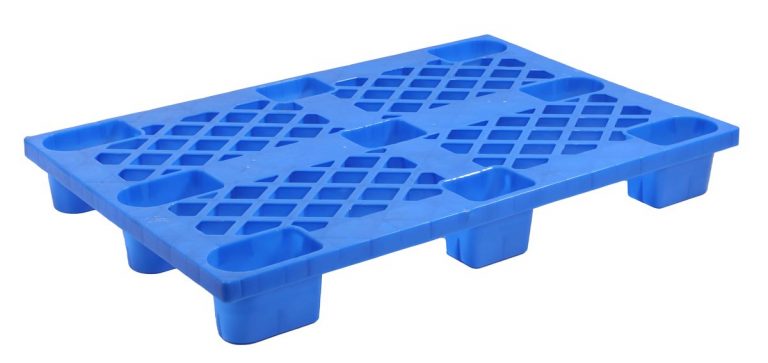
Three-Runner (Stringer) Pallets
Three-runner pallets have continuous bottom runners that span across rack beams. This design distributes rack load evenly and typically achieves the highest racking capacities (1,000–1,500 kg for reinforced HDPE models). Runner orientation must be perpendicular to rack beams.
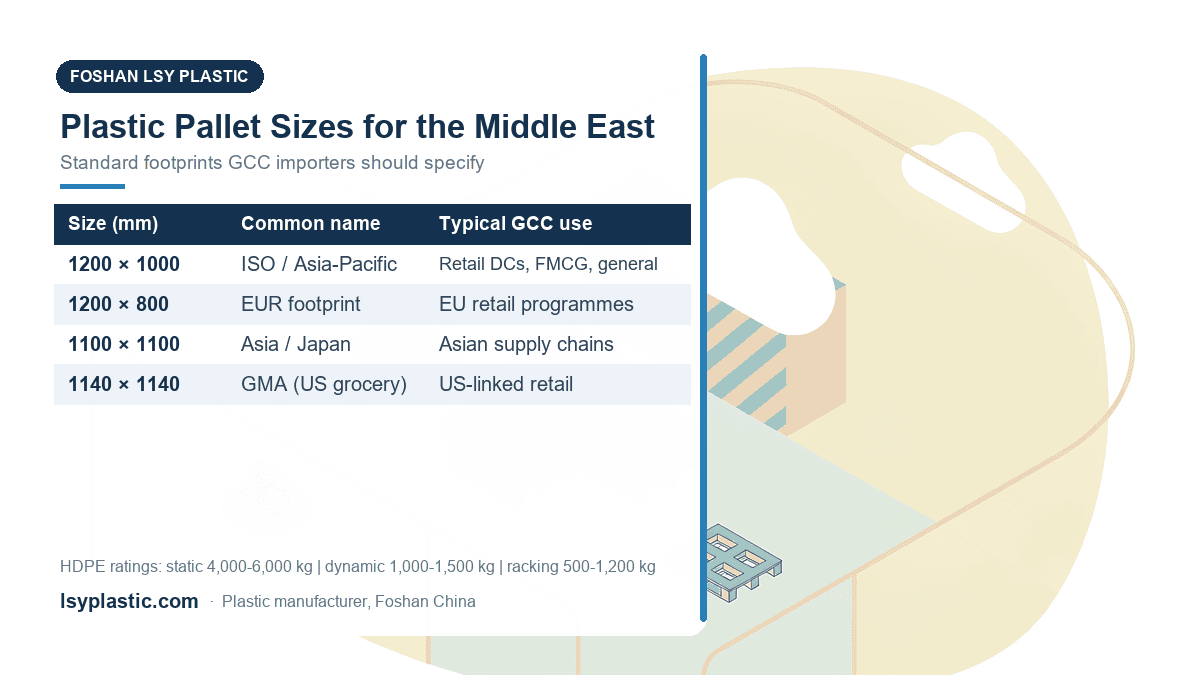
See the Pallet hub for the full range and specifications.
Six-Runner Pallets
Six-runner designs offer additional support points and improved stability in drive-in or push-back racking. Capacities range from 800–1,200 kg depending on runner thickness and reinforcement.
Picture-Frame or Perimeter-Base Pallets
These lightweight designs are optimized for floor stacking and conveyor transport. Rack loads are limited (200–500 kg) because the open center lacks support. Using these in unsupported racking without center support is unsafe.
Steel-Reinforced Plastic Pallets
Steel tubes embedded in the deck or runners dramatically increase rack load capacity to 2,000–3,000 kg. These are essential for heavy industrial applications but cost 2–3× more than all-plastic alternatives.
Beam Spacing and Rack Configuration
Rack beam spacing directly affects plastic pallet performance. Wider spans increase beam deflection and reduce effective capacity:
| Beam Spacing (mm) | Recommended for Plastic Pallets | Notes |
|---|---|---|
| 2,700 | Standard pallet racking | Optimal for 1200×1000 mm pallets |
| 2,300 | Narrow-aisle racking | Reduces beam deflection; check fork entry |
| 3,600+ | Long-span shelving | Requires steel-reinforced or heavy-duty pallets |
Beam level spacing (vertical distance between levels) should allow at least 100 mm clearance between the top of the load and the bottom of the next beam. This clearance accommodates pallet deflection under load without contact.
Rack Loading Best Practices
Follow these guidelines for safe plastic pallet storage:
Uniform Load Distribution
Place the heaviest items toward the center of the pallet and distribute weight evenly. Point loads or concentrated weight near pallet edges cause excessive deflection and stress concentration.
Overhang Limits
Product overhang beyond the pallet deck should not exceed 50 mm on any side. Excessive overhang shifts the center of gravity, increases tipping risk and exposes product to forklift damage.
Stack Height Limits
When floor-stacking loaded plastic pallets, respect the static load rating and observe these height guidelines:
- Light loads (<500 kg): up to 6 pallets high
- Medium loads (500–1,000 kg): up to 4 pallets high
- Heavy loads (>1,000 kg): up to 2 pallets high
First-In-First-Out (FIFO) Considerations
Plastic pallets are well-suited for FIFO systems because their consistent dimensions prevent jamming in gravity flow racks. Ensure that flow rack rollers are spaced to support pallet runners, not the open deck areas.
Daily Safety Inspection Checklist
Implement this inspection routine before each shift:
| Check Item | Pass Criteria | Action if Failed |
|---|---|---|
| Pallet deck condition | No cracks, splits or holes larger than 25 mm | Remove from service immediately |
| Runner integrity | All runners intact, no missing sections | Repair or replace pallet |
| Corner posts | Vertical, not bent or sheared | Replace pallet |
| Load stability | Load centered, shrink wrap intact, no overhang | Re-wrap or re-stack |
| Rack beam level | Beams level, connectors seated, no visible damage | Report to maintenance |
| Clearance above load | Minimum 100 mm to next beam | Lower load or raise beam |
Temperature and Environmental Considerations
Plastic pallet rack load capacity decreases in extreme temperatures:
- Below -20°C: HDPE becomes brittle; reduce rack loads by 20%
- Above +50°C: Polypropylene softens; reduce rack loads by 15%
- UV exposure: Outdoor racking degrades plastic over time; inspect quarterly
- Chemical contact: Certain solvents weaken polymer chains; verify chemical compatibility
For cold storage applications (-25°C to -30°C), specify cold-resistant HDPE formulations rated for freezer use.
Compatibility with Automated Systems
Automated storage and retrieval systems (AS/RS) impose additional requirements:
- Tighter dimensional tolerances (±2 mm vs ±5 mm for manual racks)
- Anti-slip surfaces to prevent load shift during acceleration/deceleration
- RFID or barcode integration for tracking
- Smooth bottom surfaces to prevent conveyor roller damage
Standard plastic pallets often require modification for AS/RS compatibility. Discuss specifications with your automation integrator before ordering.
Training and Documentation
Safe racking operations require trained personnel. Maintain documentation including:
- Rack load capacity certificates from the rack manufacturer
- Pallet rack load ratings for each SKU in use
- Maximum stack heights by product and zone
- Emergency procedures for pallet or rack failure
- Inspection logs with dates, findings and corrective actions
Summary: Key Safety Rules
- Always use the rack load rating, not dynamic or static rating
- Ensure runner orientation is perpendicular to rack beams
- Maintain 100 mm vertical clearance between load and next beam
- Inspect pallets daily for cracks, deformation and runner damage
- Reduce capacity by 15–20% in temperature extremes
- Never exceed manufacturer-specified beam spans without engineering review
- Remove damaged pallets from service immediately
For more on pallet selection, read our pallet sizes and dimensions guide and weight guide for shipping.
Explore our full range of warehouse solutions in the Plastic Pallets Hub.
Need Rack-Safe Plastic Pallets?
FOSHAN LSY Plastic manufactures reinforced HDPE pallets with rack loads from 800 kg to 1,500 kg, tested to ISO 8611 standards. Our three-runner and steel-reinforced designs are used in cold storage, pharmaceutical and automotive warehouses across the Middle East and Southeast Asia. Contact us on WhatsApp +86 19311059570 or email fstyx01@lsyplastic.com for load test reports and rack compatibility documentation.
Ready to compare options? Browse our Plastic Pallets range for plastic pallets.
Frequently Asked Questions
Why do plastic pallets behave differently in racking?
In racking a pallet is supported only at the beams, so the deck carries a continuous bending load, often for months. That is why racked ratings are much lower than static ratings and depend heavily on the pallet design, especially the beam runners.
What load ratings must I check for racking?
Check static, dynamic and racked ratings. Always spec against the racked rating for your real working weight, and allow margin for uneven loads, temperature and forklift impact.
How does beam spacing affect capacity?
Wider beam spacing increases the unsupported span and lowers capacity; closer beams support the deck better. Confirm your rack beam spacing and ask the supplier for the pallet’s racking rating at that span.
What should a daily racking safety check cover?
Check pallets for cracks or damage, confirm loads are within the racked rating and evenly distributed, look for overhang and misalignment, and inspect beams and uprights. Train staff and document the checks.