Nestable vs Rackable Plastic Pallets: Which Fleet Saves You More?
Every pallet buyer eventually hits the same fork in the road: nestable or rackable? The two designs look similar at a glance, but they solve opposite problems. Nestable pallets win on transport economics and empty-storage efficiency. Rackable pallets win on load rigidity and warehouse racking safety. This guide compares them on price, load capacity, storage footprint and total cost per trip — so you can match the right pallet to the right lane.
What Is a Nestable Plastic Pallet?
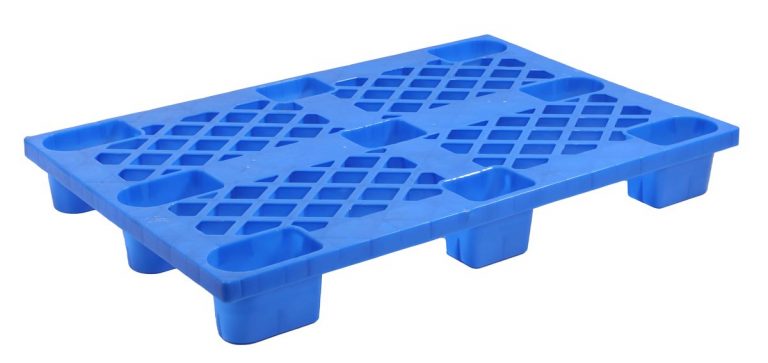
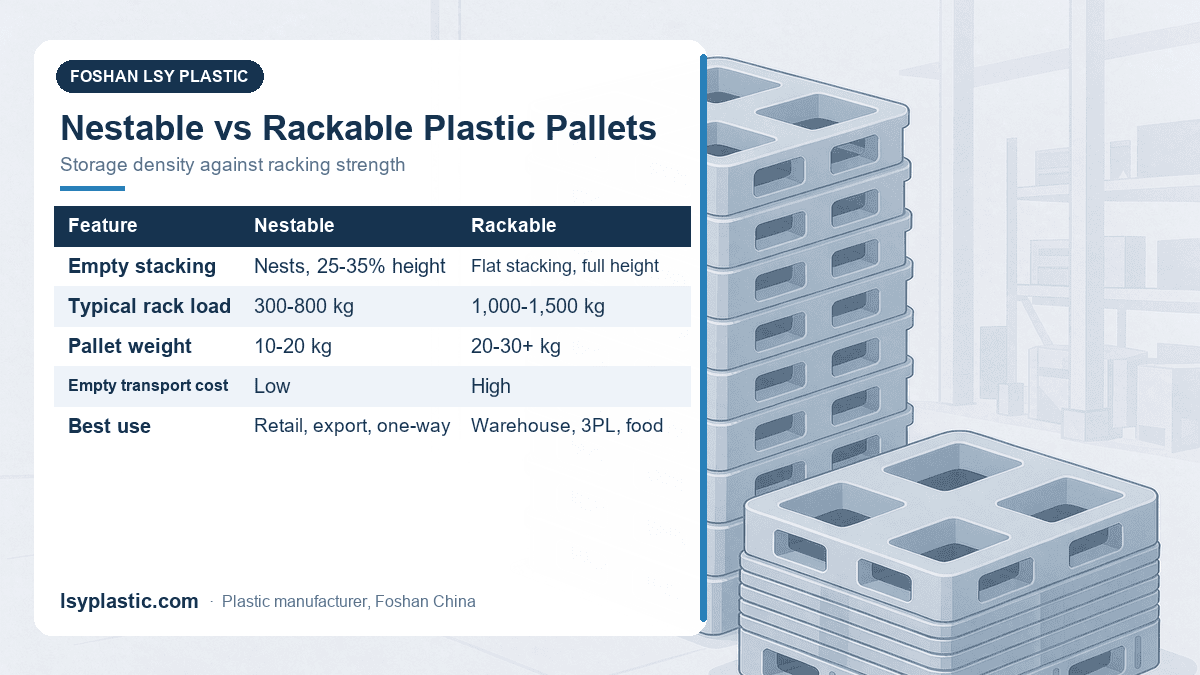
A nestable plastic pallet has a tapered base and open deck designed so one pallet tucks inside the next when stacked empty. A stack of 20 nestable pallets stands roughly the height of 4 to 6 rackable pallets, which is why freight forwarders and exporters prefer them for one-way and returnable packaging lanes.
- Tapered, open-bottom construction
- Nests into about 25-35% of its own height when empty
- Lighter, typically 10-20 kg for a standard 1200 x 1000 mm pallet
- Best for closed-loop distribution, retail display, and export shipments
Nestable pallets are the default choice for retail distribution centres, produce shippers, and any lane where pallets return empty or travel one-way.
What Is a Rackable Plastic Pallet?
A rackable plastic pallet is engineered to sit safely on warehouse racking beams. Its deck is flat, its base is solid or semi-solid, and the structural design distributes weight across the beam supports without sagging or cracking over time. Standard rackable pallets typically carry 1,000 to 1,500 kg in racking, and dynamic racking systems (drive-in, push-back) demand even higher specifications.
- Flat deck and reinforced beam structure
- Load capacity in rack: typically 1,000-1,500 kg
- Heavier, usually 20-30+ kg for a 1200 x 1000 mm pallet
- Best for warehouses, 3PLs, cold storage and food distribution
If your pallets sit in racking — even part of the time — a rackable design is the non-negotiable choice for safety and load stability.
Key Differences at a Glance
| Feature | Nestable Plastic Pallet | Rackable Plastic Pallet |
| Empty stacking | Nests inside each other (25-35% height) | Flat stacking only (full height) |
| Typical rack load | 300-800 kg (limited) | 1,000-1,500 kg |
| Pallet weight | 10-20 kg | 20-30+ kg |
| Transport cost (empty) | Low — high pallets per truck | High — fewer pallets per truck |
| Racking suitability | Light duty only | Standard to heavy duty |
| Best use | Retail, export, one-way, produce | Warehouse storage, 3PL, food & pharma |
Load Capacity and Structural Design
The structural difference is the whole story. A nestable pallet’s tapered, open design gives it a smaller footprint per unit but less beam contact area. On a forklift or in a stack it handles heavy loads fine; on racking beams, the deck can flex between supports. A rackable pallet adds reinforcement under the deck precisely to prevent that flex.
For pallet weight and load capacity planning, the rule of thumb is simple: static and forklift ratings are usually similar across both types, but the racking rating is where they diverge. If any pallet in your fleet will sit on beams, buy rackable and never mix in nestable units on the same rack level.
Storage Efficiency and Transport Savings
Here is where nestable pallets earn their keep. When you ship empty pallets back from a distribution centre or return them from a customer, space on the truck is money. Nestable pallets roughly triple the number of pallets per load, cutting return-transport cost by 50-65% compared with flat-stacking rackable pallets.
Warehouse floor storage shows the same logic: a floor-stacked nestable pool occupies a fraction of the space of a flat-stacked rackable pool. But if the warehouse uses racking, floor-space savings disappear — the pallet itself must be rackable. Match the pallet to the storage mode, not the other way around.
Total Cost per Trip: A Working Comparison
For a typical 1200 x 1000 mm pool of 1,000 pallets making 10 trips a year, the comparison looks like this:
| Cost factor | Nestable | Rackable |
| Initial purchase (1,000 pcs) | Lower (USD 18-28 each) | Higher (USD 28-45 each) |
| Empty return transport / year | Low (3x pallets per truck) | High |
| Racking damage & repair | Not rackable — n/a | Low with quality HDPE |
| Expected life | 5-8 years | 8-12 years |
| Best 5-year cost per trip | One-way / retail lanes | Dense warehouse lanes |
Neither type is universally cheaper. Nestable fleets win when transport or storage density drives cost; rackable fleets win when racking utilization and long asset life drive cost. Many operators run a hybrid pool and assign pallets per lane — see our plastic pallet selection guide for a lane-by-lane method.
Industry Fit: Which Pallet for Which Operation?
Retail distribution and e-commerce
Nestable pallets dominate retail and e-commerce inbound flows: dense trailer loads, fast turnaround, and racks that are mostly pick faces rather than deep storage. If your DC floor-stacks pallets, nestable keeps the footprint small.
3PL warehousing and cold storage
Rackable pallets are the standard for 3PL and cold storage, where space is vertical and racking utilization decides profitability. In freezers, rackable HDPE pallets keep their impact strength at -20°C, which size and dimension planning must account for when beams are set for a specific pallet depth.
Produce and food processing
Produce shippers lean nestable for ventilated airflow and one-way economics, while food processing plants with racked raw-material storage use rackable pallets for hygiene and weight. Both are washable — the pallet type only changes the storage strategy.
Automotive and heavy components
Automotive parts plants almost always choose rackable pallets with high dynamic ratings, because line-side racks hold pallets on beams and loads are heavy. Nestable pallets appear only in inter-plant returnable loops.
Can You Run Both? The Hybrid Fleet Answer
Yes — and most cost-optimized fleets do. A common split is 60-70% rackable for warehouse storage and 30-40% nestable for store delivery, export and returnable loops. The two families share the same footprint (1200 x 1000 mm), so switching between them in the same lane is painless. The main risk is discipline: label pallets or assign them by lane so a nestable unit never ends up in racking.
How to Choose: A 5-Point Checklist
- Does any pallet sit on racking beams? Yes → rackable
- Do pallets return empty? Yes → consider nestable for those lanes
- Is load over 800 kg in storage? Yes → rackable
- Are transport costs a big line item? Yes → lean nestable where possible
- Is the lane one-way export? Yes → nestable or lightweight rackable
plastic pallets buyers: our Plastic Pallets range covers the specifications outlined in this guide.
Frequently Asked Questions
Can a nestable pallet be used in racking? Only for light loads (under 800 kg) on wide-support racking, and never in dynamic racking. For standard warehouse racking, buy rackable.
Which pallet type is cheaper? Nestable pallets cost less to buy and to transport empty; rackable pallets last longer in racked operations. Compare cost per trip over 5 years, not sticker price.
Are rackable plastic pallets nestable? Some hybrid designs offer partial nesting, but true racking reinforcement and full nesting rarely coexist. Confirm the racking rating before assuming.
How much can a rackable plastic pallet hold? Typical 1200 x 1000 mm rackable pallets carry 1,000-1,500 kg on rack beams, depending on design and HDPE grade. Always verify the manufacturer’s test data.
Need plastic pallets for your warehouse or export line? LSY Plastic is a 35+ year injection molding factory in Foshan, China, exporting pallets, bins and carts to wholesalers across the Middle East, Southeast Asia and North America. Send us your size and load requirements for a factory-direct quote, or browse our product range.