
Automotive parts logistics is a returnable container business, not a packaging business. A supplier that ships parts in single-use packaging pays for it on every shipment; a supplier that runs a properly designed returnable loop pays once and then manages the container. This guide covers how plastic turnover boxes and returnable containers are specified for automotive parts — part protection and dunnage, container standards, traceability, and the loop economics that decide whether the investment pays back in months or never. For container basics, see our guide to reusable plastic turnover boxes.
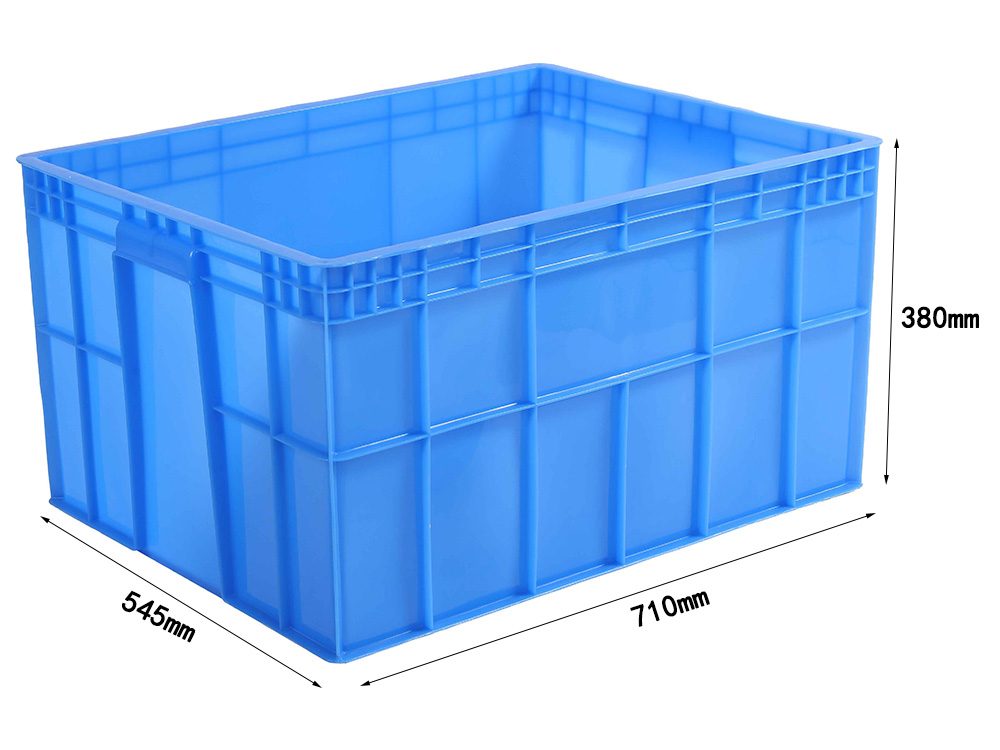
What automotive parts demand from a container
Four requirements separate automotive containers from general warehouse crates.
| Requirement | What it means in practice |
|---|---|
| Position control | Each part sits in a fixed location so feeders, robots and operators pick repeatably |
| Surface protection | No contact between finished surfaces; no fibre, dust or marking transfer |
| Dimensional repeatability | Container dimensions within tight tolerance shipment after shipment, despite wear |
| Loop survivability | Withstands dozens to hundreds of trips, cleaning cycles and stacking loads |
Cardboard fails on all four. That is why tier one and tier two suppliers move to plastic containers as soon as volumes justify tooling, and why OEMs often mandate container specifications in their logistics standards.
Container types in an automotive loop
| Type | Typical use | Notes |
|---|---|---|
| Stack and nest turnover box | General parts movement, storage, transport | Stacks loaded, nests empty; the workhorse |
| Fixed compartment box | Multiple identical parts, kitting | Moulded dividers prevent contact |
| Pallet box / bulk container | Large or heavy components, bulk flow | Fits pallet handling and racking |
| Small parts bin | Fasteners, clips, small mouldings | Often stacks on shelving and picking carts |
| Foldable container | Long distance or export loops | High return volume saving, more moving parts |
Footprint standards matter more in automotive than in most industries, because containers interface with racking, AGVs, conveyors and line-side presentation equipment. Fixing on the Euro footprint family — 600 x 400, 400 x 300, 300 x 200 mm — keeps every downstream rack and conveyor compatible.
Dunnage: the application-specific half of the design
Two identical boxes can perform completely differently depending on what is inside them. Dunnage does three jobs:
- Separation — no part touches another, so finished surfaces and coatings stay intact.
- Positioning — every part sits in the same place, which is what makes automated picking viable.
- Protection against shock — material choice and thickness absorb the impact of a box dropped at the loading dock.
Common dunnage approaches: moulded plastic layer pads, foam inserts, fabric pockets, and vacuum-formed trays. Moulded plastic dunnage is the most durable and the easiest to clean; foam is the quietest for painted surfaces but degrades faster. Whatever the choice, the dunnage must survive the same cleaning cycle as the box or the loop will fail for the reason nobody budgets for.
Traceability and container identification
Automotive customers increasingly require container-level identification for inventory accuracy and returnable asset control. Options, generally used in combination:
- Moulded-in markings — part number, container size code and supplier mark, permanent and free of added process steps.
- Barcode or QR labels — in a recessed area protected from abrasion, or on a label holder that survives cleaning.
- RFID tags — embedded during molding where automated asset tracking is required, the same principle described in our guide to pallet RFID and barcode tracking.
- Colour coding — by customer, plant or part family, so a mixed container pool cannot silently drift out of balance.
Labels applied to flat plastic surfaces peel within a few months in a wash loop. Labels belong in a recessed pocket or on a replaceable holder, and this is a design decision to make before the mould is cut.
Returnable loop economics
| Line item | How to estimate |
|---|---|
| Container cost | Unit price plus dunnage, amortised over trips |
| Trips per year | Shipment frequency per part number |
| Return freight | Empty return volume after nesting or folding |
| Cleaning | Wash cycles and labour per trip |
| Repair and attrition | Typically 2 to 5% per year depending on handling |
| Pool administration | Tracking, imbalance resolution, safety stock of empties |
Worked in cost per trip, a well-designed returnable container on a short, high-frequency lane usually beats single-use packaging within 10 to 25 trips — often under a year. The variables that decide it are return freight and loop imbalance, which is why nesting ratio and a controlled pool design matter as much as the container’s unit price.
Cleaning, maintenance and standardisation
Containers in a paint shop, engine plant or EV battery line often need wash cycles to remove dust and residue. Design implications:
- Smooth interior surfaces with drainage and no water-trapping ribs.
- Grades rated for the actual wash temperature, commonly 60 to 80 °C.
- No cardboard, foam or fibre components in the wash path unless they are replaceable.
- Replaceable dunnage layers, because one failed layer should not scrap a whole container.
- Inspection criteria written down: cracks at corners, worn stacking features, permanent staining.
Standardising on a small number of container sizes is what makes a loop manageable. Every additional size adds safety stock of empties, its own dunnage tooling and its own racking interface.
Custom containers from one factory
LSY Plastic has molded turnover boxes, bulk containers, industrial bins and dunnage since 1991 at our Foshan factory, using Japanese imported injection machines from 180T to 2500T with an in-house mould workshop. Automotive and electronics customers typically start from a part drawing and a container standard: send both and we return a container and dunnage design with nesting ratio, loading capacity and tooling lead time.
We also supply ESD and anti-static container solutions for electronics and battery applications, described in our ESD boxes and trays guide. Our OEM customers include BYD, OPPO, vivo and Delice.
Start with the part and the loop
Send a part drawing or sample, your container standard if you have one, shipment frequency and return route. We will propose container size, dunnage design, material grade, identification method and a cost per trip comparison against your current packaging.
WhatsApp: +86 19311059570
Email: fstyx01@lsyplastic.com
Related reading: attached lid container buying guide, nestable vs stackable plastic containers, and plastic totes vs cardboard boxes.