
Linen handling consumes more housekeeping labour than cleaning itself. Every room service visit involves stripping beds, collecting towels, carrying linen to the cart, and later sorting it before it goes to the laundry. A well-designed cart bag system removes several handovers from that chain; a poorly designed one adds them back with interest. This guide covers the bag types, the capacity maths, sorting at source and the cart compatibility details that decide whether the system works in practice. For the cart itself, see our housekeeping cart procurement checklist and the hotel cart FAQ hub.
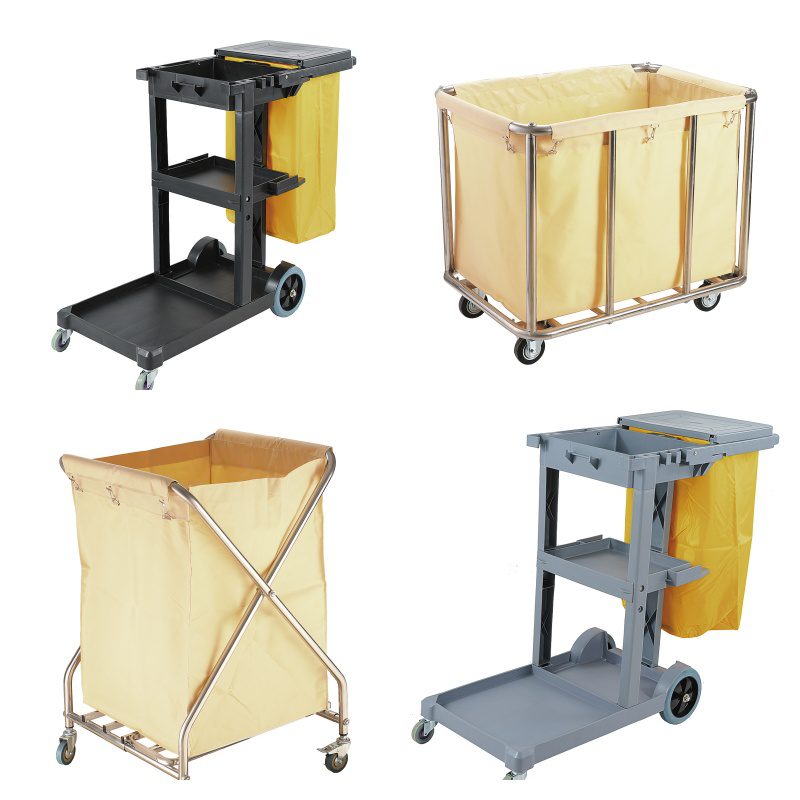
Where the labour actually goes
A room attendant’s linen work breaks into five steps: strip, carry, load, unload and sort. Bag systems can only influence three of them, but those three are the ones that accumulate across 15 to 20 rooms per shift.
- Carry — distance from the bed to the cart. A cart parked in the doorway with a wide bag opening shortens this.
- Load — how easy it is to put linen in without lifting above shoulder height or pushing past a full bag.
- Sort — whether sorting happened at the room or has to happen later in the laundry.
Sorting at source is the single biggest saving. If the attendant drops bed linen and towels into separate bags, the laundry receives pre-sorted loads, which removes a whole manual station at the back of house.
Bag system types
| System | How it works | Best for | Trade-off |
|---|---|---|---|
| Single large bag | One bag on a frame at the cart end | Small properties, low volume | All linen mixed; laundry sorting cost moves downstream |
| Multi-bag sorting system | Two to four bags side by side on a rail | Full service hotels, resorts | Uses cart width; bags must be sized to the cart |
| Rigid liner bins | Moulded plastic bins hung or nested on the cart | High volume, wet or damp linen | Heavier; can unbalance a light cart |
| Bag plus rigid base | Fabric bag over a moulded plastic liner | Properties mixing both needs | More components to maintain |
| Trolley with integrated bags | Dedicated linen trolley separate from the cleaning cart | Large properties with separate linen runs | Two vehicles to manage |
Multi-bag systems dominate full service hotels for one reason: they move the sorting decision into the guest room, where it costs a second, rather than into the laundry, where it costs a labour station.
Capacity maths
Two numbers drive bag sizing.
- Soiled linen per room. A typical full service room produces 4 to 6 kg per service day. Suites, family rooms and turnover days push higher.
- Rooms per round. Set by shift length and travel distance, commonly 14 to 18 rooms per attendant in a full service property.
A cart with 120 to 150 kg of soiled linen capacity therefore covers 25 to 35 rooms of soiled linen, which is comfortably above a standard round. The binding constraint is usually fresh linen capacity, not soiled: attendants who run out of clean sheets mid-round lose more time than attendants whose soiled bag fills up.
Weight, not volume, is the limit
Damp terry is roughly twice as dense as dry bed linen. A bag that looks half empty may already be at 40 kg. Specify bags by rated load rather than by litre capacity, and check the frame and hooks, not just the fabric — a 60 kg load on a single hook will deform a light cart’s end panel over time.
Sorting at source: designing the scheme
| Stream | Typical bag | Why separate |
|---|---|---|
| Soiled bed linen | Bag 1, colour A | Highest volume; washed at higher temperature |
| Soiled terry (towels, bath mats) | Bag 2, colour B | Denser, slower drying; different wash chemistry |
| Guest laundry / dry cleaning | Bag 3, colour C, lidded | Must not mix with hotel stock; needs itemised tracking |
| Isolation or infected linen | Bag 4, colour D, soluble or lidded | Infection control and separate wash protocol |
Colour coding has to be consistent across the property, the same discipline described in our guide to commercial recycling bin colour coding. A colour scheme that differs between floors is worse than no scheme at all.
Cart compatibility: the details that decide success
- Rail or hook positions. Confirm hook diameter against the cart frame tube. A loose hook slides along the rail and the bag ends up sitting under the cart.
- Bag opening height. The opening should sit at roughly hip height. Bags hung too high force attendants to lift wet linen overhead; too low and linen drags on the floor.
- Balance. All bags on one end tips the cart when loaded. Distribute weight across the cart and confirm caster load ratings — see the trolley caster guide.
- Doorway clearance. A cart with bags fitted is often 150 to 200 mm wider than the bare cart. Measure the narrowest door on the route before specifying.
- Lid or cover. Guest laundry and isolation linen need covered bags for hygiene and appearance.
Hygiene, materials and laundry reality
Bag material is judged by how it survives the laundry rather than how it looks new:
- Welded seams on the wet side, not stitched, so moisture does not wick through and leak.
- Machine washable outer fabric rated to at least 60 °C, because bags enter the wash cycle along with their contents in many operations.
- Waterproof backing on any bag that carries damp terry, and a wipe-clean inner surface.
- Soluble bag options for infected linen, where the bag itself goes into the wash and dissolves.
- Reinforced corners — corners fail first on every bag design.
If linen goes to an external laundry, ask what container format that laundry prefers. Some commercial laundries reject loose bagged linen and require slings or rigid containers, which changes the whole system at the cart as well as the loading dock.
Procurement checklist
- Decide bag count and colour scheme, then apply it to every cart in the fleet.
- Measure rooms per round and soiled linen weight per room to size each bag.
- Confirm hook or rail compatibility with the existing cart frame.
- Check the doorway width with bags fitted, not the bare cart.
- Specify welded seams, rated load and wash temperature.
- Add 15% spare bags to cover the laundry rotation.
- Pilot on one floor for a month and inspect corner wear, hook deformation and cart balance.
Cart, bags and bins from one factory
LSY Plastic has molded hotel housekeeping carts, cleaning trolleys, waste bins and plastic storage products since 1991 from our Foshan factory, running Japanese imported injection machines from 180T to 2500T with an in-house mould workshop. Because carts, bins and moulded accessories come from the same source, brackets, rails and hook geometry can be matched to the cart rather than improvised.
We supply housekeeping equipment to hotel groups and distributors worldwide, alongside OEM customers including BYD, OPPO, vivo and Delice, and hold a 20,000 m² warehouse for repeat orders.
Get a linen system proposal
Tell us your room count, rooms per round, linen streams and the cart model you use. We will propose bag count, capacities, mounting method, colours and a matching cart configuration.
WhatsApp: +86 19311059570
Email: fstyx01@lsyplastic.com
Related reading: hotel linen trolley buying guide, housekeeping cart accessories, and hotel cart layout planning.