
A picking operation is a bin system with people attached. When pickers walk past the right part, grab it without digging, and put it back in one motion, the bins are doing their job. When bins overflow, labels fall off and small parts migrate across dividers, every one of those seconds is charged to your labour line. This guide covers bin sizing, the shelf-versus-trolley decision, colour and label systems, and ESD options for electronics stores.
Bin sizing: the two-week rule
The most common mistake is binning to total stock instead of pick face demand:
- Calculate two weeks of picks per SKU (or your replenishment cycle if longer).
- Add 20% headroom so replenishment can arrive before the bin empties.
- Overflow stock goes to bulk racking — one bin location per SKU at the face, the rest above or behind.
This one rule typically cuts pick-face footprint by 30 to 50% versus “everything in its bin”, because slow movers stop occupying A-locations with near-empty bins.
Matching bin geometry to the part
| Part type | Bin style | Why |
|---|---|---|
| Small fasteners, screws | Divided shallow bins | Stops spread; dividers keep counts visible |
| Medium boxed components | Standard slant-front bins | One-motion pick with full visibility |
| Long parts, tubes, bars | Full-length bins or vertical tube bins | No diagonal stuffing; length protection |
| Heavy items > 10 kg | Reinforced full-side bins | Slant fronts weaken under weight; rated load matters |
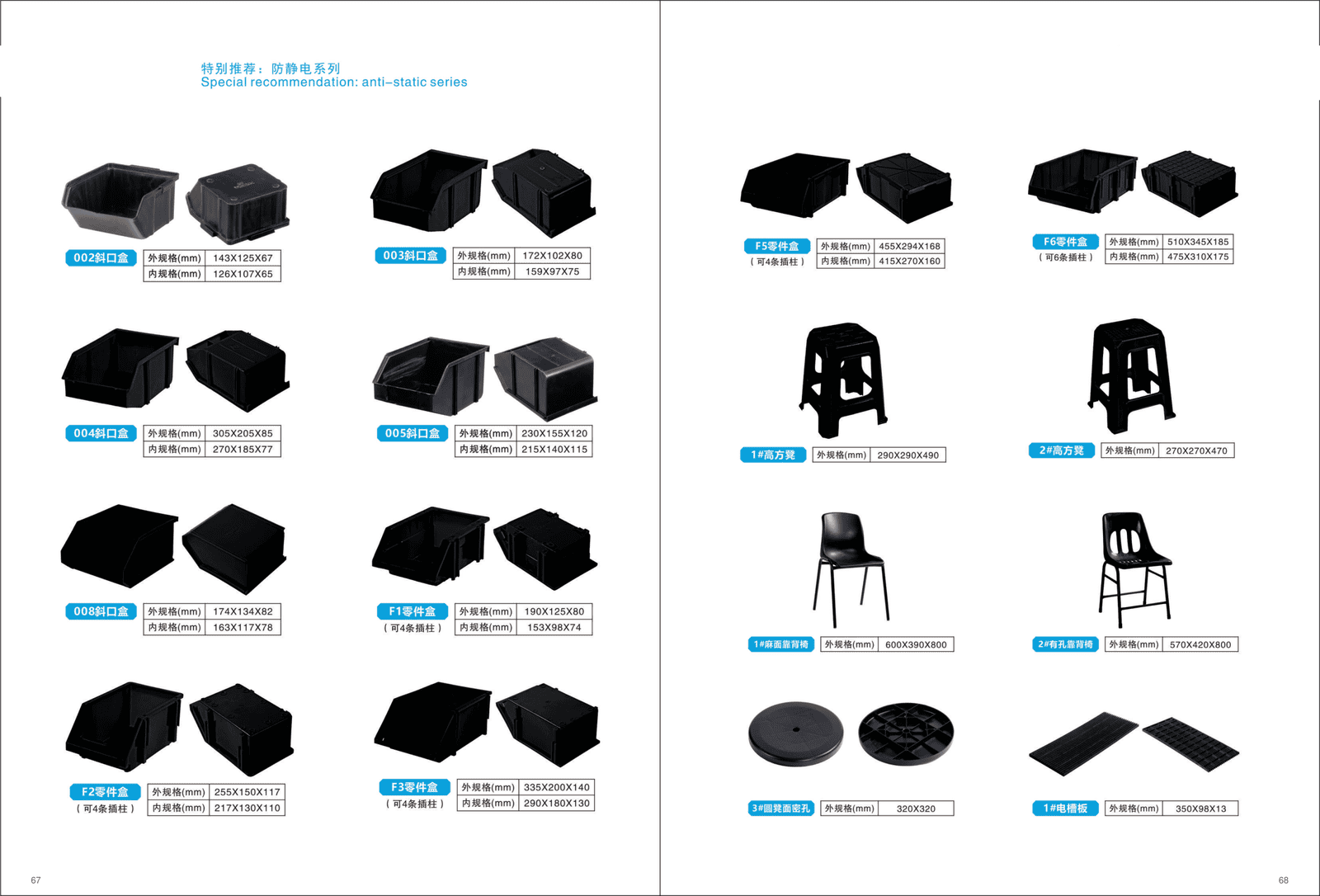
| Electronic components | ESD bins (conductive or dissipative) | Protects components from static discharge — see below |
Shelf, trolley or flow rack?
Static shelving
The default for stores rooms and moderate SKU counts. Match bin footprint to shelf pitch exactly — a bin 20 mm too wide for the pitch wastes a whole shelf column. Standardise on one bin family with modular widths so shelf layouts can be re-cut as the SKU mix changes.
Mobile trolley bins
For kitting, line-side supply and maintenance: the bin travels to the work. Requirements shift toward bin retention (bins must lock or nest on the trolley deck, not slide), and load rating per bin level. Our platform trolley load and deck guide covers the chassis side.
Flow and carton-live racks
For high-velocity SKUs: bins or cartons feed by gravity to the pick face. Plastic bins on flow racks need consistent footprint and rigid bases — thin-walled bins sag on roller beds and jam. Specify rigid-base bins for any flow application.
Colour coding and labels
Colour is the fastest signal in a picker’s field of view — but only if the scheme is universal:
- Red — quarantine / rejects / do-not-pick
- Blue — standard stock
- Green — free issue, consumables
- Yellow — hold, awaiting inspection, low-turn
- Black — ESD-controlled items
Labels beat colour for identity: a large location code on the bin front, a barcoded SKU label on the side, both at a fixed height. Fixed label position is what makes scanning a reflex rather than a search.
ESD bins for electronics stores
Electronics warehouses add a static dimension. The choice of conductive vs static dissipative depends on what is inside the bin:
- Conductive bins (surface resistance below 10⁶ Ω) for bare components on grounded shelving — fast bleed, but keep them grounded.
- Static dissipative bins (10⁶ to 10⁹ Ω) for populated boards and anything handled near powered equipment — safe bleed speed.
- Standard bins — never inside an EPA. One ordinary blue bin on an ESD shelf defeats the grounding chain of everything around it.
The full resistance-band logic is in our ESD material classification guide.
Durability points that decide bin lifespan
- Front lip reinforcement — the slant front takes every grab; a flimsy lip cracks and then cuts hands.
- Stacking rim geometry — bins that stack on themselves half-height for returns save floor space; rims must not spread under weight.
- Label area flatness — a dedicated flat label field keeps labels on for years; stick-anywhere bins lose them.
- Reinforced base for flow racks — as above, rigid bases only.
- Washability — if bins cycle through cleaning, smooth interiors without dead corners trap less debris.
Rollout checklist
- Segment SKUs by velocity; apply the two-week rule to bin sizing.
- Standardise one bin footprint family; verify shelf/trolley pitch in millimetres.
- Assign colour scheme warehouse-wide; document on one page.
- Fix label positions and sizes; reprint the whole zone at once, not piecemeal.
- Specify ESD bins for every EPA location; remove all standard bins from ESD shelving.
- Pilot one aisle: measure picks per hour before and after before rolling out.
- Buy 10% spares — bins are consumables with a five-year life, not furniture.
Parts bins from the factory that moulds them
LSY Plastic injection-moulds parts bins, bin boxes and ESD variants in Foshan on Japanese-imported machines from 180T to 2500T with an in-house mould workshop — the same plant supplying precision components to BYD, OPPO, vivo and Desay. Divider layouts, label fields, ESD compound classes and footprint families can be matched to your shelf pitch rather than to a catalogue’s convenience.
Get a parts bin system proposal
Tell us your SKU count, shelf or trolley pitch, velocity mix and any ESD zones. We will propose bin sizes, divider layouts, colour allocation and ESD classes with load data.
WhatsApp: +86 19311059570
Email: fstyx01@lsyplastic.com
Related reading: ESD material classification, nestable vs stackable containers, and plastic turnover boxes for automotive parts.