
One plastic pallet, three different capacity numbers. A pallet rated 4000 kg static might carry only 1500 kg on a forklift and 1000 kg in racking. Specifying from the biggest number on the datasheet is the fastest way to buy pallets that fail. This guide explains each rating, how they relate, and how to de-rate them honestly for real duty.
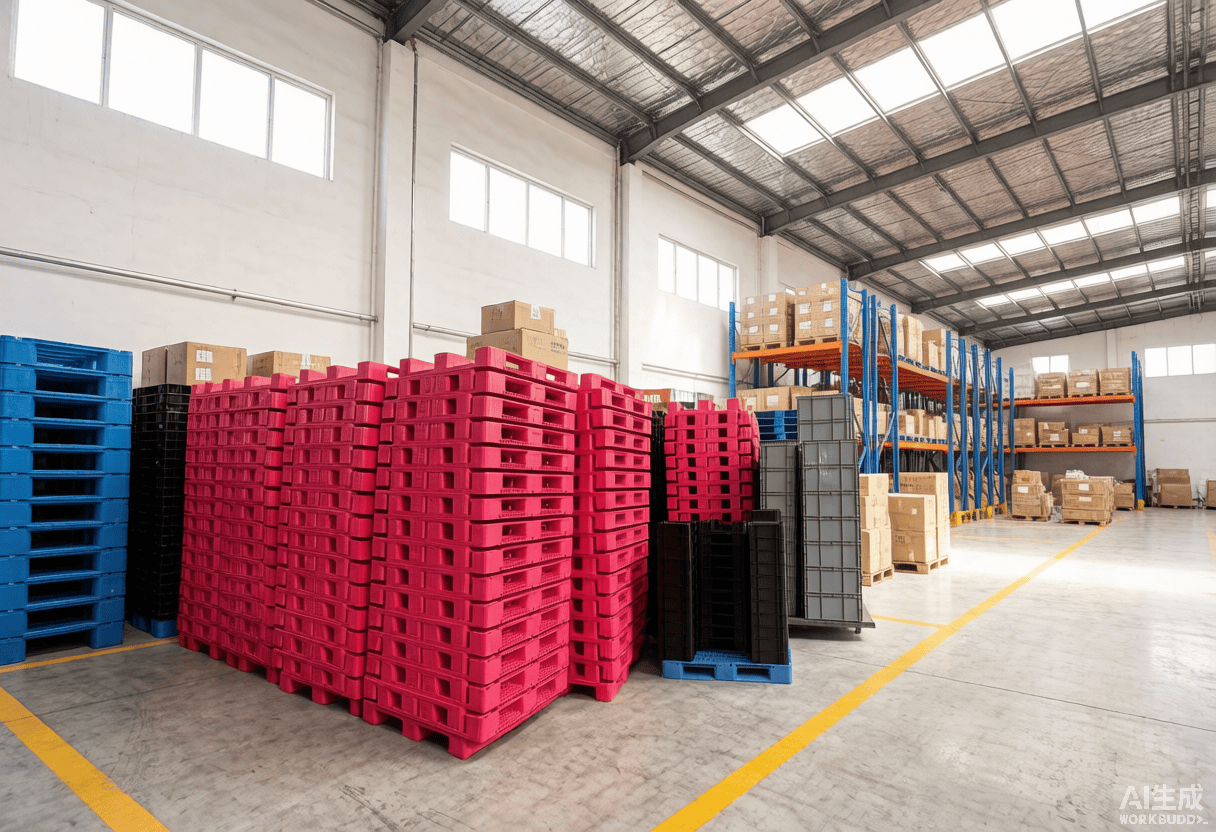
The three ratings defined
| Rating | Condition | Typical vs static |
|---|---|---|
| Static load | Loaded, resting on flat floor, not moving | 100% (reference) |
| Dynamic load | Loaded, lifted and moved by forklift/pallet jack | 40–60% of static |
| Racking load | Loaded, supported on beam edges (2- or 3-edge support) | 25–50% of static |
Why dynamic is lower than static
A stationary load presses straight down through the deck into a flat floor. The moment a forklift picks the pallet up, three new forces appear: shock from fork contact, tilt during acceleration and braking, and edge concentration when the load shifts toward the fork line. All three load the ribs and deck in ways the static test never exercises.
Any load that can shift — bagged goods, liquids in containers, unsecured cartons — should be treated as worse than its scale weight for dynamic purposes. Apply a 50% margin rather than 25%.
Why racking is the critical one
In beam racking the pallet is supported only along two edges (or three, with a support bar). The entire deck acts as a bridge, and the ribs carry bending load instead of pure compression. This is why racking ratings are the lowest of the three, and why a pallet perfectly adequate on the floor can crack in a rack within weeks. Our pallet weight comparison guide covers how structure drives this; the operational rule is simple: if it goes in a rack, buy to the racking rating.
Open-deck vs closed-deck behaviour
Open (ventilated or honeycomb) decks generally show a bigger gap between static and racking ratings than closed decks, because the open structure depends more on continuous floor support. If your operation racks 80% of pallets, the closed-deck premium usually pays back in rack life.
Temperature de-rating nobody prints on the datasheet
| Environment | Effect on HDPE | Suggested de-rate |
|---|---|---|
| Ambient 20 °C | None — ratings apply | 0% |
| Hot yard / 40 °C+ | ~1/3 stiffness loss | 25–30% |
| Cold room −20 °C | Stiffer but more brittle on impact | 15% + impact care |
| Freezer −30 °C with shock | Impact brittleness dominates | Use cold-rated PP/PE grades |
Cold-storage duty is covered in detail in our freezer pallet guide — the short version is that cold impact, not cold compression, is what kills pallets.
A practical specification method
- Identify the worst-case duty (floor stack, forklift move, or racking) for each pallet position.
- Take the true load, including pallet weight and any stacking above.
- Apply margin: 25% for stable uniform loads, 50% for shifting loads.
- Apply temperature de-rate from the table above.
- Specify against the matching rating — dynamic for forklift duty, racking for racks.
A load that computes to 800 kg in racking on a hot-climate site should be specified at roughly 1500 kg racking capacity once both margins land. That gap is not over-engineering; it is the difference between a rating and a service life.