
For factories and warehouses, the right plastic waste bin is sized by worker headcount and waste volume, not by floor space: most industrial sites do well with 120L or 240L wheeled bins at collection points, 50–100L stackable bins at workstations, and color-coded stations for segregation. Material matters as much as size — UV-stabilized HDPE for outdoor yards, flame-retardant resin where hot work or fire codes demand it, and closed lids wherever hygiene or wind is a factor.
This guide covers how to size industrial waste bins, which materials survive factory conditions, how color coding and segregation stations keep you compliant, and a buying checklist you can send straight to suppliers. The failures we see most often are not quality failures — they are sizing and placement failures that make workers bypass the bins entirely.
How Industrial Waste Bins Differ from Office and Municipal Bins
A bin that works in an office fails in a plant for three reasons. First, industrial waste is heavier and sharper: metal offcuts, dense packaging, wet scrap. A 240L bin filled with machining swarf can weigh 150 kg or more, so the bin needs a heavy-duty rim, reinforced comb bar for lifter trucks, and wheels rated for the loaded weight. Second, factory floors have forklifts, pallet trucks and overhead cranes — bins need to survive being clipped, not just looked at. Third, many plants must segregate waste streams for recycling or hazardous-waste regulations, which changes the whole layout from “one big bin in the corner” to “a network of labeled points”. If your site is closer to an office campus than a plant floor, our office waste sorting station guide covers that lighter-duty scenario instead.
Choosing the Right Bin Size for Each Zone
Size each zone by who works there and how far they will walk to a bin:
| Zone | Recommended bin | Why |
|---|---|---|
| Individual workstations / assembly cells | 20–60L open-top or swing-lid bin | Within arm’s reach; emptied daily to a central point |
| Production line ends & packing stations | 110–240L wheeled bins | High cardboard/film volume; wheeled for direct move to compactor |
| Outdoor yards, loading docks | 240L–1100L wheeled containers | Handles lifter trucks; UV-stabilized; lidded against wind and pests |
| Canteens & staff areas | 50–120L pedal or swing-lid bins | Hygiene; hands-free operation; easy-clean surfaces |
| Hazardous / oily waste points | Closed 60–240L bins with colored lids | Segregation compliance; controlled access |
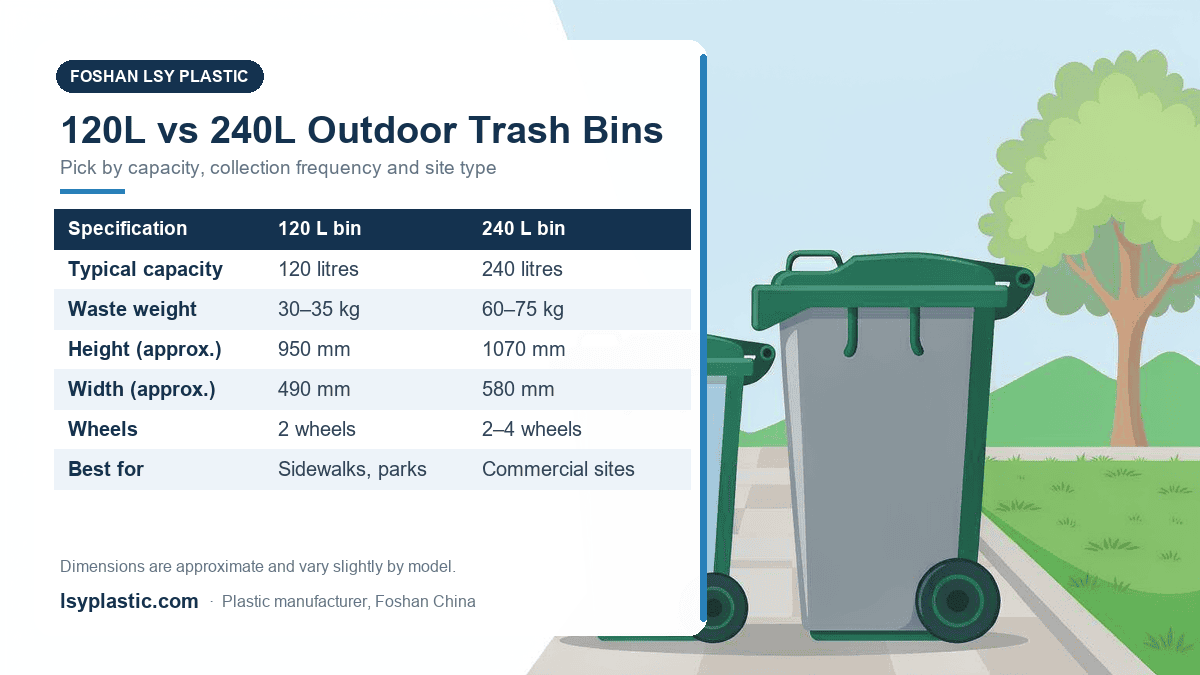
A practical rule for general refuse: one 240L wheeled bin per 25–40 employees per day of production, adjusted upward for packaging-heavy operations. Our detailed 120L vs 240L wheelie bin comparison breaks down dimensions and site planning for the two most common outdoor sizes.
Material and Build Quality: What Survives a Factory
HDPE body with UV stabilization
Outdoor and yard bins must use UV-stabilized HDPE; unstabilized plastic chalks, fades and becomes brittle within one or two summers of sun exposure. Check that the supplier states UV resistance explicitly — it is a masterbatch additive, not a given.
Wheels and axles
Loaded 240L bins weigh well over 100 kg. Rubber or TPE wheels protect floors and run quieter; the axle, not the wheel, is usually the first part to fail, so look for steel axles with metal bushings rather than plastic pivots. Replaceable wheel assemblies are worth requesting — our outdoor wheeled bin maintenance guide lists which spare parts keep a fleet alive for 8–10 years.
Flame-retardant resin where codes require it
Near hot-work zones, paint shops, or where insurers and local fire codes demand it, specify flame-retardant bins that meet standards such as UL 94 ratings. Standard HDPE will melt and drip; FR grades self-extinguish. Our fire-retardant trash bin guide explains the ratings and where they are mandatory.
Color Coding and Segregation Stations That Workers Actually Use
Segregation fails when the system relies on memory. Make the correct choice the easy choice:
- Fix one color code and print it everywhere — on the lid, the body and the floor marking. Common schemes: green for recyclables/paper, blue for plastics, yellow for hazardous, grey/black for general waste, red for contaminated or oily waste. Local recycling rules take precedence; our recycling bin color code guide summarizes the main regional schemes.
- Co-locate all streams at each point. A single lonely general-waste bin guarantees that recyclables go into it. Clusters of 3–4 labeled bins at each collection point outperform scattered singles.
- Use aperture-shaped lids (round hole for bottles, slot for paper) where contamination is costly.
- Label in the languages your workforce actually reads, with pictograms for shift workers and new hires.
Compliance and Safety Considerations
Depending on your jurisdiction, industrial waste handling may touch occupational-safety rules (blocked walkways, manual-handling limits), fire codes (combustible waste accumulation near exits), and environmental permits (segregation of hazardous streams). Three habits keep you clean during inspections: keep bin placement out of marked egress routes and aisle clearances; empty general waste at defined frequencies instead of “when full”; and document which waste stream each colored bin carries. For medical or clinical waste on site — some plants have nurses’ rooms or first-aid stations that generate actual medical waste — the rules are stricter; see our medical waste bin compliance guide before improvising.
Maintenance and Fleet Management: Keeping 200 Bins Alive
A plant running 100–300 industrial bins should treat them as a managed fleet, not consumables. Assign each wheeled bin a serial number and record its zone; broken wheels and lids get swapped from a spares shelf within a day, because a bin with a dragging wheel stops being moved and starts overflowing. Wash bins on a schedule — a pressure washer and mild detergent are enough for HDPE — and inspect UV-exposed bins annually for chalking or brittleness at the rim. Budget expectation: with basic care, a quality 240L HDPE bin body lasts 8–10 years outdoors and longer indoors, while wheels, lids and axles are typically replaced once or twice in that period. Buying from a manufacturer that stocks those spares — rather than a trading company that disappears after the shipment — is what turns a one-time purchase into a decade of service. It also means color or size additions later match the original tooling instead of looking like a mismatched patchwork fleet.
A Buyer’s Checklist for Industrial Plastic Waste Bins
- Material: UV-stabilized HDPE; flame-retardant grade where required; wall thickness at the rim and base.
- Compliance: EN 840 or equivalent dimensions if your waste contractor uses lifter trucks — non-standard combs get rejected.
- Load: stated gross load capacity, wheel rating and axle type.
- Hygiene: smooth inner surfaces, drainable, lids that seal against pests.
- Identification: molded-in or printed color, serial numbers for fleet management, space for your logo.
- Spares: availability of lids, wheels and axles — the bin body outlives its hardware by years.
As the direct manufacturer, LSY Plastic molds bins in-house with our own tooling, so sizes, colors and logo embossing can be specified at the mold level rather than painted on afterwards. Send your site layout and waste volumes for a sizing recommendation — WhatsApp +86 19311059570 or email fstyx01@lsyplastic.com.
Ready to compare options? Browse our Sanitation Solutions range for plastic waste bins.
Frequently Asked Questions
What size waste bin is best for a factory floor?
Use 20–60L bins at individual workstations, 110–240L wheeled bins at line ends and packing stations, and 240L–1100L containers in outdoor yards. As a planning figure, one 240L bin serves roughly 25–40 employees per day for general waste, with more capacity needed for packaging-heavy operations.
Are plastic waste bins suitable for hot work areas?
Standard HDPE softens near continuous 90–110°C and will melt from sparks or slag. In welding, cutting or casting zones, either place bins behind fire-rated barriers or specify flame-retardant bins meeting UL 94-type ratings, which self-extinguish instead of dripping molten plastic.
How many bins does a warehouse need?
Count streams, then apply headcount: cluster 3–4 labeled bins at each collection point so workers never face a single-stream choice. For a 100-person packaging warehouse, a workable baseline is 8–12 workstation bins, 3–5 wheeled 240L bins at line ends, and 2–4 large outdoor containers for the compactor run.
Can industrial waste bins be branded or color-matched?
Yes. As a mold-level option, pigment can be matched to your corporate colors and your logo embossed or printed on the body. Molded-in color never peels like paint, and serial numbering supports fleet management across multiple sites.
Related reading: outdoor plastic trash bins guide — 120L/240L wheelie bins, EN840 and municipal specs.



