
For most hotel service carts, a 20ft container holds roughly 60–90 assembled carts, while a 40ft HQ holds 150–230 carts depending on cart footprint, handle height and whether carts nest or ship knocked down. The exact number is decided by three variables: the cart’s assembled dimensions, whether the model nests or stacks, and whether you and your supplier agree to CKD (completely knocked down) packing, which can raise counts by 50–100%.
If you buy hotel trolleys overseas, your freight cost per cart can swing by 30% or more purely on loading plan decisions made before the container is stuffed. This guide shows the loading math for typical LSY cart models, explains when knocked-down packing pays off, and gives you a pre-order checklist so your first shipment is not a lesson.
Why FCL Planning Matters for Hotel Cart Buyers
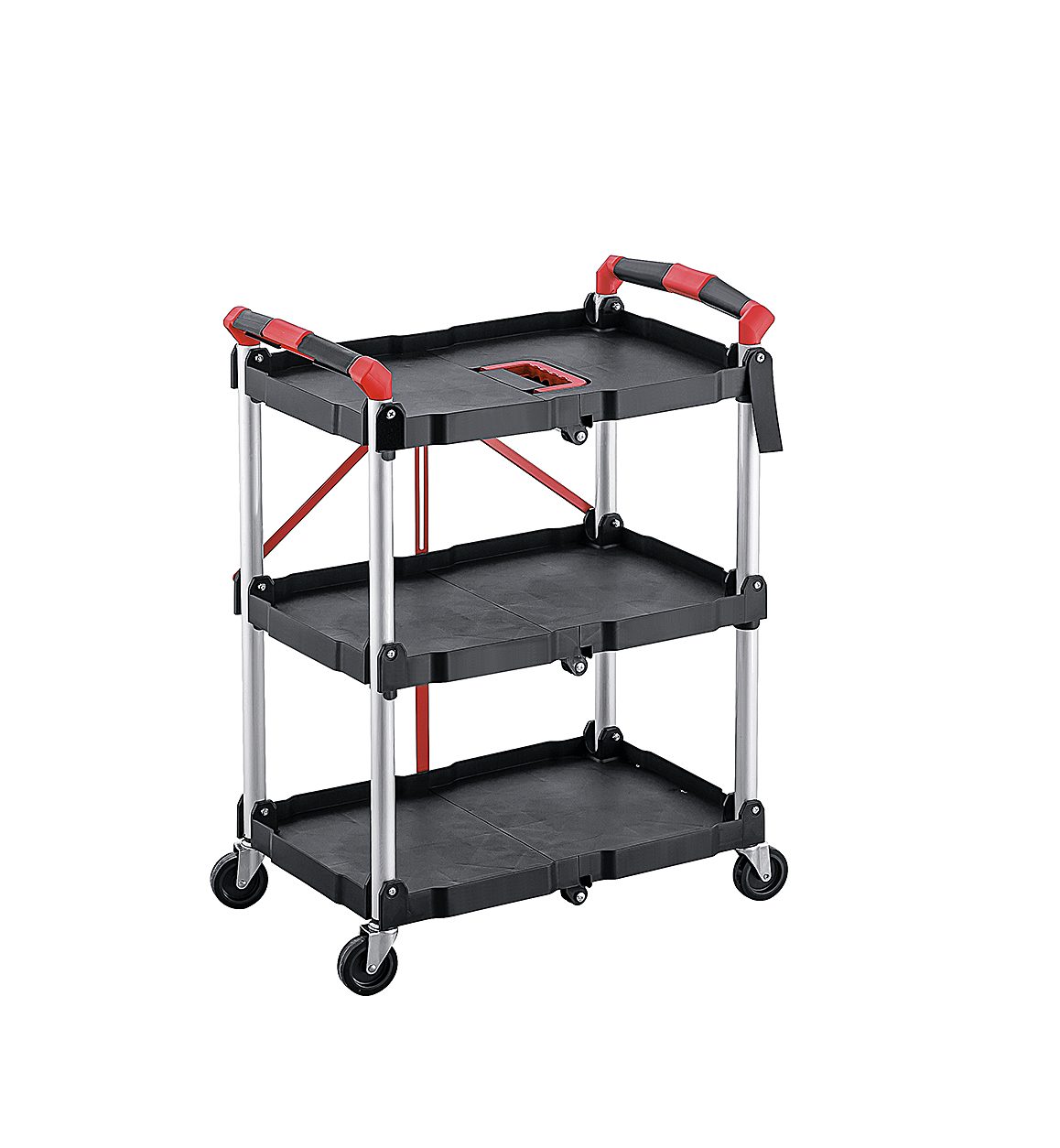
Hotel service carts — housekeeping carts, room service trolleys, collection carts — are bulky, low-density cargo. A cart that weighs 30–45 kg can occupy 0.4–0.8 CBM assembled, which means sea freight and inland haulage dominate the landed cost. Two buyers ordering the identical cart can pay very different freight per unit simply because one ordered a nesting model or approved KD packing. Since most factories (including LSY Plastic) quote overseas orders on a full-container-load basis, your container plan is part of the product decision, not an afterthought. The same logic applies to pallets and crates — our pallet container loading guide shows how much a well-chosen footprint matters there.
Know Your Container Interior Dimensions
| Container | Internal L×W×H (m) | Usable volume | Typical payload |
|---|---|---|---|
| 20ft GP | 5.90 × 2.35 × 2.39 | ~28–30 CBM usable | ~25–28 tons |
| 40ft GP | 12.03 × 2.35 × 2.39 | ~60–64 CBM usable | ~26–28 tons |
| 40ft HQ | 12.03 × 2.35 × 2.69 | ~68–72 CBM usable | ~26–28 tons |
Cart loading is width-constrained first: a container’s 2.35 m internal width fits, at best, two carts side by side per layer if each cart is about 1.0–1.1 m wide — and most hotel carts are. That means every “layer” of carts uses roughly 0.9–1.1 m of container length for a double row.
Worked Example: Loading a Typical Hotel Service Cart
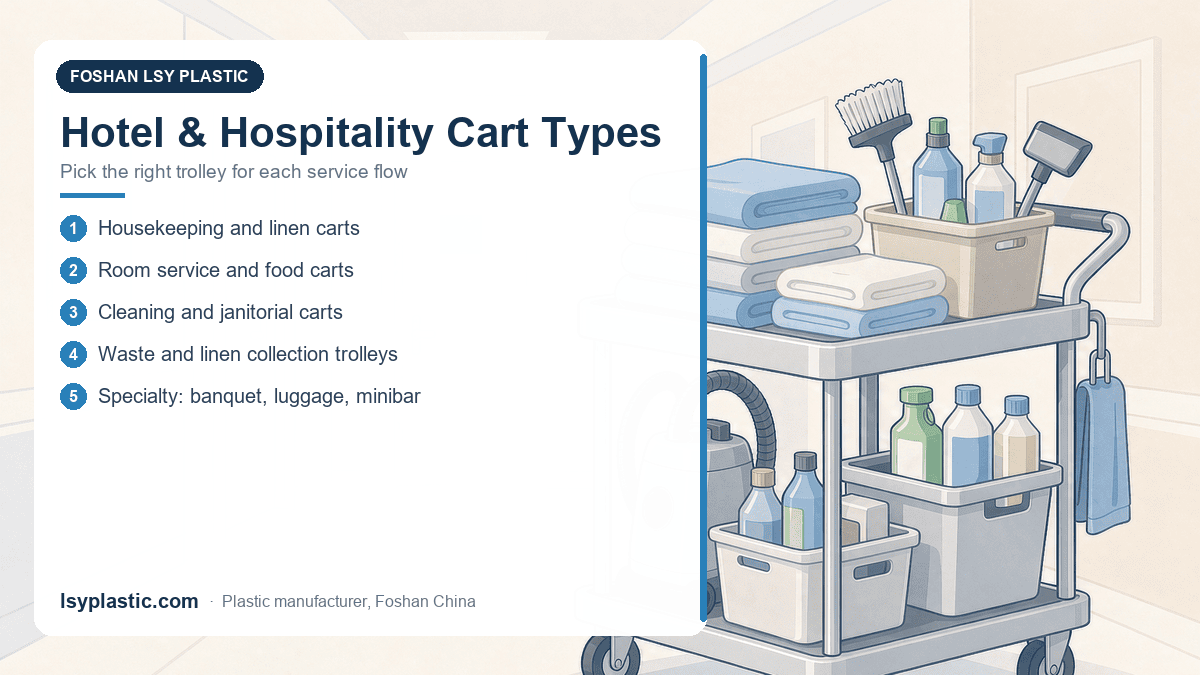
Take a standard plastic service cart around 1,000 mm long × 550 mm wide × 950 mm high with a push handle:
- Assembled, upright: the handle and caster height mean carts cannot be stacked on top of each other without racks or pallets. You fit two across the width; along 5.90 m of a 20ft you fit about 5–6 double rows × 1 layer high (carts are tall) → roughly 55–65 carts in a 20ft GP, all first-fit space.
- Assembled, nested (nesting models): some plastic-body carts are designed to telescope into each other when handle orientation allows. Nesting saves 25–35% of the space, pushing a 40ft HQ to 180–230 carts.
- Knocked down (CKD): decks, shelves, handles, bag frames and casters packed as flat kits. A cart that occupied 0.55 CBM assembled occupies about 0.18–0.25 CBM as a kit. A 40ft HQ then holds 250–320 cart kits — the highest density of all.
These figures are planning estimates. Exact counts depend on the model — our three-tier 922 series and folding models pack differently from rigid 8001/8002 carts — so always ask your supplier for a loading plan drawing before confirming the order.
When Does Knocked-Down Packing Pay Off?
CKD raises container utilization dramatically, but it is not free. Weigh the trade-offs:
| Factor | Assembled / SKD | CKD (knocked down) |
|---|---|---|
| Carts per 40ft HQ | 150–230 | 250–320+ |
| Destination labor | None — roll off and use | 15–30 min assembly per cart with basic tools |
| Shipping cost per cart | Highest | 30–50% lower |
| Damage risk | Handles and corners exposed | Lower — parts packed in cartons |
| Best for | Hotels without maintenance staff; urgent openings | Distributors, chains with facilities teams, high labor availability |
A useful middle ground is SKD (semi-knocked down): decks assembled, only handles and casters off. It recovers most of the space saving with 5 minutes of assembly per cart.
Mixing Carts with Other Products in One Container
Most of our hospitality buyers do not ship carts alone — they combine a FCL with waste bins, food storage basins, mop trolleys and cup racks for a full hotel supply package. Plastic products mix well because they are crush-resistant compared with cartons. Two planning rules:
- Heavy and rigid low, light and nestable high. Carts and mop trolleys on the container floor; basins, bins and crates nested above and in cart voids.
- Consolidate footprints. Products sharing a 1200×1000 mm or 1100×1100 mm module load like building blocks. Ask your supplier to plan the mix — a good loading plan routinely recovers 5–10 CBM versus naive stuffing.
What the Loading Decision Is Worth in Dollars
Make the trade-off concrete with a rough example for one 40ft HQ from China to the Gulf: ocean freight plus local charges might total around USD 3,500–4,500 depending on season. At 200 assembled carts, that is USD 18–23 of freight per cart. At 300 CKD kits, it drops to USD 12–15 — a saving of USD 1,200–2,400 per container before you negotiate anything. Against that, destination assembly at 20 minutes per cart and, say, USD 5 per hour of labor costs about USD 1,000 for 100 extra carts — usually a clear win for distributors, and a wash for a single hotel. The point is not the exact numbers, which move with freight markets, but that you should run this arithmetic for your own lane before choosing a packing method. Ask the factory for both versions of the loading plan and make the decision on your labor costs, not on habit.
Pre-Order Checklist for Hotel Cart Importers
- Get the assembled and packed dimensions of each model in writing — not just weight.
- Ask whether the model nests, stacks, or needs KD, and request a container loading plan (photos or a drawing of a previous stuffed container are good proof).
- Confirm assembly time and tools for CKD, and who does it at destination.
- Agree carton quality and palletization — loose carts in a shared container get damaged; we recommend cartons on the floor layer minimum.
- Check handle direction and caster removal rules for your racking at destination — a cart that does not fit your service elevator is a re-order, not a saving.
- Plan the full product mix with the factory so the container leaves with maximum value per CBM.
For model selection before you get to loading, our Hotel Cart FAQ Hub compares cart types, and the room service cart vs banquet trolley guide helps match models to your F&B operation. Wheel selection is covered separately in the trolley casters buying guide.
hotel service carts buyers: our Restaurant & Room Service Carts range covers the specifications outlined in this guide.
Frequently Asked Questions
How many service carts fit in a 20ft container?
For typical 1,000 × 550 mm hotel service carts shipped assembled, plan on 55–65 carts in a 20ft GP. Nesting models reach 70–90, and fully knocked-down kits can exceed 120. The width constraint — two carts per layer in a 2.35 m container — is what limits counts most.
Is it cheaper to ship hotel carts knocked down?
Usually yes: CKD packing cuts shipping cost per cart by 30–50% because packed volume drops by more than half. The offset is 15–30 minutes of assembly labor per cart at destination. Distributors and hotel chains with maintenance teams nearly always choose CKD; properties without staff pay more for assembled carts.
Can I mix hotel carts with other products in one container?
Yes, and it is the most cost-effective way to buy. Carts are rigid cargo that loads on the container floor; nested bins, basins and crates fill the remaining volume and the cart voids. Ask the factory for a mixed loading plan — good planning typically recovers 5–10 CBM versus separate orders.
How long does production take before container loading?
Standard models in stock colors ship in about 10–20 days after deposit for a full container; custom colors or logo embossing add mold preparation time. Confirm the production schedule against your hotel opening or project date before signing, and ask for booking flexibility if your vessel schedule slips.
Related reading: hotel & hospitality carts hub — service carts, housekeeping trolleys and how to pick the right model.



