
India is now one of the world’s fastest-growing electronics manufacturing hubs — from Bengaluru and Hyderabad to Chennai, Noida and Pune. Whether you run an SMT line, assemble mobile devices, or handle lithium cells, ESD packaging is not an optional extra; it is insurance against invisible damage. This guide explains what to look for when you buy ESD boxes, trays and pallets from a factory in China, with real specifications and clear export terms.
Why ESD packaging matters for Indian factories
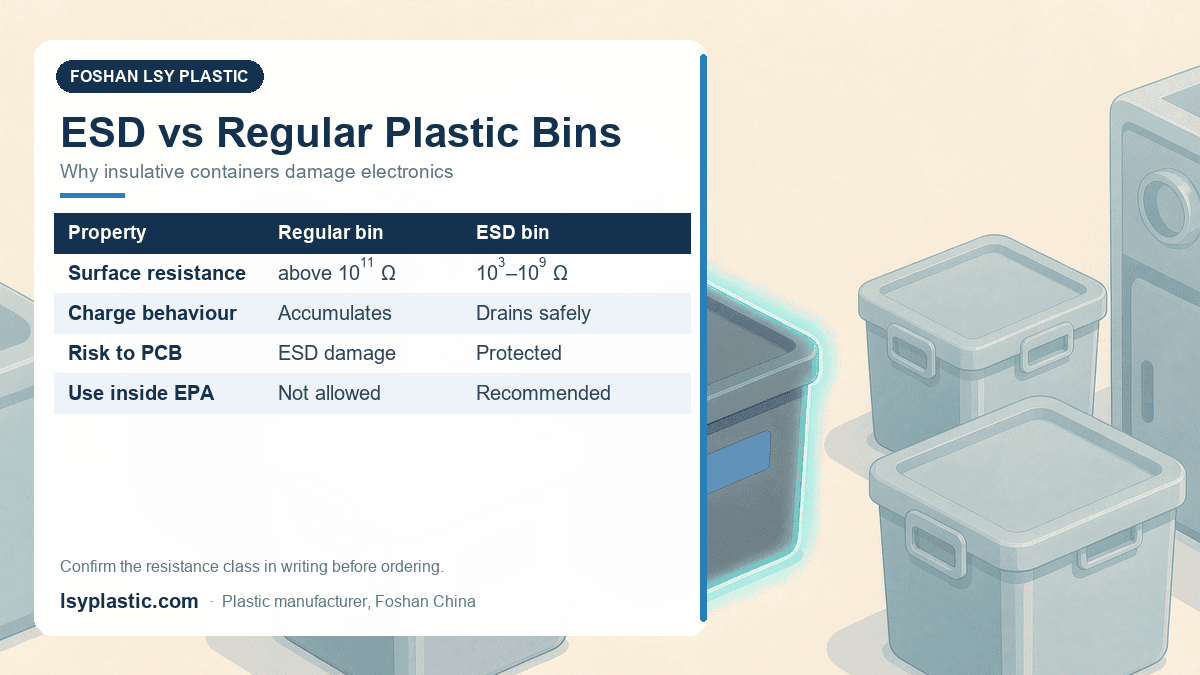
A single static discharge of just a few hundred volts can damage a semiconductor, corrupt a PCB, or shorten a battery’s life. In high-volume Indian electronics plants, that risk scales quickly into scrap, rework and warranty claims. ESD-safe containers, trays and pallets keep components inside an Electrostatic Protected Area (EPA) from the warehouse to the production line.
Conductive vs static-dissipative: choose the right grade
The right grade depends on your process sensitivity:
• Conductive (<10^5 Ω surface resistance): very fast discharge, best for the most sensitive components or closed EPA cells.
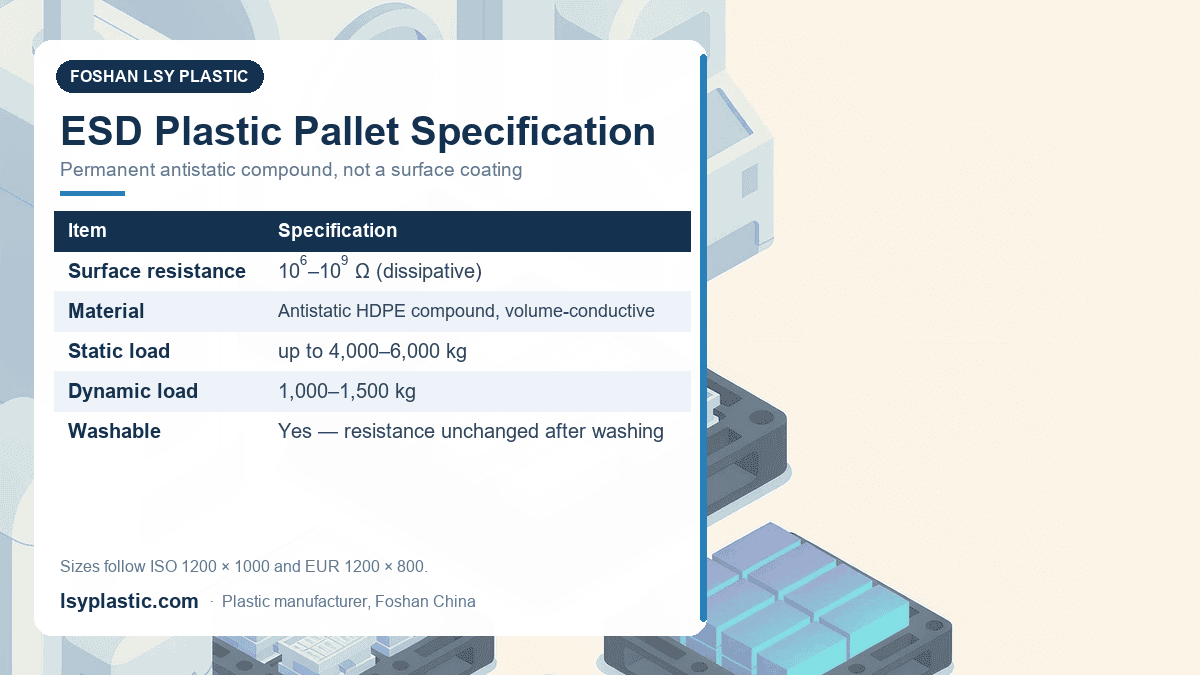
• Static-dissipative (10^6–10^9 Ω): controlled discharge, the standard for SMT, PCB handling, warehouse storage and inter-factory transport.
We confirm the correct grade after reviewing your component sensitivity and handling flow. For more on trays and resistance testing, see our ESD tray safety guidelines.
LSY ESD product range
As a 35-year injection moulding factory in Foshan, Guangdong, China, LSY produces ESD products on Japan-imported JSW, Mitsubishi and NSC presses from 180T to 2500T. Our range includes:
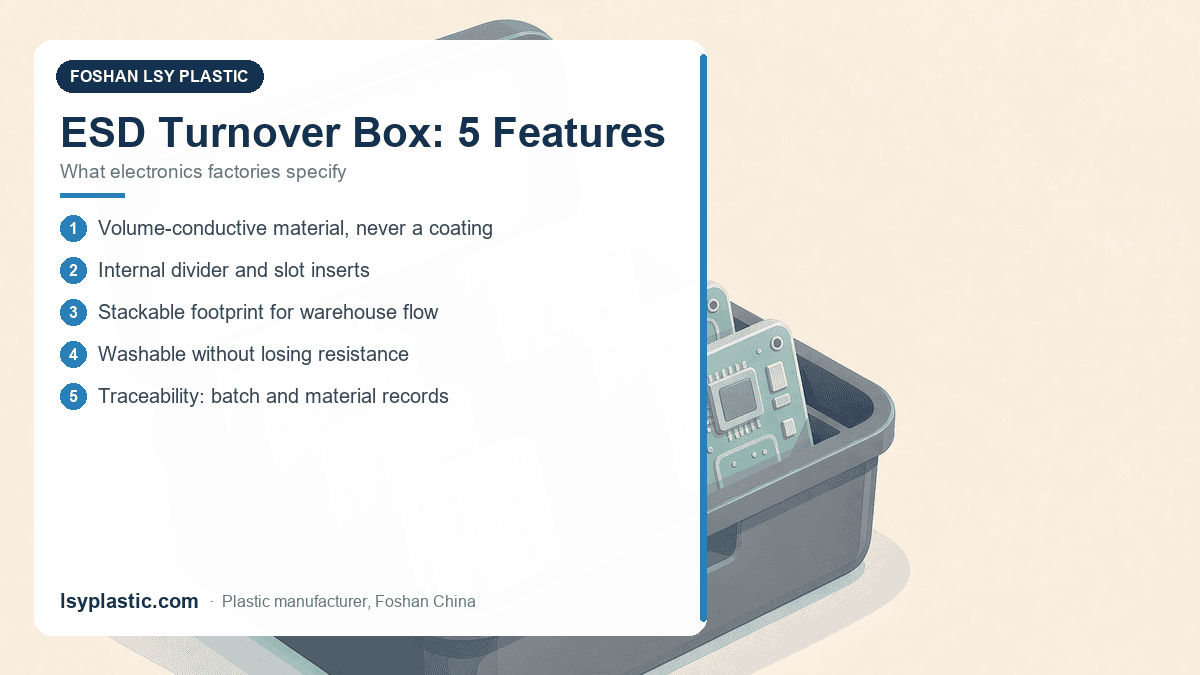
• ESD stackable boxes for component storage and warehouse picking.
• Conductive trays moulded to your PCB or battery module footprint.
• ESD pallets for palletised transport of sensitive loads.
• Anti-static layer pads to separate stacked layers and prevent rubbing damage.
All items use carbon-loaded resins, so protection is built into the material — not a coating that wears off.
Load capacity and sizes
ESD boxes share the same robust dimensions as our standard logistics range: 595 × 480 × 350 mm, 590 × 490 × 350 mm and 600 × 350 × 300 mm are common starting points. For pallets, the footprint options include 1200 × 1000 mm (ISO), 1200 × 800 mm (EUR) and 1100 × 1100 mm. Typical load ratings are static 3,000–10,000 kg, dynamic 1,000–2,500 kg and racking 500–1,500 kg depending on design. We provide exact ratings per model with test reports on request. See our plastic pallet load capacity guide for details.
Export advantages: no ISPM-15, no fumigation
Unlike wooden packaging, plastic ESD containers are not subject to ISPM-15 heat treatment or fumigation. That means no port delays for quarantine checks, no fumigation certificates, and faster customs clearance at Indian gateways such as Nhava Sheva (JNPT), Mundra and Chennai.
How to order from India
Send us the product type (box/tray/pallet/layer pad), dimensions, ESD grade, estimated monthly quantity and destination port. We check wall thickness and reinforcement, confirm the material grade, and issue a factory-direct quotation. Samples are charged at cost price; domestic Chinese orders have no MOQ; export orders ship FCL only.
Ready to compare options? Browse our ESD & Anti-Static Industrial range for ESD containers and pallets.
Frequently asked questions
What is ESD packaging and why do Indian electronics factories need it?
ESD stands for ElectroStatic Discharge. In PCB assembly, semiconductor handling, lithium-battery plants and mobile-phone manufacturing, an uncontrolled static discharge can destroy sensitive components without visible damage. ESD packaging dissipates or conducts static electricity safely, protecting parts during storage, transport and line-side feeding.
What is the difference between conductive and static-dissipative ESD materials?
Surface resistance decides the protection level. Conductive materials (typically under 10^5 Ω) discharge static very fast and suit enclosed EPA zones or highly sensitive CMOS parts. Static-dissipative materials (10^6–10^9 Ω) release charge in a controlled, slower way and are the standard choice for SMT lines, warehouses and transport between work stations.
Which ESD products can LSY supply?
We manufacture ESD stackable boxes, conductive trays, ESD pallets and anti-static layer pads. All are moulded with carbon-loaded PP/HDPE resins, not painted or surface-coated, so the ESD property lasts through washing, stacking and long warehouse life.
What is your sample and MOQ policy?
Samples are charged at cost price — we do not send free samples. Orders within China have no MOQ. For overseas orders including India, we ship full container loads (FCL) only, directly from our factory to your chosen port.
How do I get a quotation for ESD boxes or trays?
Send us the outer/inner dimensions you need, the weight each box will carry, the ESD grade required (conductive or dissipative), your estimated monthly volume and the destination port. We confirm wall thickness, reinforcement structure and material grade, then send a factory quotation within one business day.
Contact us on WhatsApp +86 19311059570 or email fstyx01@lsyplastic.com for a factory-direct ESD quotation. For the full ESD range, visit our ESD-safe packaging solutions overview.



