
ESD Containers for Humid Climates: What Export Buyers Must Check
If your factory is in Vietnam, Malaysia, Thailand, India, or the Gulf, the biggest hidden risk to your ESD packaging is not the container itself — it is the humidity in the air around it. Surface resistivity drifts, moisture films form, and a box that tested perfectly in a dry lab can underperform after a six-week sea voyage. This guide explains what changes in a humid climate and which five specifications to confirm before you place an order.
1. How humidity moves surface resistivity
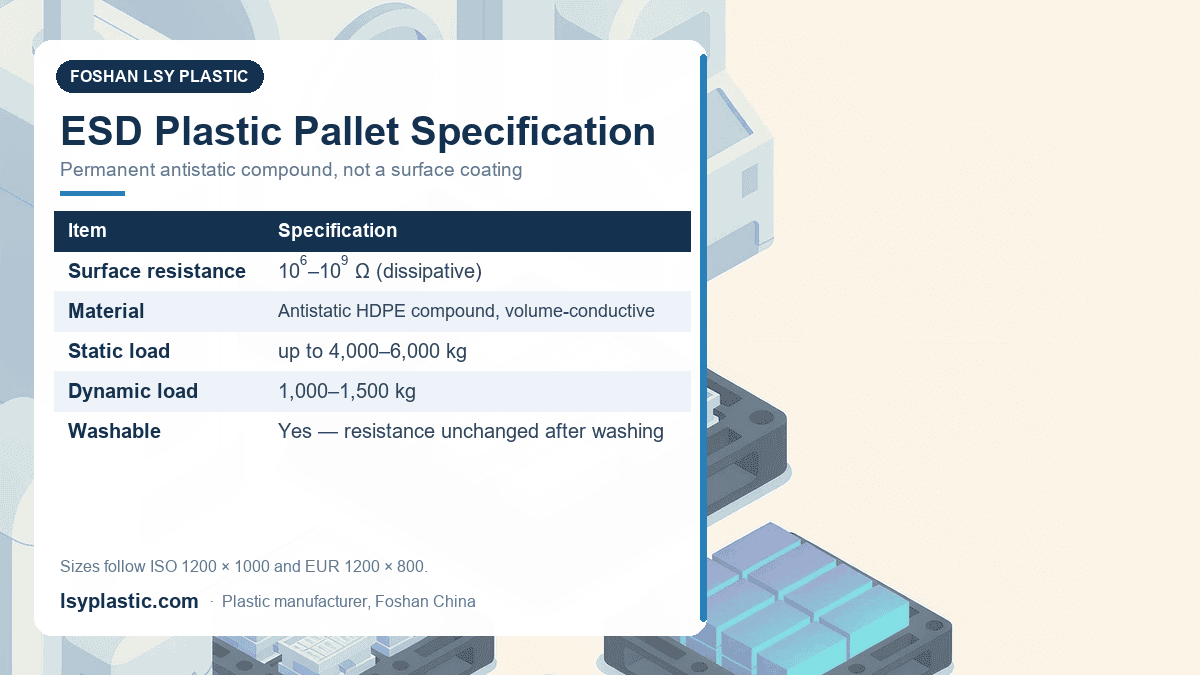
Surface resistivity is measured at a fixed relative humidity (RH), usually 12% or 50%. In tropical and Gulf ports, container interiors routinely sit between 60% and 90% RH during transit. Moisture adsorbed onto a plastic surface can lower surface resistivity by one or two orders of magnitude, which turns a dissipative part into a conductive one and can slow or accelerate static decay in ways your ESD audit did not plan for. The fix is not a thicker wall — it is a stable, volume-conductive material that holds its rating across the RH range of your route.
2. Material choice for wet, warm routes
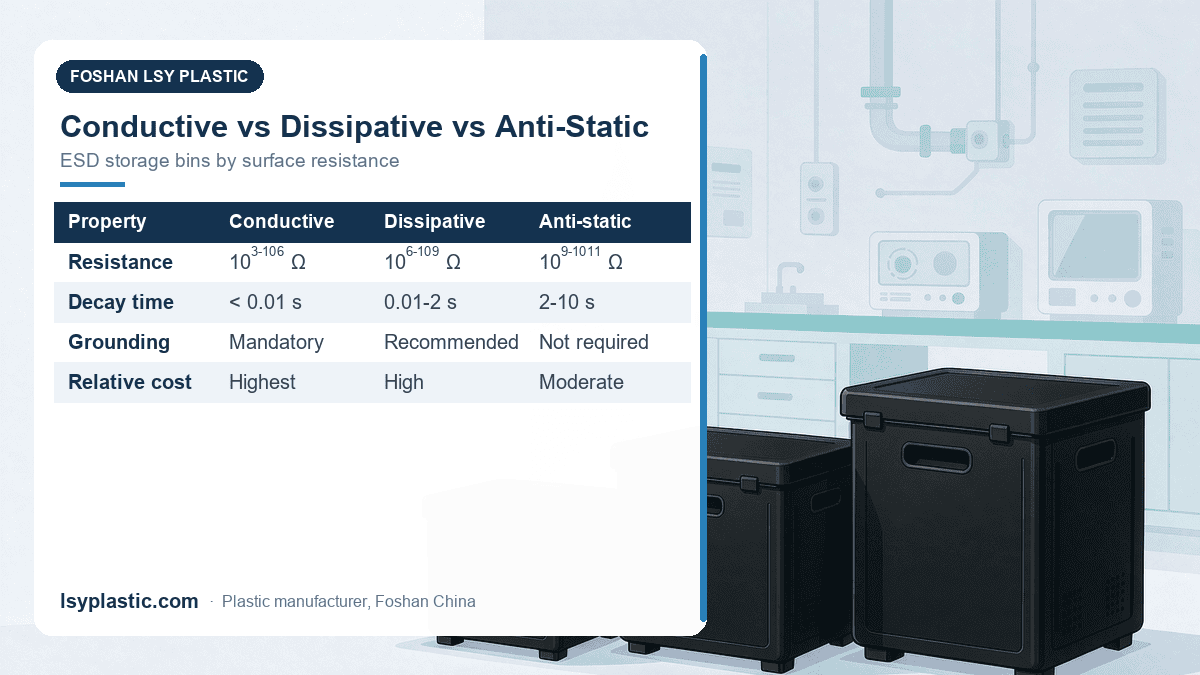
Three families dominate: carbon-filled PP (most conductive, permanent, darker colors), anti-static masterbatch in HDPE/PP (light colors, rating depends on additives), and humidity-independent conductive compounds for electronics. For long sea freight into humid regions, carbon-black filled PP is usually the most stable because its conductivity comes from a percolated carbon network rather than from surface moisture. Ask your supplier for a datasheet showing surface resistance at both 12% and 50% RH — a single number at one humidity is not enough.
3. Sea freight and container condensation
A 40HQ traveling from Foshan to Cai Mep or Jebel Ali can swing 25 °C between day and night. That temperature cycle drives container rain — condensation that drips onto cartons and trays. Practical mitigations: use desiccant bags sized to the load, add a liner or moisture barrier for high-value PCB shipments, and stack ESD trays so condensate cannot pool inside them. Ventilated crates, by contrast, are the wrong choice for ESD goods precisely because they invite moist air in.
4. Receiving and storage in a humid plant
Once on site, the same risk continues. Unbox in a controlled EPA, keep ESD containers off concrete floors in monsoon season, and maintain warehouse RH below 60% where feasible. Rotate stock so older containers are used first, and re-test a sample after any long storage period — static decay performance is the property most sensitive to both humidity and contamination.
5. Five specs to confirm before ordering
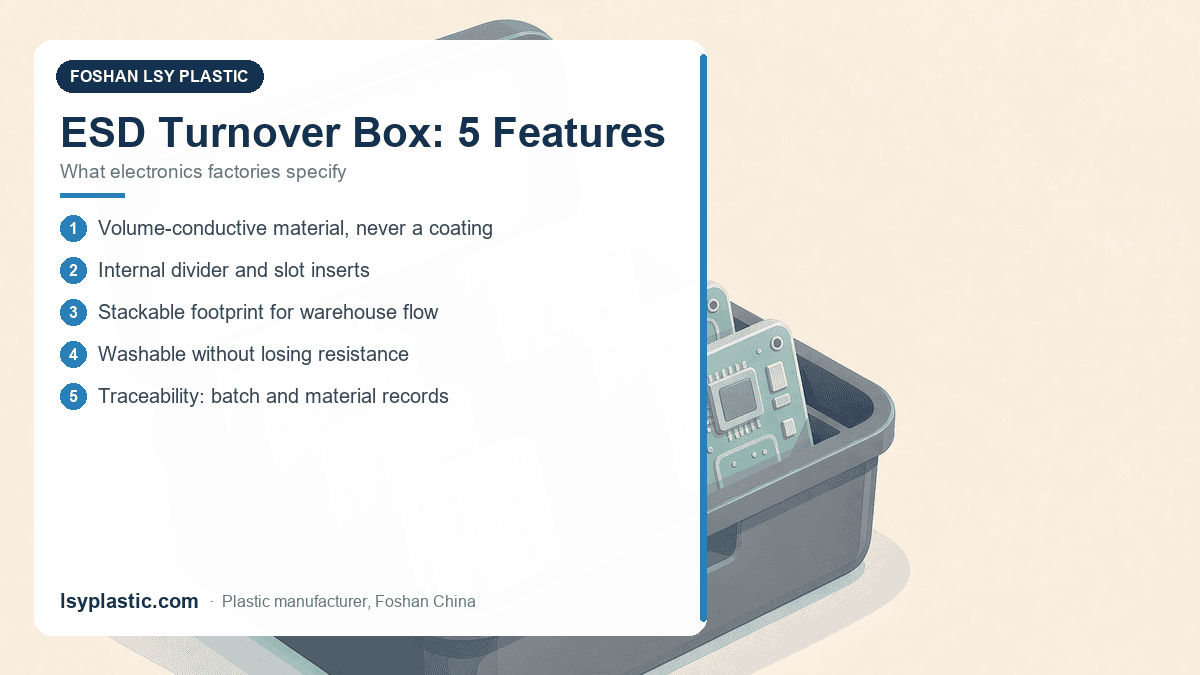
1) Surface resistance range at 12% and 50% RH. 2) Base resin and conductive filler (carbon vs additive). 3) Wall thickness and rib design at the corners, where stacking stress concentrates. 4) Container dimensions against your rack and tote system. 5) Whether the finish is food-contact or electronics-only, since additives differ. Confirm the test method (ASTM D257 or equivalent) and request a sample lot with a signed spec sheet and lot number.
6. Packaging for export and OEM branding
Export orders ship as full container loads (FCL). Containers can be nested to cut freight cost, and the factory can mould a logo or silk-print the body for repeat OEM orders. Plan a buffer against monsoon-season lead times, and confirm THC, DDP, and CIC charges at the destination port before you lock a landed cost.
Need reliable ESD containers and pallets? Browse the ESD & Anti-Static Industrial collection and request a quote.
Frequently Asked Questions
Are samples free?
No. Samples are charged at cost price and the buyer covers the freight. When you place the following FCL order, the sample cost is credited against it.
What is the minimum order quantity (MOQ)?
International orders ship by full container load (FCL). China domestic orders have no MOQ.
How long is production and delivery?
Lead time depends on the model and the season — confirm with the factory on WhatsApp +86 19311059570 before you plan your purchasing schedule.
Can you produce anti-static containers for a specific resistance target?
Yes. Share your target surface resistance range and operating humidity, and the factory will recommend the suitable compound and confirm the datasheet before production.
Contact the Factory
WhatsApp / WeChat: +86 19311059570
Email: fstyx01@lsyplastic.com
Address: No.2 Danzao Development Avenue, Nanhai District, Foshan, Guangdong, China.
Read next: the ESD Containers & Trays Hub, our comparison of ESD turnover boxes vs ESD trays on the SMT line, and the conductive vs dissipative material classification guide.



