
Lithium battery packs move through three storage states before they reach an OEM assembly line: cell, module, and pack. At every state, the component that keeps them from shorting, crushing, and shifting is not the outer carton — it is the moulded plastic layer pad or separator board sitting between layers. A wrong pad means scratched cell casings, dented busbars, and in the worst case an internal short that no outer packaging can contain.
FOSHAN LSY Plastic is a 35-year injection moulding manufacturer in Foshan, China with a dedicated battery accessories line — the same factory that supplies battery packaging to BYD and Desay Battery. This guide covers the layer pad specs that matter for lithium battery packaging, from cell isolation to full container load (FCL) shipping.
Why layer pads, not cardboard, for lithium cells
Cell-level packaging uses individual anti-static boxes; module and pack level uses layer pads. The pad does three jobs at once:
- Physical isolation — keeps module edges and cooling plates from touching the layer below, preventing dent transfer
- Load spreading — a 30 kg module stack of six layers puts 180 kg on the bottom module; the pad spreads that load across the footprint instead of concentrating on corners
- Anti-static path — when specified in conductive or dissipative resin, the pad gives static a controlled bleed path instead of letting charge build on the cell casing
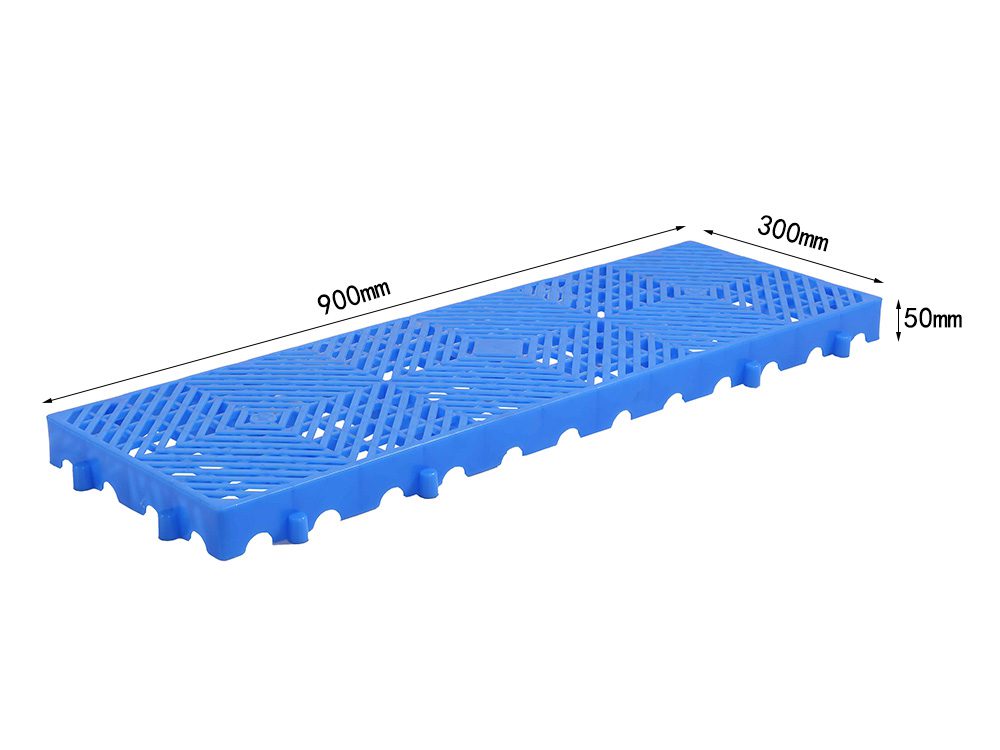
Layer pad sizes for battery module footprints
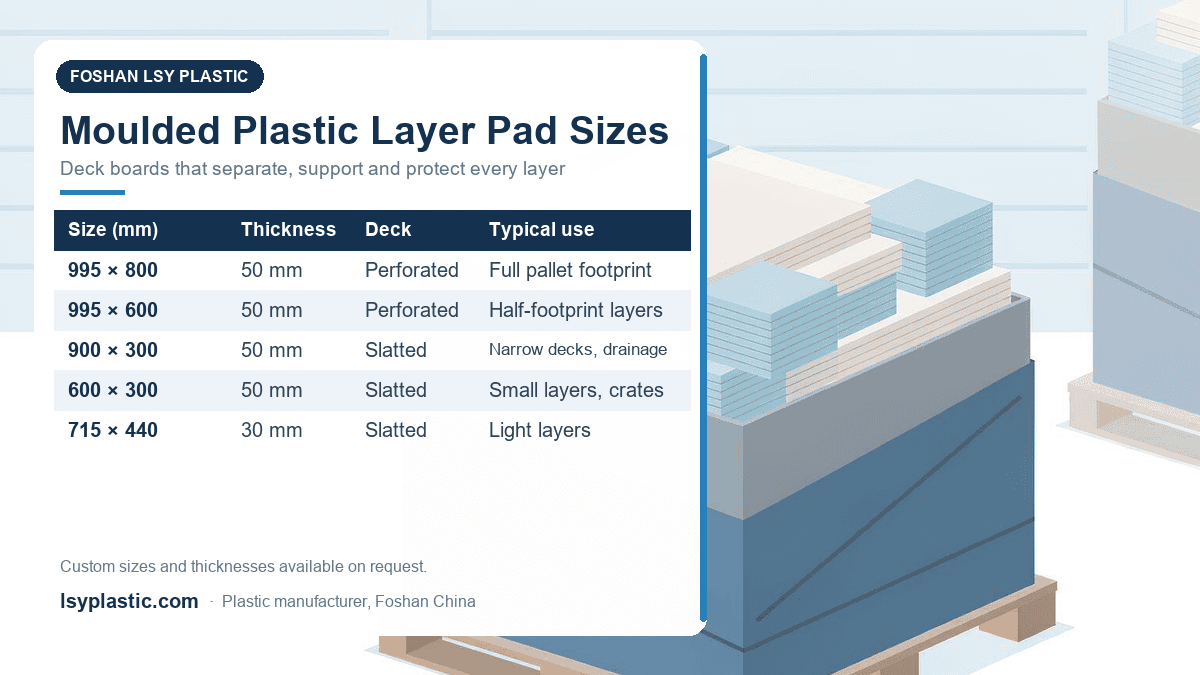
LSY moulds layer pads in five sizes: 995 x 800, 995 x 600, 900 x 300, 600 x 300 and 715 x 440 mm. Battery modules follow different footprints by platform:
- Standard module 590 x 490 mm — pairs with 995 x 600 mm pad, two modules per layer
- Long module 590 x 350 mm — 900 x 300 mm pad covers one module layer with margin
- Small cell tray 600 x 400 mm — 995 x 600 mm pad covers two trays per layer
Material choice: conductive, dissipative, or plain HDPE
Not every layer in a lithium battery stack needs to be ESD-rated. The rule of thumb:
- Cell and bare module layers — conductive or static dissipative resin (surface resistance 10^3 to 10^9 ohms) per the ESD material classes in our ESD material classification guide
- Pack-level layers (module already sealed in its housing) — plain HDPE is sufficient and cheaper
- Wash-down and reefer logistics — HDPE for both; PP also performs at -20°C
Export packaging: FCL and ISPM 15
Battery shipments leave China by full container load (FCL). Moulded plastic layer pads are ISPM 15 exempt — no fumigation, no heat treatment, no wood declaration. Pads stack flat inside the container on standard 1200 x 1000 mm export pallets, and the same pallets carry the battery modules on the return leg.
Ordering checklist for battery packaging pads
- Match pad footprint to module footprint (or module grid — two modules per pad)
- Static load rating ≥ 1,500 kg for six-layer stacks
- Material per layer: conductive / dissipative near bare cells, HDPE near sealed packs
- Slatted deck for ventilation if modules ship with cooling plates attached
- Four-way entry if the stack moves on pallet jacks at the OEM line
LSY Plastic moulds battery packaging — layer pads, anti-static boxes, ESD trays, and custom OEM tooling — on 180 to 2,500 ton presses in the 20,000 m² Foshan factory. Samples are supplied at cost price; domestic orders in China carry no MOQ; overseas orders ship by FCL. Request a quote at fstyx01@lsyplastic.com or WhatsApp +86 19311059570.
For lithium battery pack packaging, see the layer pad hub for ESD-rated, vented and stackable pad specs.
What layer pad size works for lithium battery modules?
Standard modules at 590 x 490 mm pair with the 995 x 600 mm pad (two modules per layer). Long modules at 590 x 350 mm pair with the 900 x 300 mm pad. Cell trays at 600 x 400 mm pair with the 995 x 600 mm pad (two trays per layer).
Do lithium battery layer pads need to be anti-static?
Layers touching bare cells or unsealed modules should use conductive or static dissipative resin (surface resistance 10^3 to 10^9 ohms). Layers between sealed pack housings can use plain HDPE — the housing itself is the insulator.
How do I order samples of battery packaging pads?
Samples are supplied at cost price so you can verify fit on your own module stack. Domestic orders in China carry no MOQ; overseas orders ship by full container load (FCL).
Related reading: plastic layer pads guide — moulded deck boards, layer pad specs and sourcing.
Sourcing plastic layer pads? See our Pad Series line for the sizes and materials discussed above.



