ESD — electrostatic discharge — is the spark you cannot see that damages a component you cannot test for. A human being walking across a carpet generates several thousand volts and feels nothing; the same discharge through a MOSFET gate destroys it silently. Electronics factories spend money on ESD control because the failure does not show up at goods-in. It shows up in the customer’s hands.
What the three terms actually mean
The packaging industry uses three words loosely and pays for it later. The distinction is measured, not marketing:
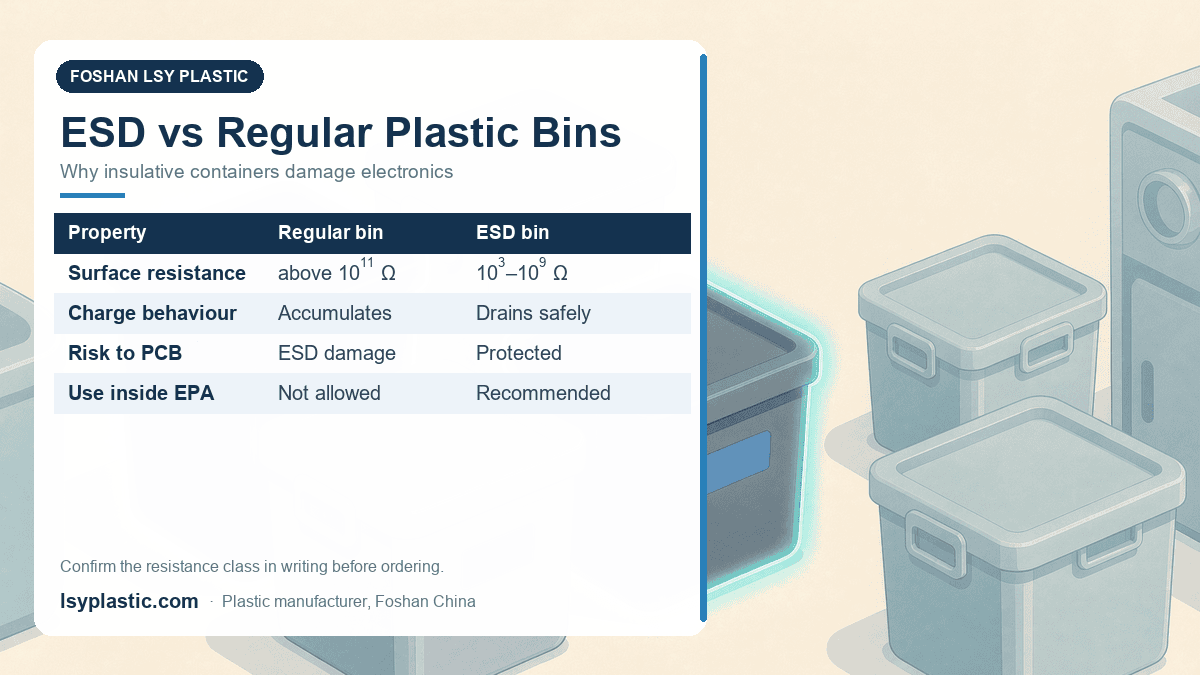
| Term | Surface resistivity | What it does |
| Conductive | 10³ – 10⁶ Ω | Bleeds charge away almost immediately. Used where a discharge must not build at all. |
| Dissipative | 10⁶ – 10⁹ Ω | Bleeds charge away slowly and safely. The working range for most ESD packaging. |
| Antistatic | 10⁹ – 10¹² Ω | Resists generating a charge in the first place, but does not drain one reliably. |
| Insulative | above 10¹² Ω | Ordinary plastic. Holds charge and is the material class ESD control exists to avoid. |
The practical consequence: an antistatic tray that has been sprayed will keep a board from generating charge during handling, but it will not protect a charged board placed into it. A dissipative tray will. Buyers who specify “antistatic” when they need “dissipative” find out at audit.

Why compounded beats coated
There are two ways to make a plastic dissipative. The first is to compound a conductive filler — carbon black, carbon fibre or a permanent antistatic agent — into the resin before moulding. The second is to spray or dip an antistatic coating onto a finished part.
The coating is cheaper and it wears off. It washes off with cleaning, it thins with abrasion, and it dries out with humidity. A compounded part carries the property through its whole service life because the property is in the material, not on it. For any packaging that will be cleaned, stacked in a return loop or used for more than one season, compounded is the only specification that survives.
Humidity moves the number
Surface resistivity is not a fixed material constant — it responds to relative humidity. Dry air pushes readings up; humid air pushes them down. This is why an ESD programme that works in Guangzhou’s wet season can fail an audit in a Gulf winter with air conditioning running, or in a heated European plant in January.
The practical rule: test in the environment where the packaging will actually be used, and re-test seasonally. A certificate generated in a humid laboratory says nothing about a dry production floor.
How to verify what you bought
- Surface resistivity meter with the correct probe geometry — readings are useless if the probe does not match the standard.
- Measure in several places, including the deepest part of a tray or box, because filler distribution can vary across a large moulding.
- Measure again after cleaning, which is the test that separates compounded material from a coating.
- Keep the batch records — for an audit trail, the lot number matters more than the reading.
Specifying ESD packaging from a factory
When you enquire, give the target resistivity band, the operating humidity range and whether the packaging will be washed. Those three answers determine whether you need a conductive or dissipative grade, and whether a standard grade will hold up in your loop. A supplier who only asks how many pieces you want is not going to help you through an audit.
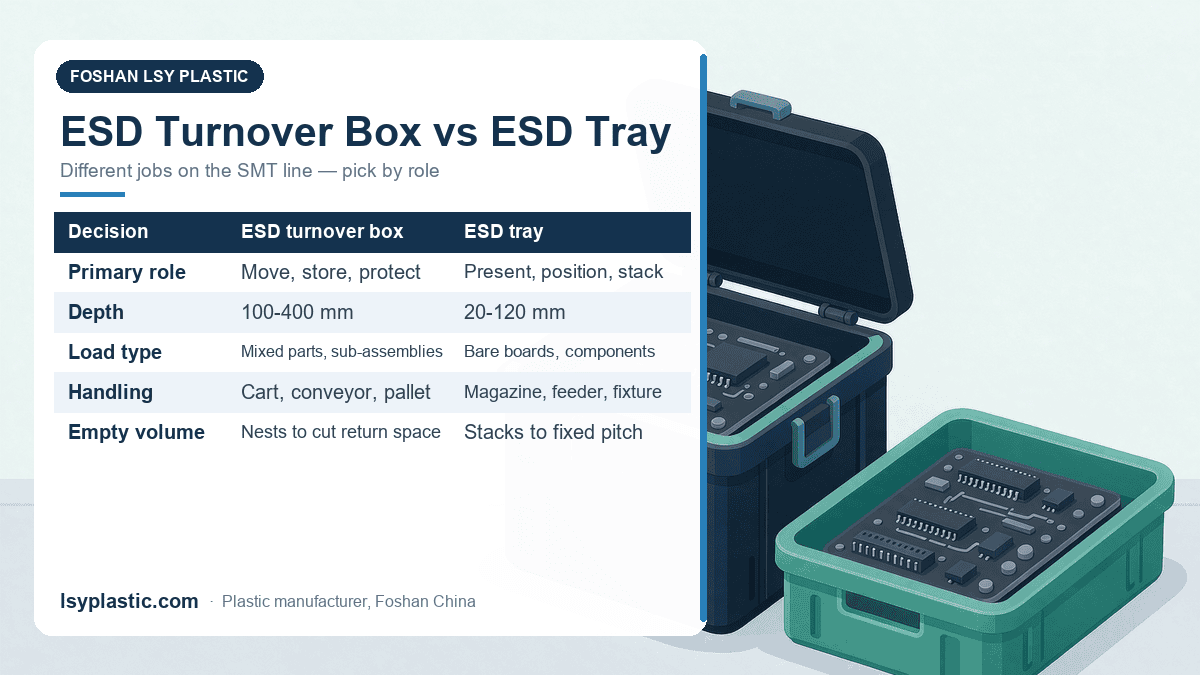
FOSHAN LSY Plastic moulds ESD turnover boxes, trays and pallets with conductive and dissipative grades compounded into the resin, covering the 10³–10⁹ Ω range, on presses from 180 to 2,500 tons in Foshan. Export orders ship as full container loads; samples are charged at cost.
Sourcing These Products? Buy Direct from the Factory
LSY Plastic has been an injection moulding manufacturer in Foshan, China for over 35 years. We supply hotels, restaurants and warehouses worldwide at factory-direct prices, shipped by full container load (FCL).
Buying in volume? For the same quantity, we commit to the best price on the market.
FAQ
What does ESD stand for, and why does it matter?
Electrostatic discharge. It matters because the discharge that damages a semiconductor is below the threshold a person can feel — around 3,000 volts — while many components are damaged at a few hundred. The damage is often latent: the part passes test and fails in the field.
Is antistatic the same as dissipative?
No. Antistatic material resists generating charge; dissipative material drains charge away at a controlled rate. For protecting a charged board, dissipative is the specification you need.
Does the anti-static property wear off?
On a coated part, yes — cleaning and abrasion remove it. On a compounded part, no, because the conductive filler is distributed through the material and a fresh surface has the same property as the original one.
Related: MOQ, samples and FCL shipping policy — how we supply overseas buyers, including container loading volumes.