Most ESD programs are written for the workbench and the storage shelf — then the sensitive goods are packed into whatever box is nearest and sent on the road. Transit is exactly where electrostatic damage peaks: dry air, friction between packaging layers, and hours of uncontrolled handling between your EPA and your customer’s incoming inspection. That is why procurement teams increasingly search for ESD compliant containers for shipping electronics, not just for storage. This guide explains what compliance means for a shipping container, which material class to specify, and how the container dimensions lock into your pallet plan before the container is loaded.
FOSHAN LSY Plastic is a 35-year injection moulding factory in Foshan, China, running Japan-imported presses from 180 to 2,500 tons with a self-owned mould workshop. Its ESD range — conductive EU-standard boxes, component storage bins and anti-static pallets — is exported to electronics and automotive supply chains, so the specs below come straight from production, not from a catalogue template.
What “ESD compliant” means for a shipping container
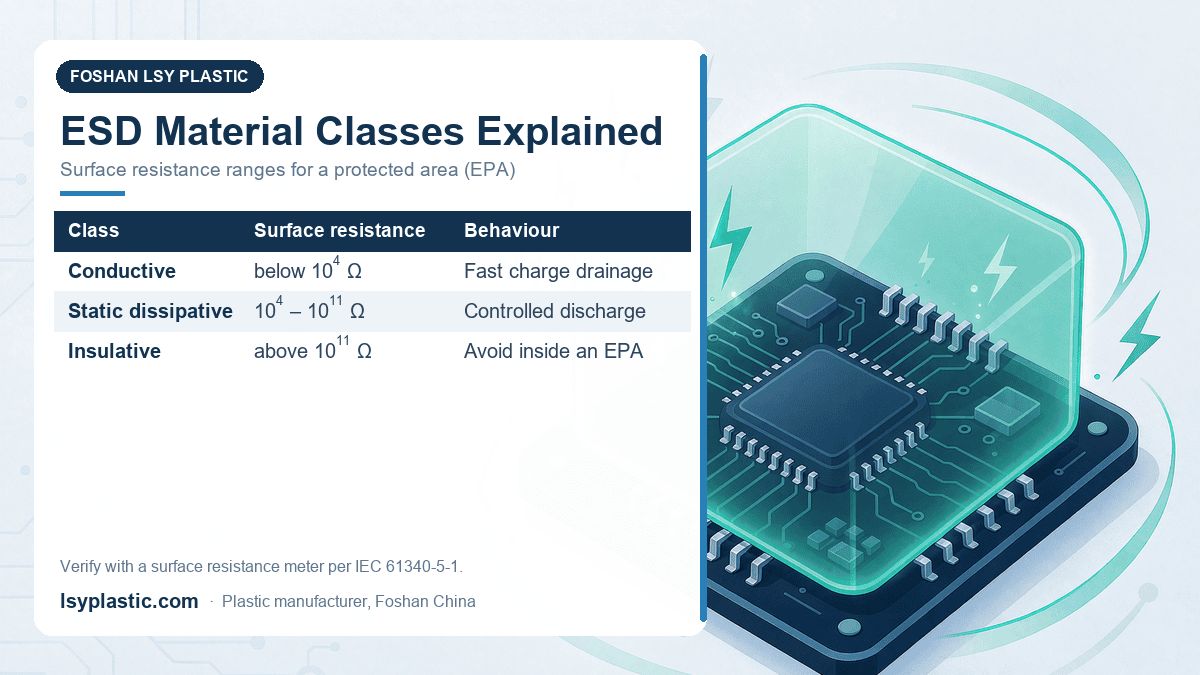
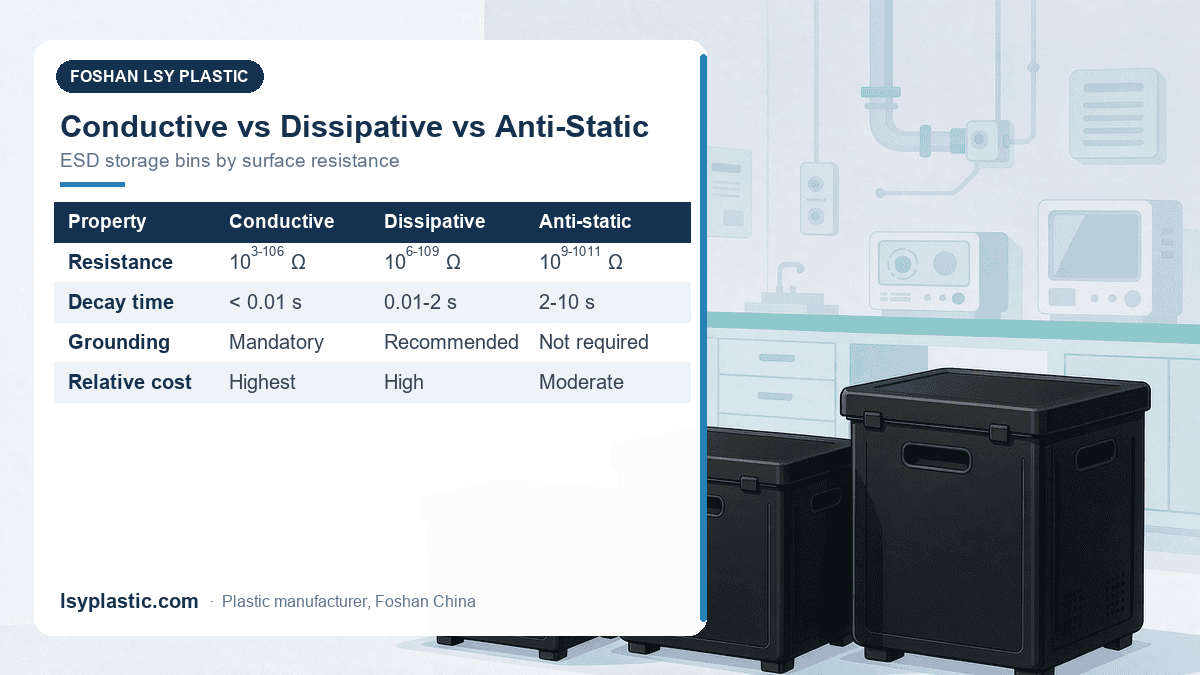
Compliance starts with the material class, and the three classes do very different jobs. Conductive containers measure 100–104 ohms on the surface and act like a Faraday cage — they shield contents from external electrostatic fields, which is what you want when goods cross uncontrolled zones. Static dissipative containers sit at 104–1011 ohms and bleed charges away slowly without hard grounding points. Anti-static material only prevents tribocharging; it neither shields nor dissipates, so it is the weakest claim on a shipping box.
Program-level compliance is defined by ANSI/ESD S20.20, which auditors apply to the whole EPA; container-level verification uses surface resistance testing per ANSI/ESD STM11.11, and shielding performance of packaging is measured per ANSI/ESD S11.31. A supplier who cannot state the surface resistance class and test method of a shipping box is selling a color, not compliance.
Molded-in conductivity beats coatings
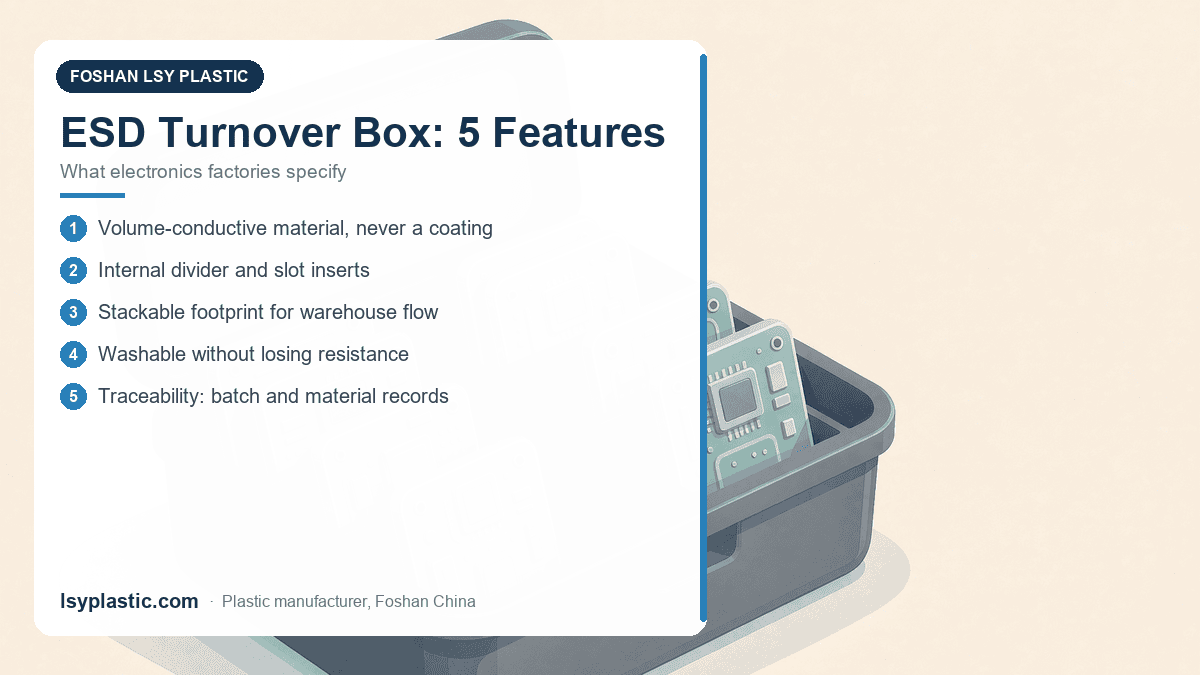
The failure mode of cheap ESD packaging is simple: the anti-static layer is a surface treatment, and surface treatments wash off, wear out and stop measuring after a few logistics cycles. LSY’s EU-series shipping boxes are injection moulded from impact-resistant conductive polypropylene (PP) — the conductive compound is distributed through the plastic matrix, so the surface resistance of 104–106 ohms does not degrade with washing, abrasion or time. For returnable packaging that shuttles between a Tier-1 supplier and an OEM plant dozens of times a year, that difference decides whether the box is still compliant in month eighteen.
EU-standard boxes: the shipping workhorse
The EU series follows European modular footprints — 300×200 mm, 400×300 mm and 600×400 mm — so mixed box sizes combine into clean layers on 1,200×800 mm and 1,200×1,000 mm pallets with no wasted deck space. Current production models include:
- EU2311 — 300×200×120 mm, small parts
- EU3310 — 340×300×100 mm, low profile
- EU4311 / EU4316 / EU4322 — 400×300 mm in 120, 170 and 225 mm heights
- EU4616 — 600×400×175 mm, the best seller for PCB and module transport
- EU4628 / EU4633 — 600×400 mm deep versions at 290 and 340 mm
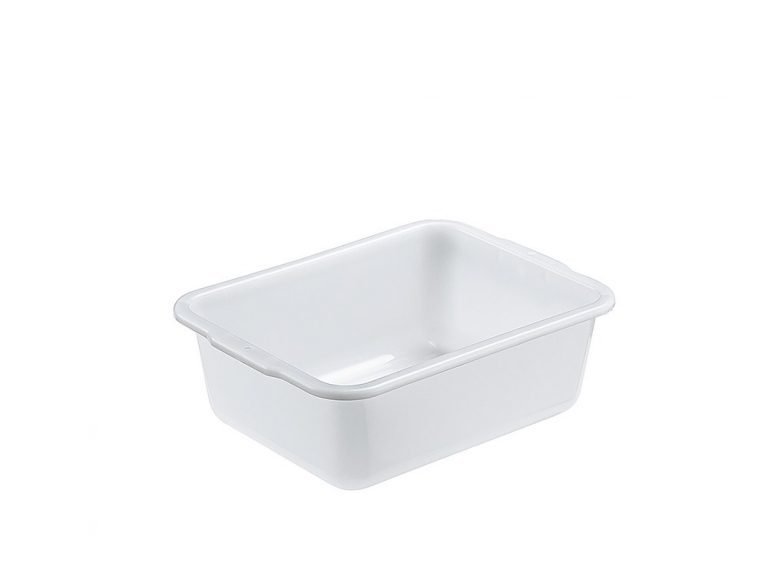
All models carry reinforced rims for high stacking loads, a smooth flat bottom that runs on roller tracks and AS/RS conveyors, and integrated handles for manual handling. Full model details and internal dimensions are on the EU Series ESD conductive boxes product page.
Before the container leaves the factory
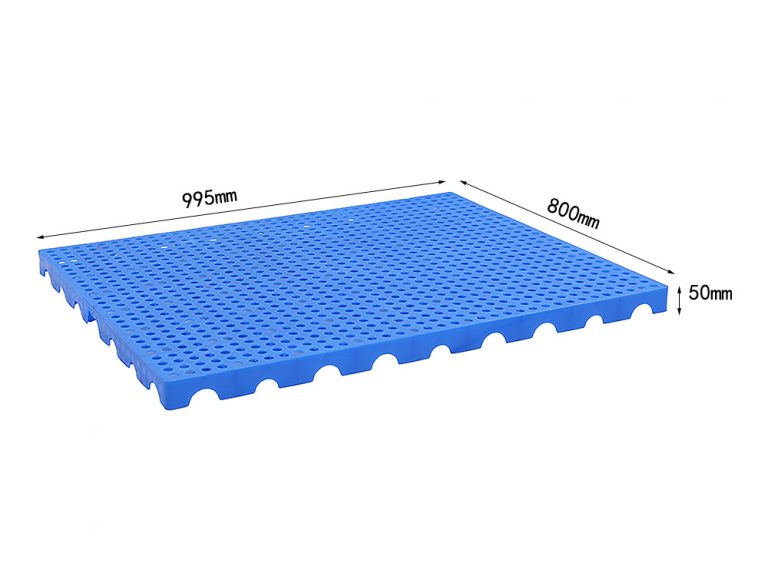
Two checks close the loop. First, verify the incoming goods: request the surface resistance test report per STM11.11 for the production batch, and re-test annually — quality ESD containers hold their properties for five or more years, but any box that drifts out of class or cracks physically must be retired. The ESD container testing and maintenance guide walks through the full routine. Second, plan the load: ESD boxes stack into the same pallet footprints as the anti-static pallets underneath them, so a full container load can be packed floor-to-ceiling without mixed non-ESD packaging touching the product.
Frequently Asked Questions
Do you charge for samples?
Samples are supplied at cost price — the sample itself is not free, and courier freight is on the buyer’s account. The sample cost can be referenced against the following bulk order.
What is the minimum order quantity?
Domestic (China) orders ship by courier or logistics with no MOQ. Overseas orders ship as full container load (FCL), and ESD box models and sizes can be mixed within the container.
Can we get custom sizes or colors for our line?
Yes — with a self-owned mould workshop, custom internal dimensions, dividers and colors are supported for project volumes. Confirm the drawings before the production schedule is locked.