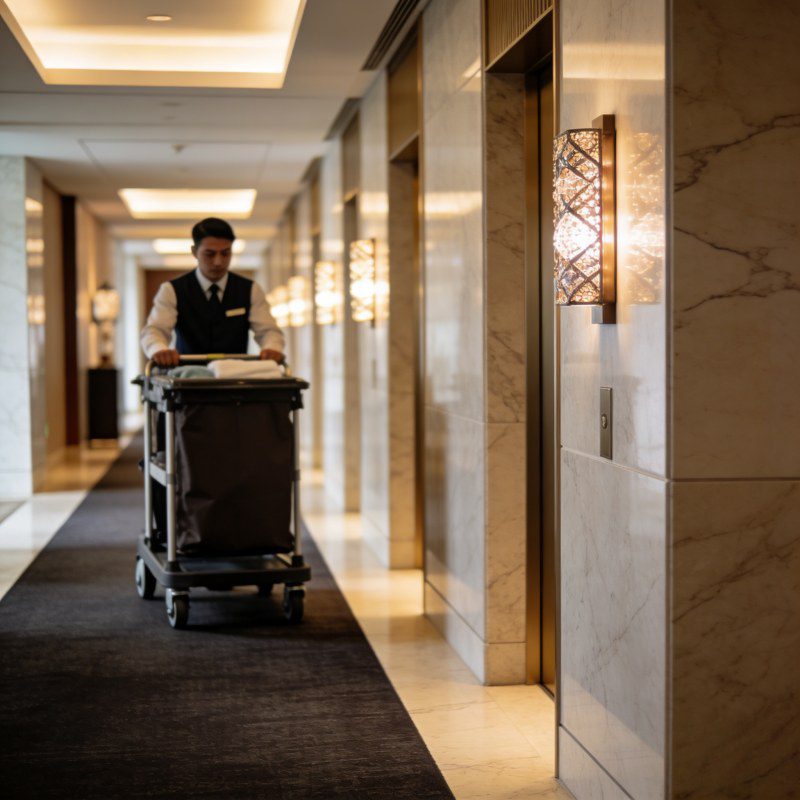
Hotel guests do not complain about trolley wheels — they complain about the noise at 6:30 a.m. outside their room. For a 300-room property, caster choice is a guest-experience decision. The wrong wheel scratches marble, rattles over thresholds and leaves black marks on vinyl. This guide compares caster materials, load ratings and floor protection so procurement teams can specify wheels that stay quiet and last.
All trolley models referenced below are part of the hotel cart range built by FOSHAN LSY Plastic, a 35-year injection moulding factory in Foshan, China, with Japan-imported presses from 180 to 2,500 tons and a self-owned mould workshop.
1. Wheel material: hard vs soft
The material touching the floor determines noise, grip and marking. Hard wheels — polypropylene (PP) and hard nylon — roll easily on carpet and tolerate high load. They are also noisy on hard surfaces and can leave marks or micro-scratches on polished tile and marble. Soft wheels — thermoplastic polyurethane (TPU) and thermoplastic rubber (TPR) — absorb vibration, run almost silently and are normally non-marking. The trade-off is slightly higher rolling resistance and a softer tread that wears faster under very heavy loads.
For guest-floor trolleys, specify TPU or TPR casters as standard. Keep hard PP/nylon wheels for back-of-house and laundry carts where noise matters less and load is higher.
2. Swivel, fixed and brake casters
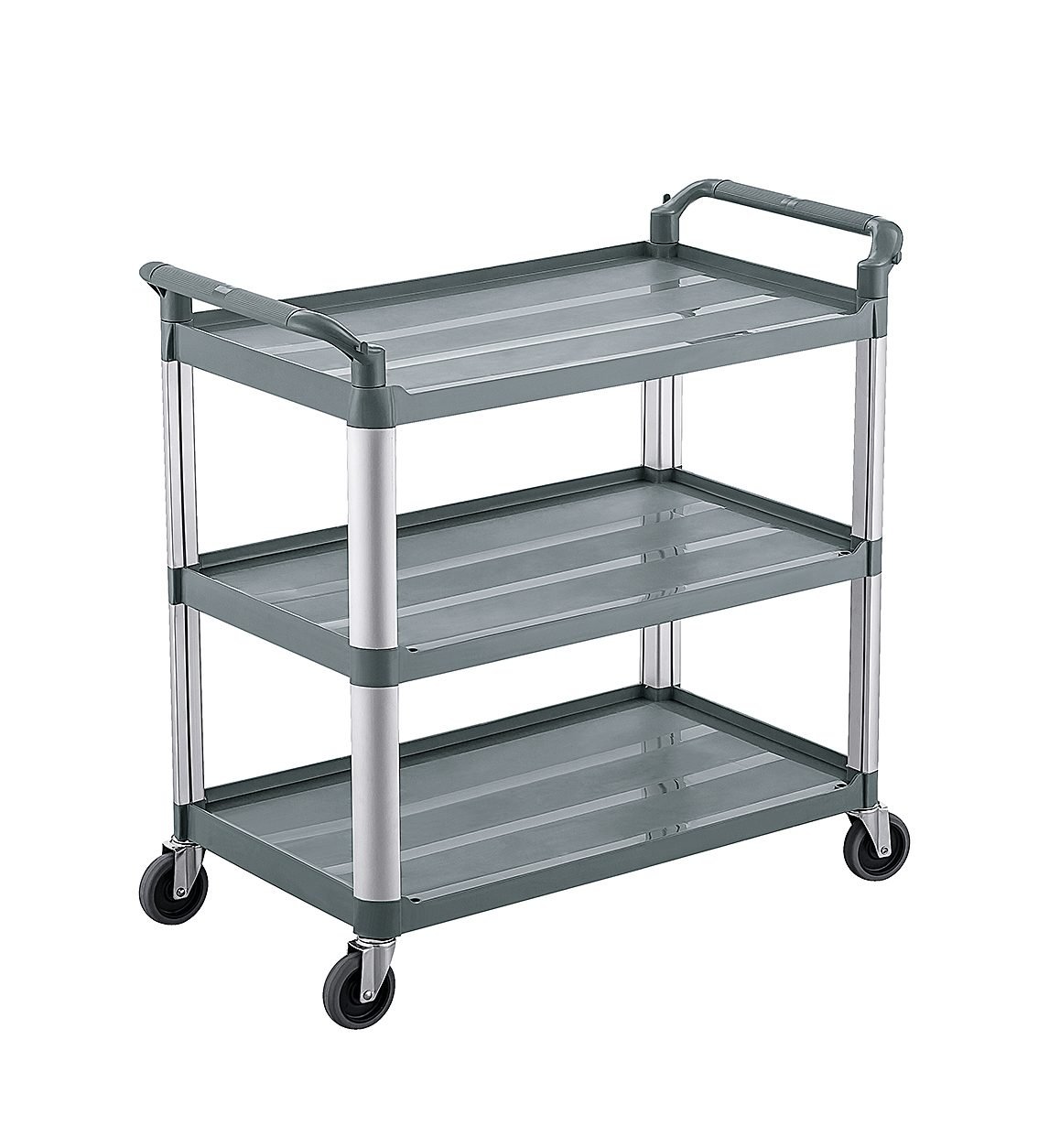
A housekeeping trolley needs to turn in tight corridors and park against a wall without rolling away. The standard layout is two swivel casters at the front and two fixed casters at the rear. This gives straight-line stability when loaded and easy steering when pushing from a standing start. For room-service and banquet carts that are left unattended on sloped floors, add total-lock brakes on at least two wheels. Brake casters cost more but prevent runaway carts and wall damage.
Some premium hotel carts use four swivel casters for 360-degree manoeuvrability in compact service lifts. This works well only if the casters have good tread and the operator is trained; otherwise the cart can drift sideways on sloped corridors.
3. Load rating per caster
Hotel trolleys are rarely overloaded intentionally, but a housekeeping cart loaded with linen, mini-bar stock and cleaning supplies can reach 80-120 kg. A four-caster cart should use casters rated for at least 40-50 kg each — and the rating should be checked against the dynamic load, not the static display load. LSY’s 8001, 8003 and 8005 housekeeping series are configured with casters sized for this duty cycle; the stainless-steel 8201/8209 range uses larger wheels for heavier banquet loads.
4. Floor protection and non-marking tread
Luxury hotels invest heavily in polished stone, vinyl and timber corridor finishes. A non-marking TPU/TPR tread leaves no black streaks and resists picking up grit that can scratch floors. Grey or light-coloured wheels are preferred over black wheels in high-end properties because any marks are less visible. Regular caster cleaning is also part of floor care: hair and thread wrap around axles and create drag marks if ignored.
5. Replacement cycle and spare parts
Even the best caster wears out. Under daily hotel use, expect 18 to 36 months of service from a quality soft caster before the tread flattens or the swivel bearing loosens. Buying from a manufacturer that keeps caster hardware and replacement wheels in stock matters: LSY supports the 8001, 8002, 8003, 8005 and 922 series with replacement caster sets so a worn wheel does not retire an entire cart.
Spec checklist for quiet hotel trolley wheels
- Material: TPU or TPR for guest floors; PP/nylon for back-of-house
- Layout: front swivel + rear fixed as standard; total-lock brakes on sloped floors
- Load: ≥ 40-50 kg per caster dynamic load for housekeeping duty
- Floor care: non-marking grey or light tread, regular hair/thread cleaning
- Spares: confirm replacement caster sets are available from the supplier
For the wider hotel cart decision framework — including deck size, bag configuration and stainless vs plastic body — see the hotel and hospitality carts complete guide. For the full trolley and cart catalogue, visit the housekeeping carts product category.
FAQ — quiet hotel trolley wheels
Can we receive samples of the casters before ordering?
Yes. Samples of the trolley and caster configuration are supplied at cost price so your engineering or housekeeping team can test noise level, floor marking and load behaviour on your own corridors. Domestic orders in China carry no MOQ; overseas orders ship by full container load (FCL).
Do you accept small trial orders for overseas hotels?
Overseas orders are shipped by FCL only. A 40-foot container holds a practical mix of hotel trolleys, spare caster sets and complementary housekeeping accessories. Sample shipments for evaluation are arranged separately by courier.
Related guide: housekeeping cart parts and accessories.
Is there a minimum order quantity?
There is no MOQ for domestic orders delivered within China. Export orders are quoted and shipped by the container, with unit pricing depending on model mix and destination port.