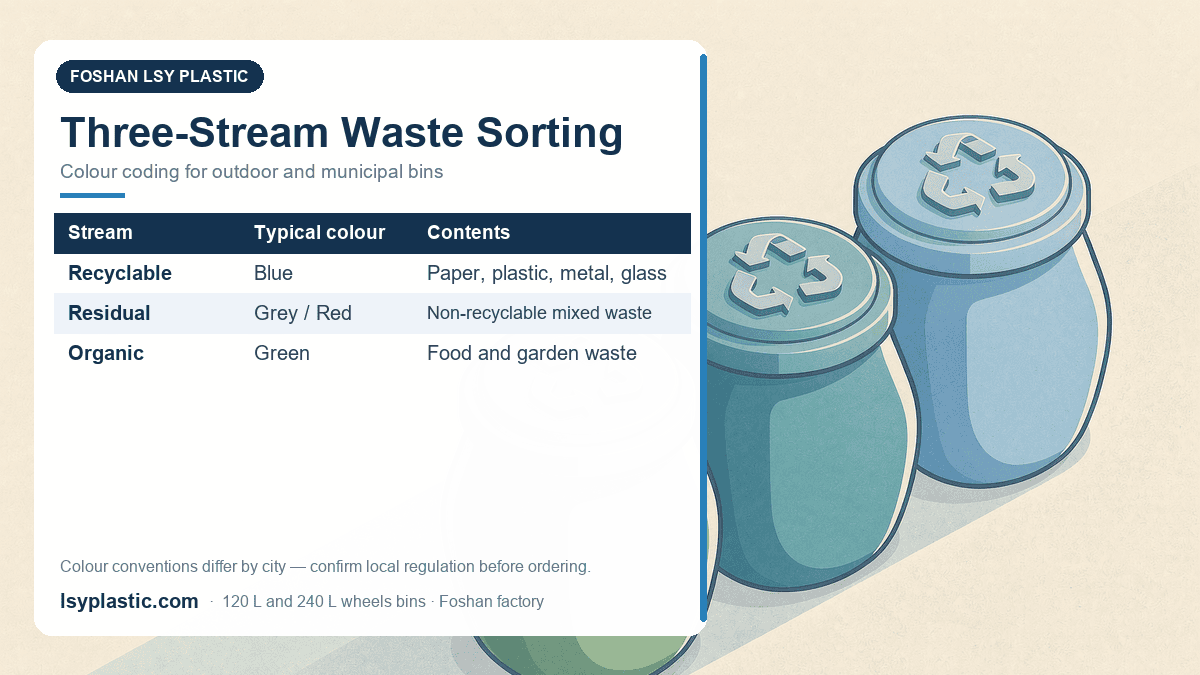
Stocking the wrong bin color has cost distributors real tenders. A municipality that collects organics in green, recyclables in blue and residual waste in black will reject a mixed shipment that reverses two of the three. For importers and wholesalers, color is not decoration — it is how collection crews, cleaners and residents sort at a glance. This guide maps the common color conventions across export markets and shows how to configure the 120L and 240L HDPE bins from FOSHAN LSY Plastic before you commit to a container.
LSY Plastic is a 35-year injection moulding factory in Foshan, China, running Japan-imported presses from 180 to 2,500 tons with a self-owned mould workshop. Its outdoor wheeled bin range is produced in-house in four stock colors: red, green, blue and black.
Why color codes decide tenders
Waste collection schemes assign one color per stream so that a driver, a cleaner or a resident never has to read a label. When the colors match the local scheme, contamination drops and collection stays on schedule. When they do not, customers either repaint, relabel or return the goods. Because bin shells are moulded in the color itself, a wrong-color order cannot be fixed downstream — the correction has to happen before moulding, not after delivery.
Common conventions by market
Conventions vary by country and even by municipality, but three patterns repeat across export markets:
Europe: green is most often organics or glass, blue is paper or recyclables, yellow is packaging in several countries, and grey or black is residual waste. Germany, France and the Nordics each publish their own local rules, so confirm the tender document before locking colors.
Gulf (GCC): municipal schemes commonly use green for organics, blue for recyclables and black for general waste, with red increasingly reserved for hazardous or medical streams in facilities.
Asia-Pacific: schemes are the most fragmented. Singapore, Malaysia and Japan each publish national guidelines, and several markets add a red stream for healthcare waste. Distributors serving multiple cities usually stock all four colors rather than guessing.
The practical rule: treat green, blue, black and red as the four-color baseline, and treat anything beyond that as a custom requirement to confirm per project.
The LSY four-color bin range
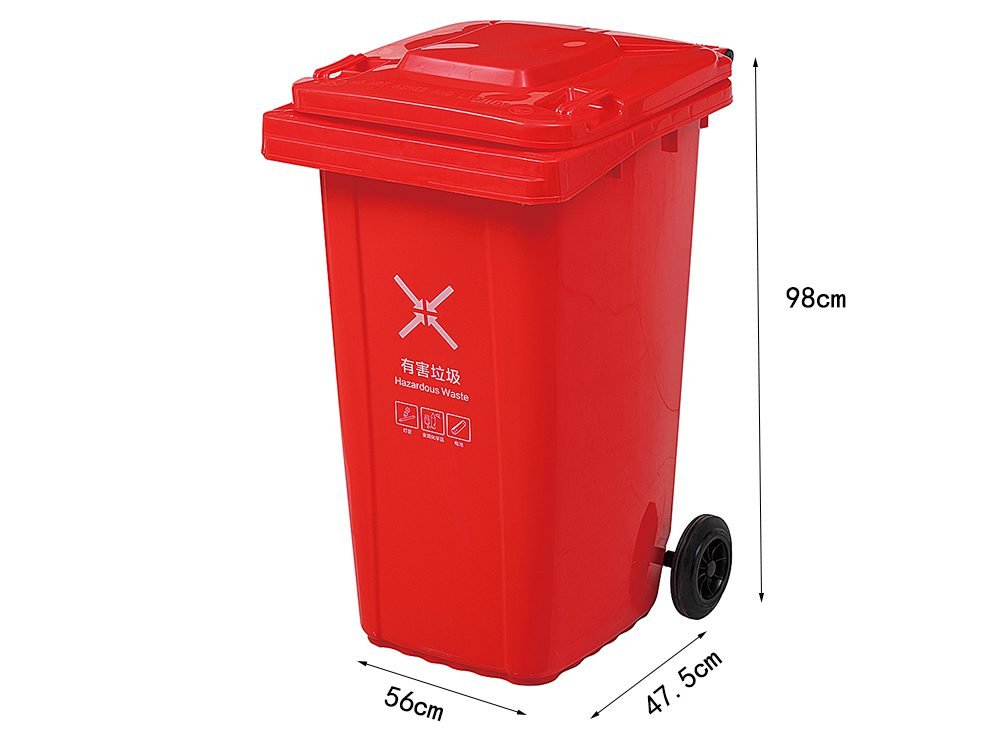
Every outdoor bin series in the outdoor wheeled bins buying guide is moulded in red, green, blue and black HDPE. The two core sizes:
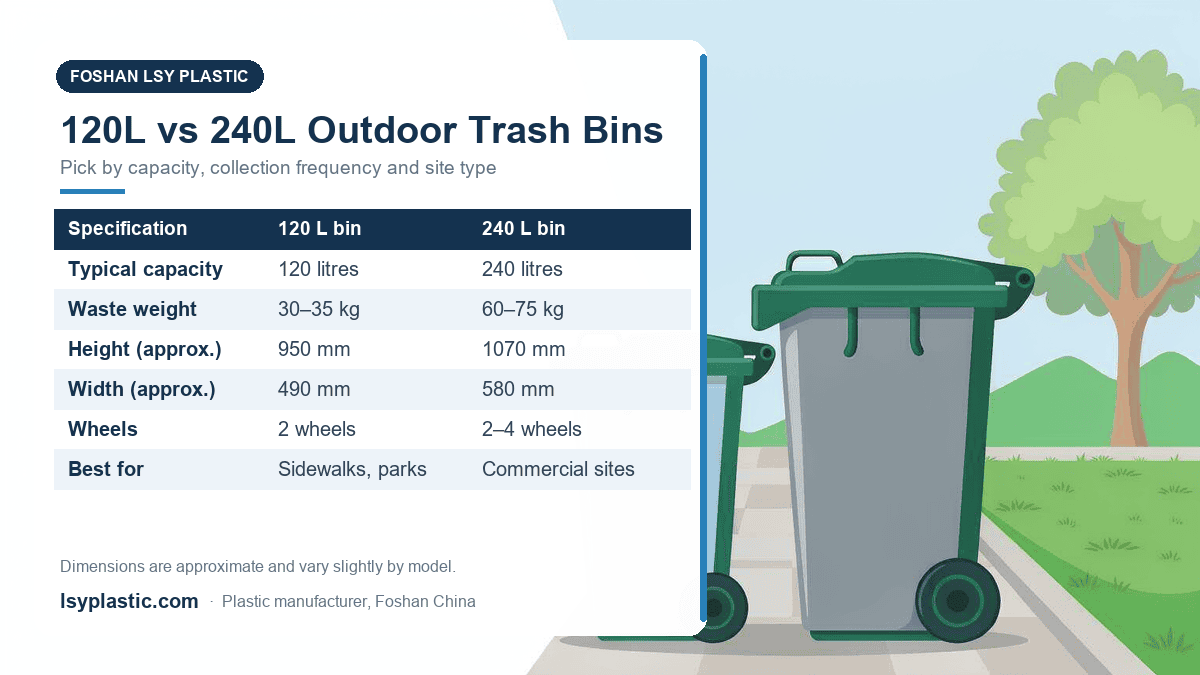
120L bin: height 930–960 mm, width 480–505 mm, depth 545–565 mm, empty weight 8–10 kg and 40–50 kg loaded. It fits standard doorways, lifts and narrow corridors, which is why offices, hotels and food courts specify it for daily collection.
240L bin: height 1,070–1,100 mm, width 580–600 mm, depth 730–760 mm, empty weight 12–15 kg and 80–100 kg loaded. It is the municipal workhorse for street collection, apartment waste rooms and commercial kitchens.
Both sizes ride on braked castors and accept flat or dome lids, and the range is offered in the standard three-color scheme plus custom colors for projects that need a fifth stream or a branded shell. Full capacity and dimension trade-offs are compared in the 120L vs 240L wheelie bin guide.
How to specify colors in one order
Most distributors mix colors inside a single container: for example, half green, a quarter blue and a quarter black for a residential program, or two colors plus red for a hospital campus. Because the shells are injection-moulded per color, confirm the split ratio per size (120L vs 240L) before the production schedule is locked, and agree in writing whether the color matches a named standard or a physical sample.
Procurement checklist
Before ordering a color-mixed bin program: confirm the local collection scheme in the tender document; map each stream to one of the four stock colors; decide the size mix using site corridor width and lift dimensions; confirm lid type per stream (flat for general waste, dome or letter-slot where security matters); and agree the color split per size in the purchase contract. For factory and warehouse programs rather than public schemes, see the dedicated industrial plastic waste bins guide.
Sourcing These Products? Buy Direct from the Factory
LSY Plastic has been an injection moulding manufacturer in Foshan, China for over 35 years. We supply hotels, restaurants and warehouses worldwide at factory-direct prices, shipped by full container load (FCL).
Buying in volume? For the same quantity, we commit to the best price on the market.
Frequently Asked Questions
Do you charge for samples?
Samples are supplied at cost price — the sample itself is not free, and courier freight is on the buyer’s account. The sample cost can be referenced against the following bulk order.
What is the minimum order quantity?
Domestic (China) orders ship by courier or logistics with no MOQ. Overseas orders ship as full container load (FCL); colors can be mixed within the container.
Can we order a color outside red, green, blue and black?
Yes — custom colors are supported for project volumes. Confirm the color standard (named standard or physical sample) and the per-size split before production is scheduled.
Related products
Related: MOQ, samples and FCL shipping policy — how we supply overseas buyers, including container loading volumes.