Sourcing custom plastic parts from a China OEM factory is one of the highest-leverage decisions an importer can make. Done right, it cuts part cost by 30-60%, secures capacity for scale, and unlocks product categories that domestic suppliers refuse to take on. Done wrong, it results in tooling rework, quality surprises, missed ship dates, and warranty claims that erase the savings. This guide walks through every step of the China custom injection molding OEM process — from initial RFQ to ongoing production quality control — and highlights the decisions that separate a good supplier relationship from a costly one.
New to custom molding? Start with the injection molding process guide for a full walkthrough.
Why Source Custom Plastic Parts from China OEM Factories?
Three structural advantages have kept China at the center of global plastic injection molding for two decades:
- Cost efficiency: lower labor, energy, and tooling cost combine to deliver 30-60% part cost savings vs. North American or European suppliers.
- Capacity scale: factories in Guangdong, Zhejiang, and Jiangsu routinely operate 50-200 molding machines producing parts at volumes few other countries can match.
- Vertical integration: many factories own mold-making shops, resin compounding lines, and assembly operations under one roof, eliminating multiple handoffs.
To skip the planning fundamentals, see our injection molding process step-by-step guide and the material selection comparison.
When Custom OEM Injection Molding Makes Sense
OEM plastic injection molding is the right call when:
- Your annual volume exceeds 5,000-10,000 parts (tooling amortization becomes favorable).
- The part geometry is stable and unlikely to change within 12-18 months.
- The part uses commodity or engineering-grade resin (PP, HDPE, ABS, PC, PA, POM).
- You need tight tolerance, repeatable quality, and cosmetic consistency.
- The brand wants to private-label or customize the part geometry.
If your volume is below 1,000-5,000 parts per year, consider prototyping, 3D printing, or low-volume bridge tooling. For volumes between those ranges, hybrid approaches (soft tooling, machined production tooling) often bridge the gap.
The 6-Step OEM Sourcing Process
Step 1: Define the Part Specification
Before contacting any factory, lock down these six specifications:
- 3D CAD file (STEP or IGES, ideally with critical dimensions called out).
- Resin grade (specific grade preferred; generic family as fallback).
- Annual volume and order frequency (quarterly, monthly).
- Cosmetic requirements (texture, color match, surface finish).
- Tolerance bands for critical dimensions (typical ±0.05 mm to ±0.2 mm).
- Regulatory requirements (FDA, EU 10/2011, REACH, RoHS, UL).
The clearer the spec, the faster the factory can quote accurately and the less risk of costly revisions after tooling starts.
Step 2: Request Quotes from 3-5 Factories
Always request quotes from multiple factories. Send the same spec package to each. Compare on the following dimensions, not just price:
- Tooling cost and tooling ownership (you own the mold or the factory retains it).
- Per-part cost at your low, mid, and high volume tiers.
- Lead time for tooling and first-article samples.
- Material certification and traceability.
- Quality management certifications (ISO 9001, IATF 16949 for automotive, ISO 13485 for medical).
- Communication responsiveness and English fluency.
Outliers on price (either low or high) are red flags. Very low quotes often hide material substitution or unfinished tooling; very high quotes may indicate over-spec.
Step 3: Audit the Factory (Virtual or On-Site)
Pre-payment tooling deposits are non-trivial. Protect your investment with a factory audit. Options include:
- Virtual audit via video call: walks through the production floor, mold shop, QC lab.
- Third-party audit: firms like SGS, Bureau Veritas, or TÜV run standardized factory capability audits.
- On-site visit: most thorough but requires travel; combine with industry trade shows such as Canton Fair or Chinaplas.
Look for: machine age and brand, mold shop capability, QC inspection stations, warehouse organization, and worker training documentation.
Step 4: Tooling Design and T1 Samples
After deposit payment, the factory produces a tooling design for approval. This typically takes 1-3 weeks. Approval launches mold machining, which takes another 4-8 weeks for steel tooling (P20, H13, S136) or 2-4 weeks for aluminum tooling.
T1 samples (first-article samples off the new mold) follow. Inspect T1 samples against your spec:
- Critical dimensions measured on a calibrated CMM or caliper, recorded in a First Article Inspection (FAI) report.
- Cosmetic appearance against the approved color standard.
- Functional fit-check against mating parts.
- Material verification via melt flow index or density test.
Approve T1 or request changes. Two rounds of revisions are typical; three or more suggest a tooling design issue that needs a deeper review.
Step 5: Production Run and Quality Control
After T1 approval, the factory runs the production batch. Quality control during production can take several forms:
- First-in / first-out inspection on every batch start.
- In-process checks at hourly intervals during the run (dimensions, weight, visual).
- AQL sampling at finished goods (Acceptable Quality Level, typically 1.0 to 2.5 for industrial parts).
- Pre-shipment inspection by your team, a third party, or a factory-employed QC inspector.
Insist on retaining samples from each production run for traceability. If a quality issue surfaces after delivery, retain samples let you and the factory identify whether the defect was present at the point of shipment or introduced post-shipment.
Step 6: Logistics, Customs, and Delivery
Production parts ship via sea freight (FCL or LCL), air freight (urgent orders), or courier (samples). Sea freight is most economical for production volumes; expect 25-40 days door-to-door from China to North America or Europe.
The factory typically provides commercial invoice, packing list, bill of lading, and any certificates of conformity or test reports. Customs clearance on your end requires the HS code, country-of-origin declaration, and compliance with any import regulations (FDA prior notice for food-contact parts, REACH for chemicals, etc.).
MOQ, Lead Time, and Cost: Real Numbers for 2026
| Order Specification | Typical MOQ | Tooling Lead Time | Production Lead Time | Cost per Part (Compared to NA/EU) |
|---|---|---|---|---|
| Simple 1-cavity tooling, mid-volume | 1,000-5,000 pcs | 4-6 weeks | 3-4 weeks | 40-60% lower |
| Multi-cavity tooling, mid-to-high volume | 10,000-50,000 pcs | 6-10 weeks | 4-6 weeks | 50-70% lower |
| Complex tooling, high volume | 50,000+ pcs | 10-14 weeks | 6-10 weeks | 60-75% lower |
| Insert molding or over-molding | 5,000+ pcs | 8-12 weeks | 4-6 weeks | 50-65% lower |
| Two-shot or multi-material molding | 10,000+ pcs | 10-14 weeks | 4-6 weeks | 55-70% lower |
Common Pitfalls and How to Avoid Them
Pitfall 1: Choosing on Price Alone
The lowest quote often wins the order and then loses the relationship. Always weigh tooling quality, resin grade, audit results, and communication alongside price.
Pitfall 2: Skipping the Tooling Design Review
Tooling is an upfront investment. Rushing the design review or skipping your own engineer review can mean reworking the tool after T1, costing weeks and thousands of dollars.
Pitfall 3: Inadequate Specification
Vague specs lead to surprise deviations. Lock down tolerances, color, texture, regulatory requirements, and inspection criteria before tooling kicks off.
Pitfall 4: No Pre-Shipment Inspection
Skipping pre-shipment inspection to save cost is a false economy. One shipment of defective parts erases the savings from years of cheap production.
Certifications That Matter
Verify which certifications the factory holds and which are relevant to your application:
- ISO 9001: baseline quality management system.
- IATF 16949: required for automotive parts.
- ISO 13485: required for medical devices.
- FDA / EU 10/2011: compliance for food-contact parts.
- REACH / RoHS: chemical and substance compliance for the EU market.
- UL / CSA: electrical safety for parts used in electrical products.
For a refresher on injection molding basics, see our process step-by-step and the PP vs HDPE vs ABS material selection guide. Browse the complete injection molding hub for tooling, materials, and OEM capability overviews.
Need reliable plastic products for your business? LSY Plastic manufactures hotel luggage carts, HDPE & PP pallets, and custom injection-molded parts with 35+ years of OEM experience. Contact us today:
WhatsApp: +86 19311059570
Email: fstyx01@lsyplastic.com
Looking for custom injection molded parts? Explore our OEM and ODM injection molding services range — injection molded in our own factory with 35+ years of experience.
Frequently Asked Questions
What is the China OEM injection molding sourcing process?
A typical flow runs: RFQ with drawings or samples, supplier selection and design-for-manufacture review, tooling build with first samples, sample approval, pilot or first-article, then mass production with quality control. Clear drawings and a defined quality standard at step one prevent tooling rework later.
What MOQ and lead times should I expect?
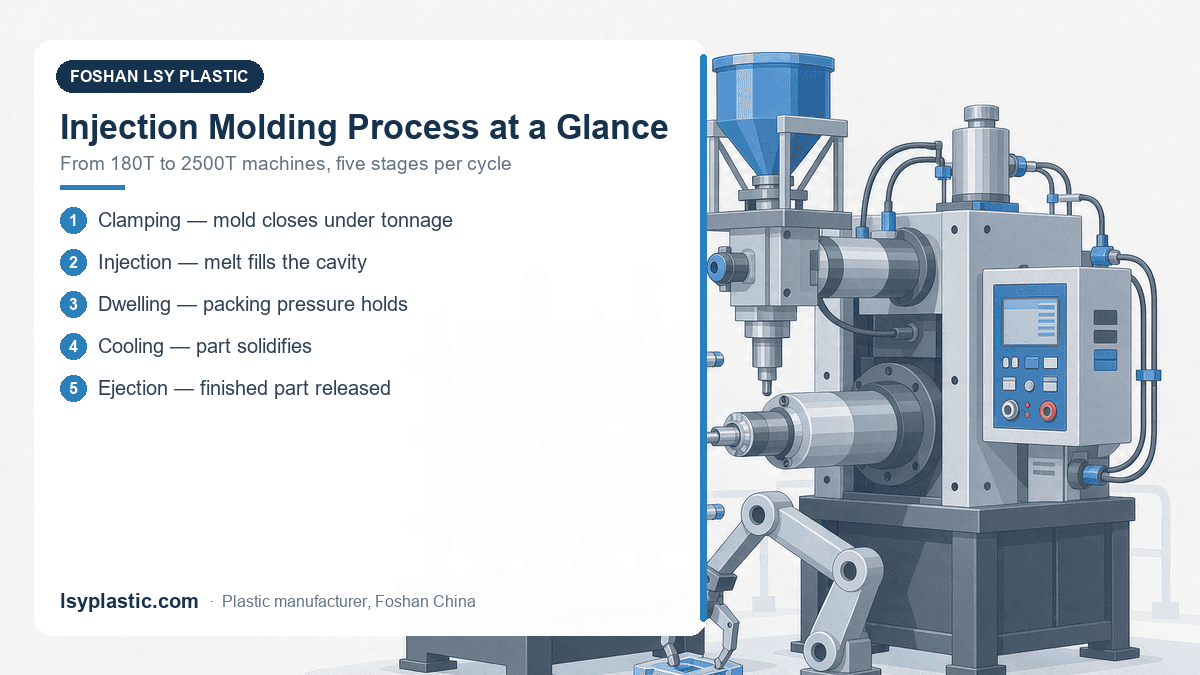
Tooling is a one-time cost; part MOQ depends on mould cavity count and order size, and lead time covers tooling (weeks) plus production. LSY runs Japanese machines from 180T to 2500T. There is no MOQ for domestic orders, and overseas orders ship FCL.
How much can sourcing from a China OEM factory save?
Done right, part cost typically falls 30 to 60 percent versus domestic production while securing capacity for scale. The savings are real only if tooling is done correctly and quality control is in place, otherwise rework and warranty claims erase them.
What certifications should a China OEM supplier have?
Look for ISO 9001 quality systems and, depending on end use, food-contact approvals (FDA, EU 10/2011, LFGB) or toy safety (EN71). Ask for certificates that name the exact material and model you are buying, because a generic certificate is not enough.