
A housekeeping cart is a system, not a trolley. The frame is the cheap part; the accessories attached to it decide whether a room attendant finishes a floor in three hours or four. This checklist covers every accessory that earns its place on the cart, the spares ratio a property should hold, and the replacement triggers most hotels miss.
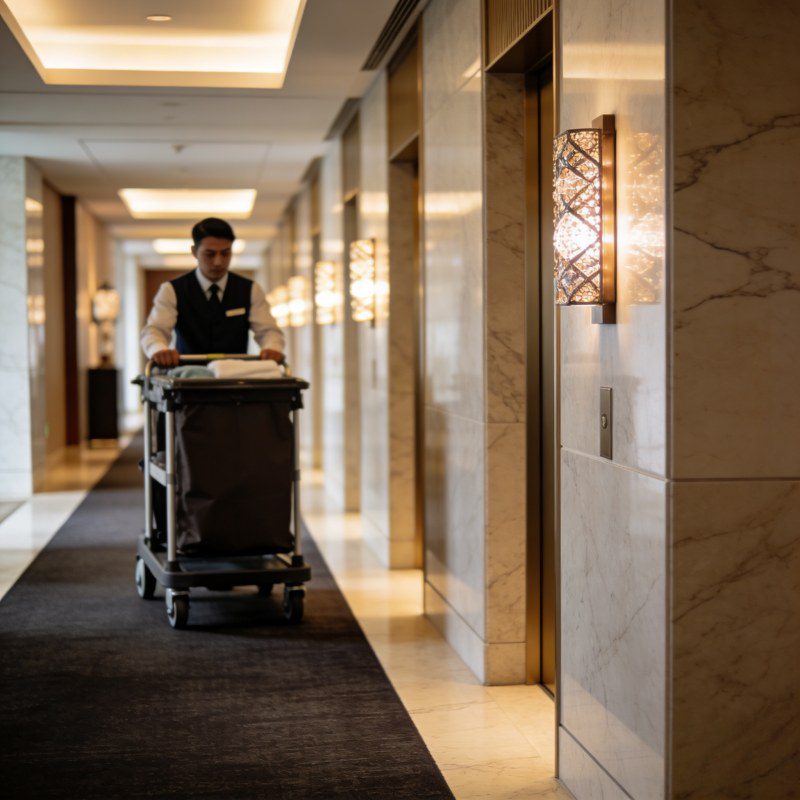
The core accessory set
| Accessory | Function | Stock ratio |
|---|---|---|
| Linen bag frame + bags | Dirty linen separation from clean stock | 3 bag sets per cart position |
| Trash bag holder | Wet/dry waste away from linen | 1 per cart + 20% spares |
| Caddy tray | Chemicals, cloths, small tools | 1 per cart, removable |
| Dustpan & brush clip | Spot cleaning without returning to store | 1 per cart |
| Sign / DND holder | Service status display | 1 per cart |
| Spare caster set | Keeps cart in service on failure | 1 set per 5 carts |
Bag systems: the three-set rule
Hotels that run two bag sets per cart are always one delayed wash away from a floor stopping. The reliable pattern is three: on-cart, in-wash, staged-clean. Our linen bag systems guide covers frame sizing and bag material choice in depth; the accessory-level point is simpler — buy bags with reinforced rims and measure the frame before ordering, because “standard size” varies by 10 cm between manufacturers.
Liners: match the frame, not the label
- Measure frame circumference and depth in millimetres.
- Order liners 10–15% deeper so the rim folds and clamps.
- Standardise one liner spec across all carts to simplify purchasing.
Undersized liners tear at the rim within days and oversized liners collapse into the frame — both look like a “quality problem” but are actually a spec problem.
Casters: the accessory with a hard budget impact
One seized caster slows a room attendant by seconds per door, which compounds to 15–20 minutes per shift across a floor. Replacement triggers: marking on floors, binding swivels under no load, or visible flat-spotting. Full rating and material guidance is in our hotel trolley casters guide; as a spare-parts rule, one complete set of four wheels per five carts keeps the fleet moving while a failed unit is swapped out in minutes.
Caddy trays and chemical control
The caddy is where safety compliance lives. A divided caddy with bottle restraints keeps guest-visible chemicals separated and upright; an open tray does neither. Check that the caddy lifts out completely — carts get deep-cleaned weekly, and a fixed caddy turns that into a two-person job.
Quarterly accessory audit
| Check | Pass condition |
|---|---|
| Bag frames | No cracks, hooks intact, bag rim clamps hold |
| Liners/bags stock | 3-set ratio intact, correct size on reorder |
| Casters | Spin free, no marking, no flat spots |
| Caddy | Dividers present, restraints functional |
| Signs & clips | All present, legible, securely mounted |
A fifteen-minute audit per quarter prevents the slow drift into “everything rattles and nothing clips on” — the state that quietly costs one extra room-hour per attendant per day.