In Saudi Arabia and the UAE, the pallet choice is not just a cost decision—it is a climate decision. With summer heat above 45 °C, sand-laden air and strict food-safety rules, warehouse operators in Riyadh, Jeddah, Dubai and Abu Dhabi are redoing the old wood-versus-plastic math. This guide compares the two materials under real desert conditions, on lifespan, hygiene, temperature, pests, weighing accuracy and total cost.
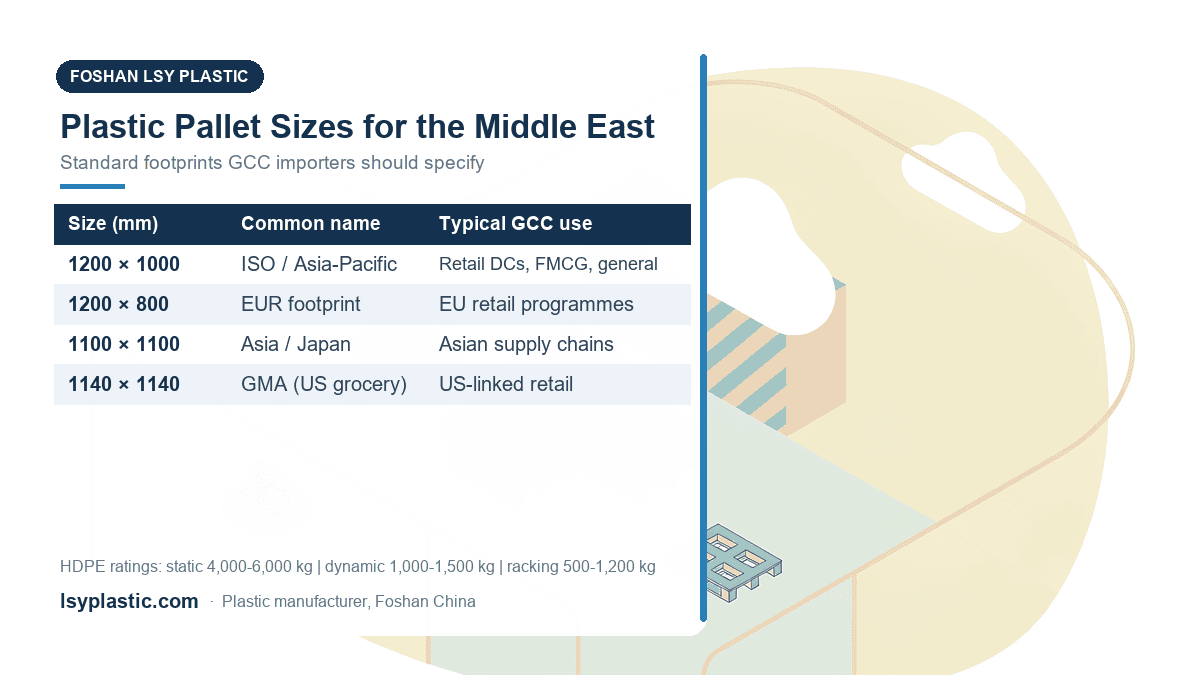
If you are shortlisting pallets, start with our guide to plastic pallet sizes and dimensions for export and warehousing.
What the Desert Does to Wooden Pallets
Wooden pallets were designed for temperate, dry warehouses, not Gulf summers. In desert climates they degrade along four fronts:
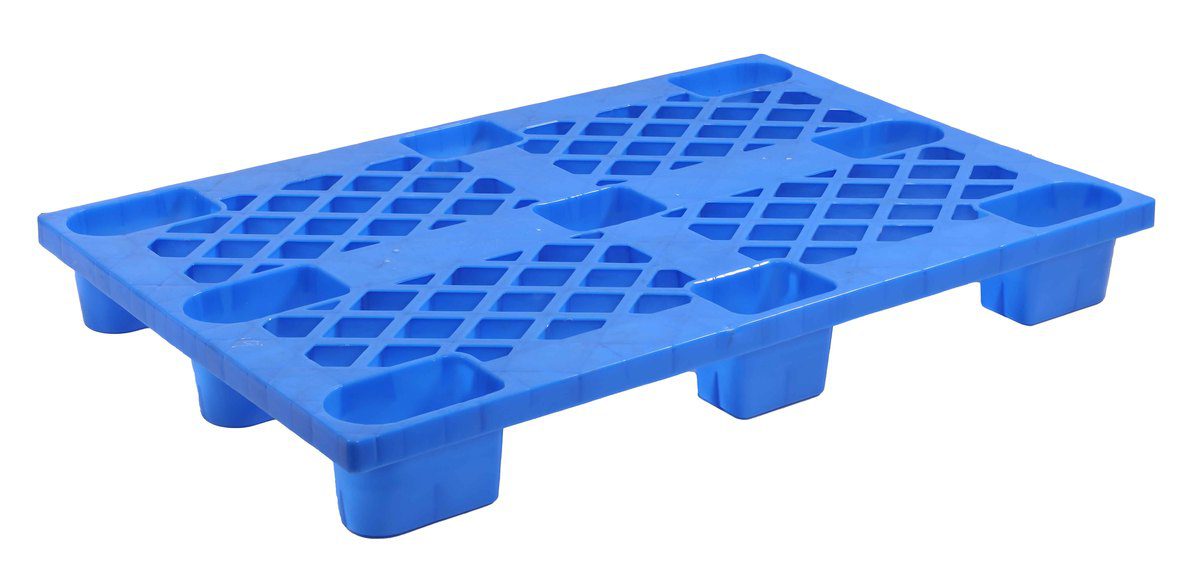
- Heat cycling and warping — day-to-night temperature swings and hot tarmac stress the boards; pallets bow, split and loosen their nails within a couple of years.
- Humidity and condensation — cold stores and port air drive moisture into the boards; wood swells, rots and grows mildew, which then contaminates product and audits.
- Sand abrasion — blowing sand erodes boards and finishes, leaving splinters that damage cartons and bags.
- Pest pressure — imported wood must be insect-tight; in warm climates any untreated wood is an open door for borers.
The result: in Saudi and UAE operations, wooden pallet service life is measurably shorter than the 5+ years a temperate warehouse would expect. Repairs and replacement become a recurring line item, not a one-off.
What the Desert Does to HDPE Plastic Pallets
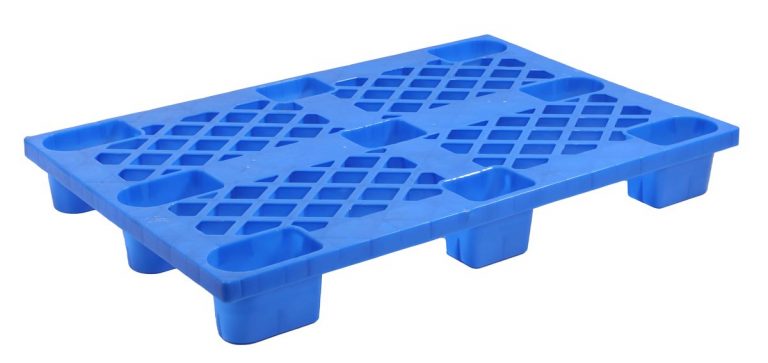
HDPE plastic pallets are molded from resin that simply does not absorb water, feed insects, or splinter. Under Gulf conditions the practical advantages are:
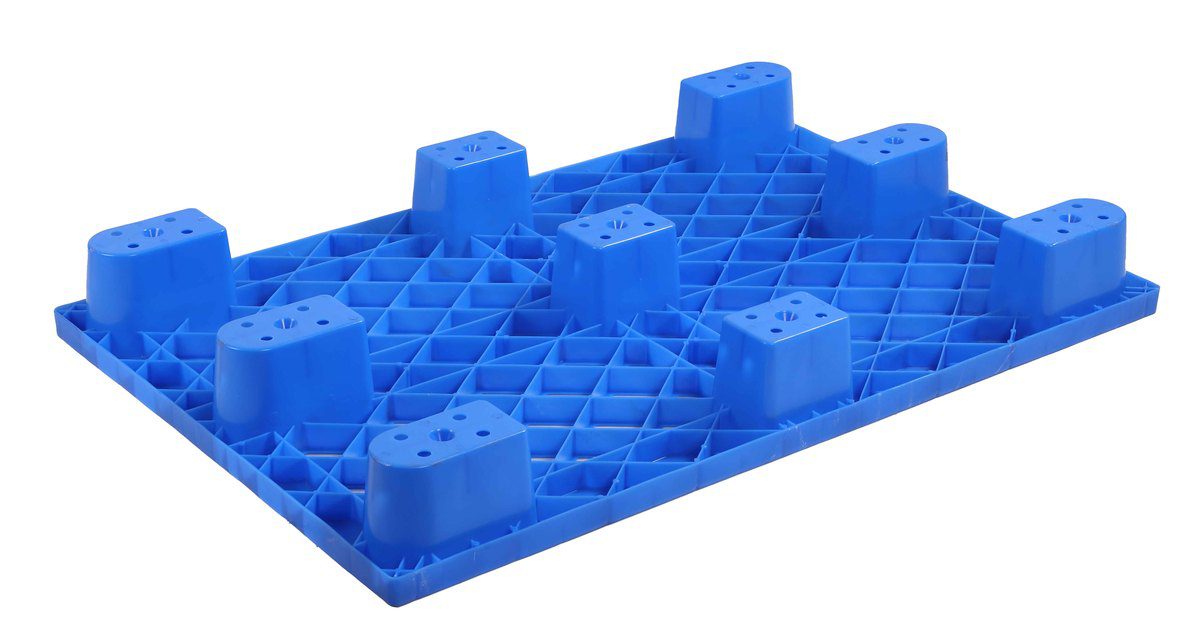
- Heat stability — HDPE keeps its mechanical strength in hot stores and on sunny quays; it does not warp or shed parts under temperature cycling.
- Zero moisture pick-up — no swelling, rot or mildew in cold stores or humid reefer ports.
- Sand-friendly surface — smooth and non-porous, easy to wash or blow clean before audits or export.
- UV caution — for pallets left outdoors for years, specify UV-stabilized HDPE to prevent surface brittleness. Indoor fleets do not need it.
One honest caveat: plastic pallets cost more up front, and in extreme prolonged heat the racking load rating of a plastic pallet should be confirmed with the manufacturer’s test data rather than assumed. For a deeper material comparison, see our plastic vs wooden pallets full comparison.
Hygiene and Food-Safety Compliance in Saudi and UAE
Saudi Arabia’s food-safety regulator (SFDA) and the UAE’s municipal food-safety programs inspect warehouses, cold stores and market floors. Wooden pallets are a chronic finding: splinters in product, moisture-stained boards, and hard-to-sanitize surfaces. Plastic pallets are smooth, non-porous and pressure-washable, which is why food-grade HDPE pallets are increasingly the default for food and beverage distribution in the GCC.
For direct food-contact applications, choose food-grade HDPE with the relevant food-contact compliance certificates. Pallets used only for secondary packaging (cartons, boxes, drums) do not need food-grade resin, but they still benefit from the washable, splinter-free surface.
ISPM-15 and Cross-Border Compliance
Wooden pallets moving across borders must meet ISPM-15: they are heat-treated or fumigated and stamped. In the Gulf, where imports arrive from dozens of origins, a single unmarked or infested pallet can hold up a whole container at inspection. Plastic pallets are exempt from ISPM-15—there is nothing living in them to treat. That exemption saves paperwork, inspection delays, and the cost of fumigation, and it makes plastic pallets far easier to re-export on return legs. For more detail, see our ISPM-15 export compliance guide.
Weighing Accuracy and Supply Chain Efficiency
A molded plastic pallet weighs the same, pallet after pallet, with tight tolerance. Wooden pallets vary by several kilograms depending on moisture content—a board that dried in a hot warehouse can be visibly lighter than one taken from a reefer. For any operation that weighs loads in or out, or bills by weight, that variance is silent revenue leakage.
Consistent dimensions also matter for automation. AGVs, ASRS cranes and conveyor systems read pallet geometry; plastic pallets hold dimensional tolerance far better than wood, which swells and shrinks with humidity. Saudi and UAE e-commerce and 3PL operators moving toward automation consistently favor HDPE pallets for this reason.
Total Cost of Ownership: The Real Comparison
The upfront price gap is real: a wooden pallet typically costs a fraction of an HDPE pallet. But under desert conditions the total cost equation favors plastic faster than it does in temperate markets:
- Lifespan — wood in Gulf use may last only a few years with repairs; a well-made HDPE pallet is commonly used for 8–10 years or more.
- Repair and replacement — broken boards and loose nails create an ongoing repair cost that plastic never has.
- Product protection — splinters, protruding nails and moldy boards damage goods; damaged goods are write-offs, not pallet costs.
- Hygiene and audit risk — failed audits, rejected loads and re-cleaning are expensive surprises.
- Residual value — plastic pallets are recyclable at end of life; waste wood often costs money to remove.
When you model these factors over a 5–10 year horizon for a Saudi or UAE warehouse, most operators find plastic reaches break-even well within the first few years, then keeps saving money every year after.
Which Pallet Should Saudi and UAE Warehouses Choose?
- Food, pharma, retail and any washable operation: food-grade HDPE plastic pallets.
- Racked distribution centers and automated facilities: plastic pallets with verified racking ratings and tight dimensional tolerance.
- Outdoor storage, long UV exposure, or one-way export lanes: weigh UV-stabilized plastic versus cheap wood carefully—if the pallet will not return, wood may still win on cash flow.
- Most floor-stacked, closed-loop Gulf operations: plastic is the lower total cost over the asset’s life.
LSY Plastic is a 30+ year manufacturer of HDPE pallets in 180T–2500T injection molding machines, with a 20,000 m² warehouse and OEM supply to BYD, OPPO, vivo, Desay and Meituan. We ship across the Middle East with load test reports and food-grade options.
Get a Quote
Evaluating HDPE pallets for Saudi Arabia, the UAE or Qatar? Send us your load profile, racking span and quantity, and we will return a quote, test data and a container loading plan within 24 hours.
Contact our export team:
WhatsApp: +86 193 1105 9570
Email: fstyx01@lsyplastic.com
Browse our range at lsyplastic.com or request our catalog.
Frequently Asked Questions
How does the desert climate affect wooden pallets?
Heat above 45C, very low humidity and airborne sand dry and crack wood, warp and splinter it, and it absorbs water when it does rain. Wood also harbours pests and needs ISPM-15 treatment for any cross-border movement.
Why is HDPE better in desert climates?
HDPE’s UV stability, moisture resistance and impact strength handle 45C-plus summers and sand far better than wood or even PP. It does not absorb water, rot, warp or grow mould, which keeps loads clean in Riyadh, Jeddah, Dubai and Abu Dhabi.
Which pallet should Saudi and UAE warehouses choose?
For hygiene-critical, reusable or export operations, HDPE plastic wins on lifespan, hygiene and pest risk; wood only makes sense for one-way, low-value loads. Follow your trade lane for size, usually ISO 1200x1000mm or EUR 1200x800mm.
Do plastic pallets need ISPM-15 treatment?
No. ISPM-15 is a phytosanitary rule for wood packaging, so plastic pallets are exempt, which avoids fumigation stamps, delays and rejection at GCC borders. LSY moulds HDPE pallets for hot-climate full-container export.