
Product Overview: The Ultimate Hygiene Solution
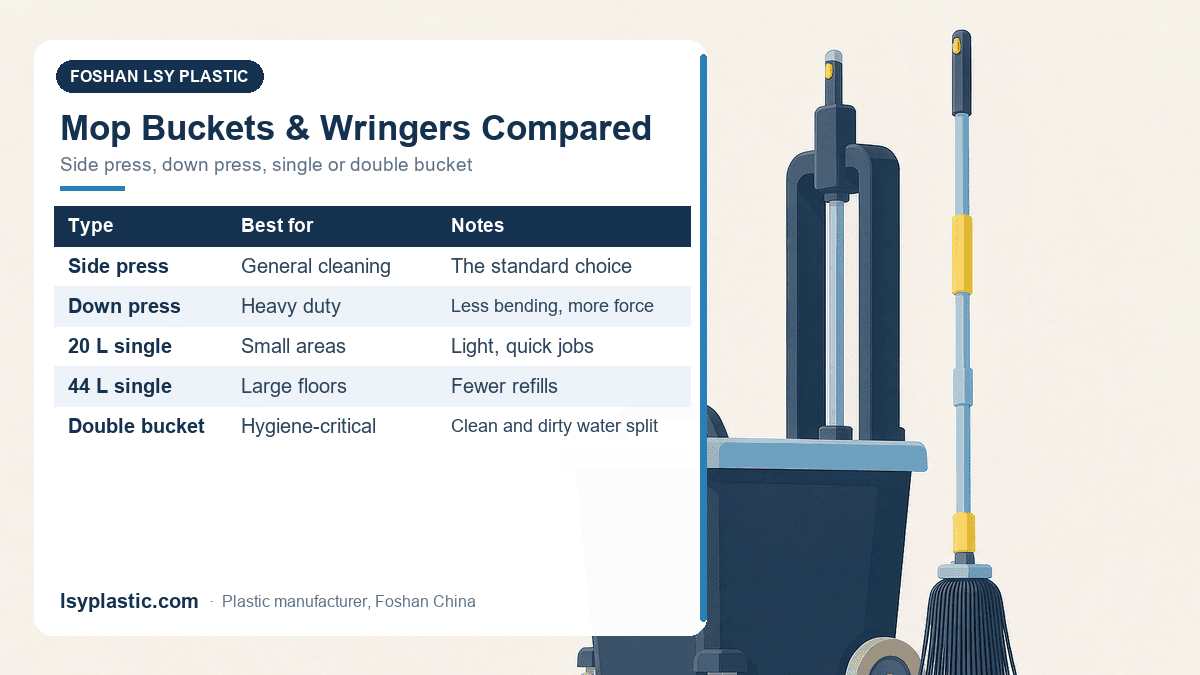
Efficiency meets superior sanitation with the 8528A Double Mop Bucket System. While single-bucket systems are great for quick spills, the 8528A is designed for deep, professional cleaning where cross-contamination is not an option.
By utilizing a two-bucket architecture, this system allows janitorial staff to keep fresh cleaning solution completely separate from the dirty rinse water. The result? Floors that aren’t just “wiped,” but truly sanitized. Built on a heavy-duty rolling chassis with a high-leverage wringer, the 8528A is the workhorse of choice for hospitals, food prep areas, and high-traffic commercial zones.
Key Features & Professional Advantages
- True Two-Bucket System: Features two independent 25L buckets (50L total capacity). One side holds your clean chemical solution, while the other catches the dirty water, ensuring you never put grime back onto the floor.
- High-Leverage Down-Press Wringer: Engineered to extract more water with significantly less physical effort. The downward motion is more ergonomic for the user and more effective for heavy industrial mops.
- Heavy-Duty Rolling Chassis: The buckets sit securely on a reinforced steel or high-impact plastic frame, providing a stable base that won’t tip, even when navigating thresholds or uneven floors.
- Color-Coded Efficiency: Typically outfitted with Red and Blue buckets to help staff instantly distinguish between clean and dirty water, or to follow strict zone-cleaning protocols.
- Quiet-Glide Casters: Equipped with non-marking, 360-degree swivel wheels that move silently across polished surfaces without leaving streaks.
Technical Specifications
| Model No. | System Type | Total Capacity | Product Size (cm) | Packing Size (cm) | Wringer Type |
|---|---|---|---|---|---|
| 8528A | Double Bucket System | 50 Liters (2x25L) | 86 x 41 x 91 | 75 x 42 x 52 | Professional Down-Press |
Specialized & Double Bucket Carts
| Model No. | Type & Key Features | Capacity | Product Size (cm) | Packing Size (cm) | Color |
|---|---|---|---|---|---|
| 8529A-25 | Single Bucket / Under Pressure Frame | 25L | 54 × 36 × 90 | 45 × 36 × 48.5 | Blue / Red |
| 8529V-25 | Single Bucket / Side Pressure Frame | 25L | 54 × 36 × 90 | 45 × 36 × 48.5 | Blue / Red |
| 8528A-25*2 | Double Bucket / Under Pressure (Electroplating) | 25L × 2 | 75 × 41 × 88 | 74 × 41 × 43 (1pc) | Blue + Red |
| 8528A-25*2 | Double Bucket / Under Pressure (Spray Painting) | 25L × 2 | 75 × 41 × 88 | 74 × 41 × 43 (1pc) | Blue + Red |
| 8528V-25*2 | Double Bucket / Side Pressure (Electroplating) | 30L × 2 | 75 × 41 × 88 | 74 × 41 × 43 (1pc) | Blue + Red |
| 8528V-25*2 | Double Bucket / Side Pressure (Spray Painting) | 30L × 2 | 75 × 41 × 88 | 74 × 41 × 43 (1pc) | Blue + Red |
Frequently Asked Questions (FAQ)
1. Why is a “Clean and Dirty Water Separation” system important?
Traditional mopping often involves dipping a dirty mop back into clean water. A Double Bucket Trolley prevents this cross-contamination, ensuring that only fresh cleaning solution touches your floor, which is essential for meeting modern health and safety standards.
2. Should I choose a Down-press or Side-press wringer?
Down-press wringers are generally more ergonomic for the user as they utilize downward body weight. Side-press wringers are highly durable and often preferred for their simplicity in general-purpose cleaning.
3. Are the wheels suitable for sensitive flooring?
Yes. Our trolleys use non-marking rubber casters that glide silently and safely over hardwood, tile, and polished concrete without leaving scuffs or noise.
More from LSY Plastic
Browse the full Janitorial & Cleaning Trolleys range, or read our guide: Mop Bucket and Wringer Sizes (18L–44L): Capacity Guide for Hotels and Janitorial. Factory-direct MOQ and FOB quotes within 24 hours.
How these wringer buckets are made
Capacity and mop head first — the wringer has to match the head size, or the stroke will not pull the water out.
Mop buckets and wringers fail at the wringer, not the bucket. The moulded gear and the press plate take the whole mechanical load, so the wall thickness and the rib pattern behind the pressing face decide service life.
Where buyers actually use these wringer buckets
Capacity and mop head first — the wringer has to match the head size, or the stroke will not pull the water out.
Contract cleaners, hotels, hospitals, schools and food plants specify wringer buckets by the mop head and the floor area per shift. The mechanism has to wring a mop dry enough that a floor is safe to walk on minutes later.
Ordering, wringer options and shipping
Samples are charged at cost, and for a wringer the sample is worth more than the spec sheet — the moulded gear and the press plate take the whole mechanical load, so you want to feel the stroke before committing. Domestic orders have no minimum quantity; export orders move as full container loads (FCL).
The wringer is specified as a serviceable assembly rather than a sealed unit, so a worn gear or press plate can be replaced without scrapping the whole bucket. Confirm the model code when ordering, because the 20 L, 25 L and 36 L frames do not share the same mechanism.
On the 8528A, confirm the wringer model and the mop head size together; if the two do not match, the stroke will not pull the water out.
For the full selection logic behind this product family, see our commercial mop bucket guide.
FAQ
Are samples free?
Samples are charged at cost.
What is the minimum order?
No minimum on domestic orders; export orders ship as full container loads.
Is the wringer replaceable?
The press mechanism is specified as a serviceable assembly — confirm the model when ordering.
Double bucket wringer system: separating clean from dirty
A two-bucket system exists to stop clean water meeting dirty water, which is the single biggest cause of cross-contamination in floor cleaning. The system only works if the two buckets are clearly distinguished — by colour, by labelling or by a fixed position on the cart.
How the collection bucket fits into the cleaning round
A collection bucket is one component of a cleaning system, not a standalone product. What decides whether it works is the cart it hangs on, the liner it takes and the route it travels. A bucket that does not clip securely to the cart gets carried by hand, which is how handles break and how staff end up making two trips.
Capacity should follow the round: a bucket that is emptied once per floor can be smaller than one that travels a whole building. Oversizing to reduce emptying frequency usually backfires — a heavy bucket gets dragged rather than carried, and the base takes damage a correctly sized unit never sees.
The liner ring is the part buyers forget
Most of these buckets are designed around a liner retained by a ring or a lip. Order the buckets without checking the liner fit and the bag slips inside on the first day, which makes the whole system unusable in practice. Confirm the liner size against the bucket’s internal dimensions, and check whether the retaining ring is included or a separate item.
Material and the cleaning chemicals it meets
Standard polypropylene and polyethylene handle normal cleaning chemicals well. Aggressive solvents and some disinfectants at high concentration will attack the surface over time, and the failure shows up as stress cracking around the rim and the handle mounts. If the property uses a strong chemical regime, say so at the quotation stage — a different material grade can be specified.
Frequently asked questions
Is the liner retaining ring included?
It varies by model. Ask explicitly on the order — a bucket designed for a ring does not work well without one, and retrofitting is not always possible.
What capacity is usual for hotel floor service?
It follows the route rather than the property size. Size for one floor or one shift of emptying, not for the whole building.
Can the buckets be colour-coded by area?
Yes, subject to a minimum quantity per colour. Colour coding by area or by chemical is a common way to prevent cross-contamination in cleaning systems.
Ordering notes: wringer model and capacity
Capacity and mop head first — the wringer has to match the head size, or the stroke will not pull the water out.
- Colour. Send a RAL or Pantone reference rather than a colour name. Stock colours ship faster; custom shades carry a minimum quantity per colour.
- Export packing. Overseas orders ship as full container loads (FCL). Loose cartons are not consolidated for export.
- Samples. Samples are supplied at cost price plus freight, not free of charge.
- Lead time. Stock colours from existing moulds run a few weeks from deposit and artwork confirmation. Custom colour or new tooling adds time and is confirmed in writing with the quotation.
- Documentation. Commercial invoice, packing list and bill of lading as standard; certificate of origin where the destination requires it.
Related reading: hotel janitorial cart guide.
Where these wringer buckets ship
Wringer and mop bucket shipments from this line go mostly to Vietnam, the Philippines, Qatar, Singapore. Export orders move full container load; samples are charged at cost and credited against a confirmed order.


