What Is a Plastic Layer Pad?
A plastic layer pad is a rigid moulded board that sits between layers of stacked goods — on a pallet, inside a crate or on a shelf — to spread load across the layer beneath, keep goods separated, and let air or water move through the stack. In warehouse and export logistics the same product is also called a deck board, separator board or dunnage board.
LSY Plastic moulds these pads in perforated and slatted designs for customers who want a reusable replacement for cardboard sheets, plywood and timber boards. They are used wherever a stack has to stay stable, ventilated and clean across many trips rather than one.
Why Moulded Plastic Instead of Cardboard, Plywood or Timber
Separator sheets in cardboard and plywood are cheap the first time and expensive the tenth. Moulded plastic pads change the economics of the stack:
- Reusable across hundreds of trips. A moulded pad survives handling, moisture and repeated washing. Cardboard delaminates after one wet cycle; plywood splinters and loses screws.
- Moisture-proof and washable. HDPE and PP do not absorb water, so pads can be hosed or washed down and returned to service the same shift.
- No splinters, staples or nails. Nothing on the pad can puncture bagged goods, damage labels or injure hands.
- No ISPM-15 wood packaging treatment. Because there is no wood in the product, export shipments avoid heat-treatment and fumigation marking. See our guide to plastic pallets and ISPM-15 export compliance.
- Load spreading and stack stability. Moulded ribs and feet spread point loads and give the layer above a flat, predictable surface, which is exactly what stops a tall stack from leaning.
- Closed-loop recyclable. Worn pads can be reground and returned to production — see plastic pallet recycling and sustainability.
LSY Moulded Layer Pad Range
Our current moulds cover the sizes below. All are moulded in a single piece with a reinforced underside, so the pad keeps its shape across the full area instead of sagging in the middle.
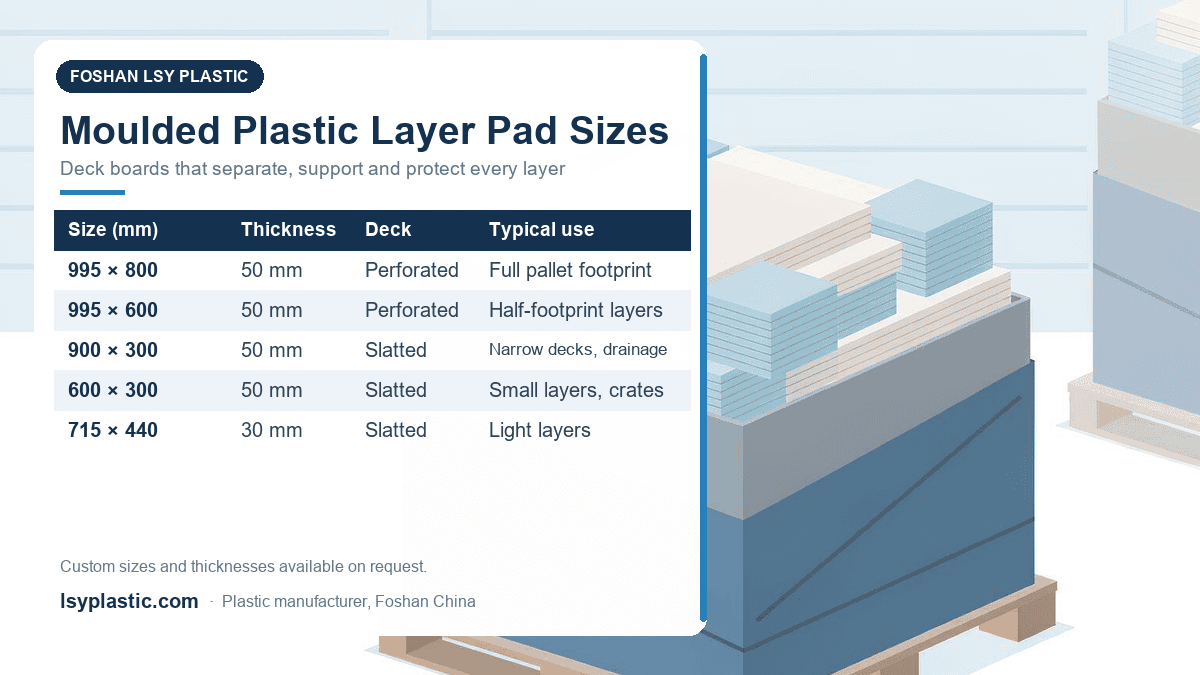
| Overall size (mm) | Deck thickness | Deck surface | Typical use |
|---|---|---|---|
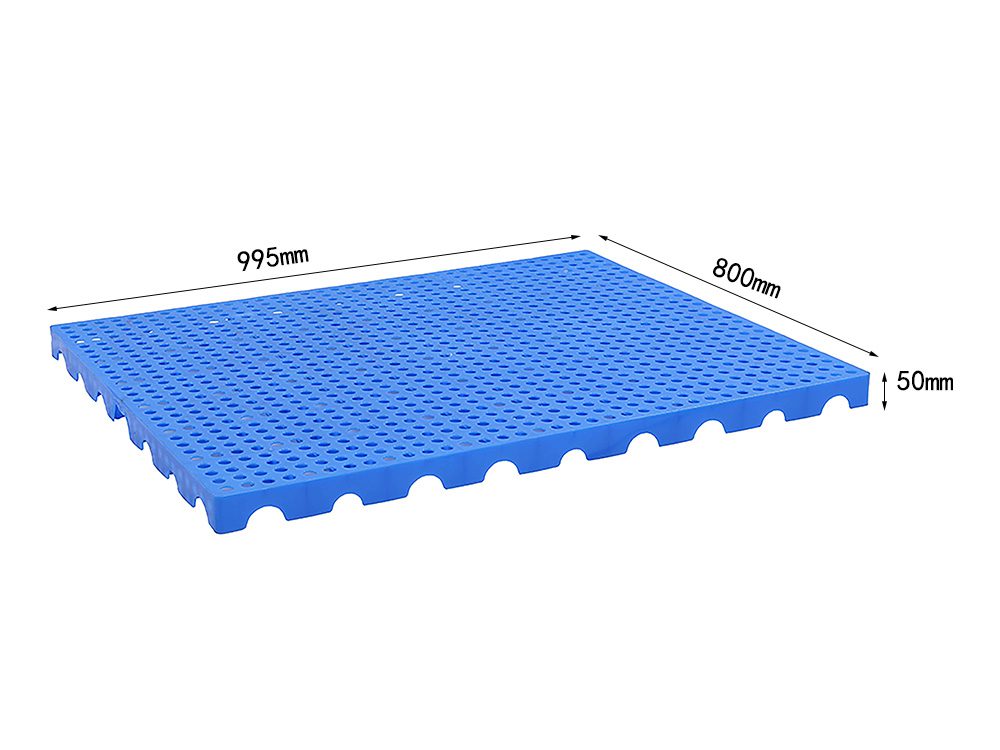
| 995 x 800 x 50 | 50 mm | Perforated | Full pallet-footprint layer separation |
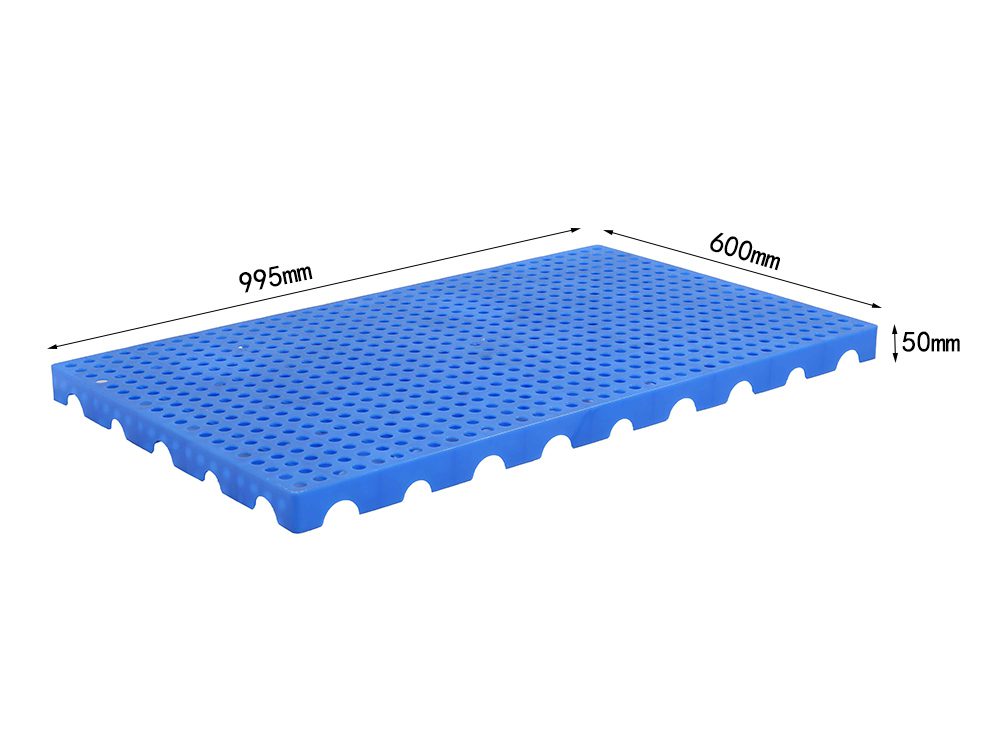
| 995 x 600 x 50 | 50 mm | Perforated | Half-footprint layers and shelving |
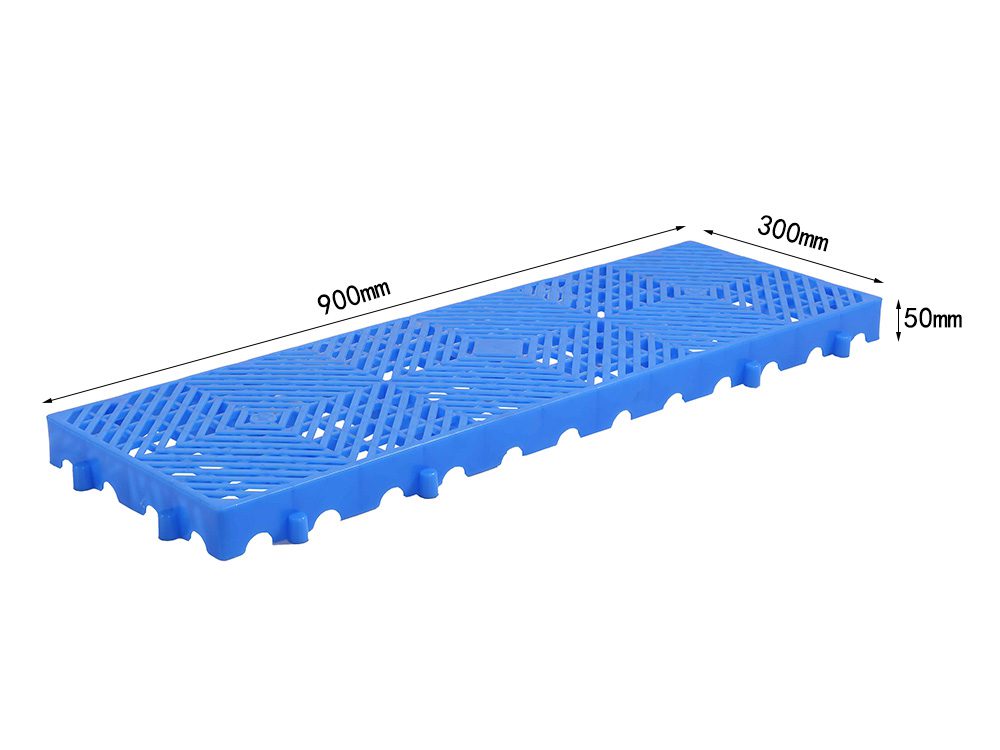
| 900 x 300 x 50 | 50 mm | Slatted | Narrow decks, drainage and airflow |
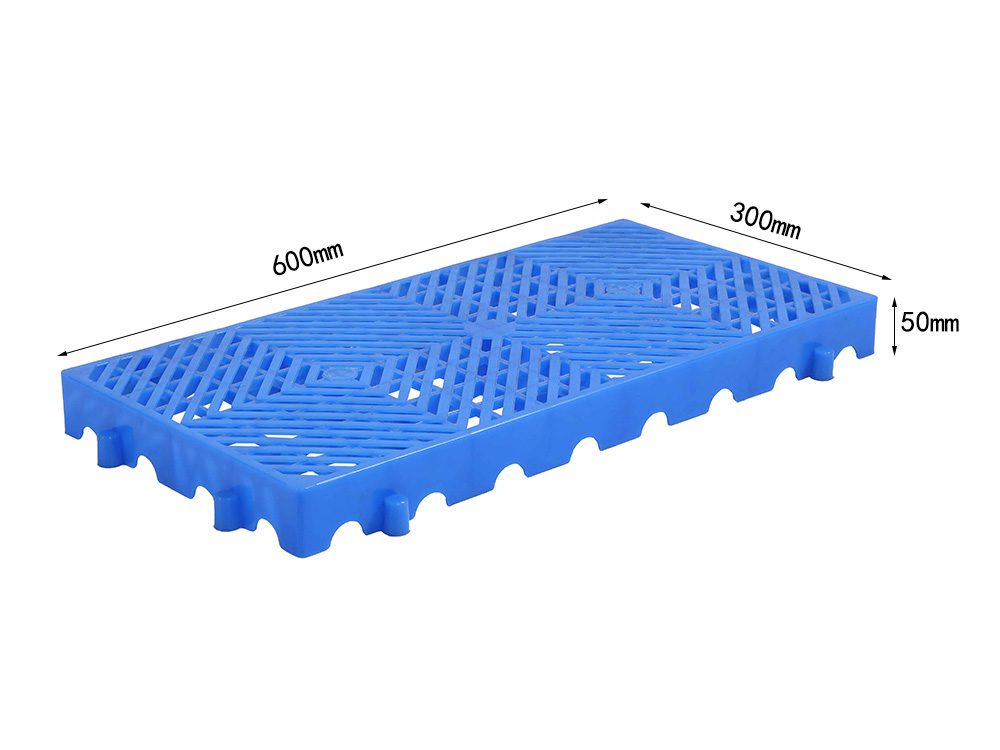
| 600 x 300 x 50 | 50 mm | Slatted | Small layers, crates and trays |
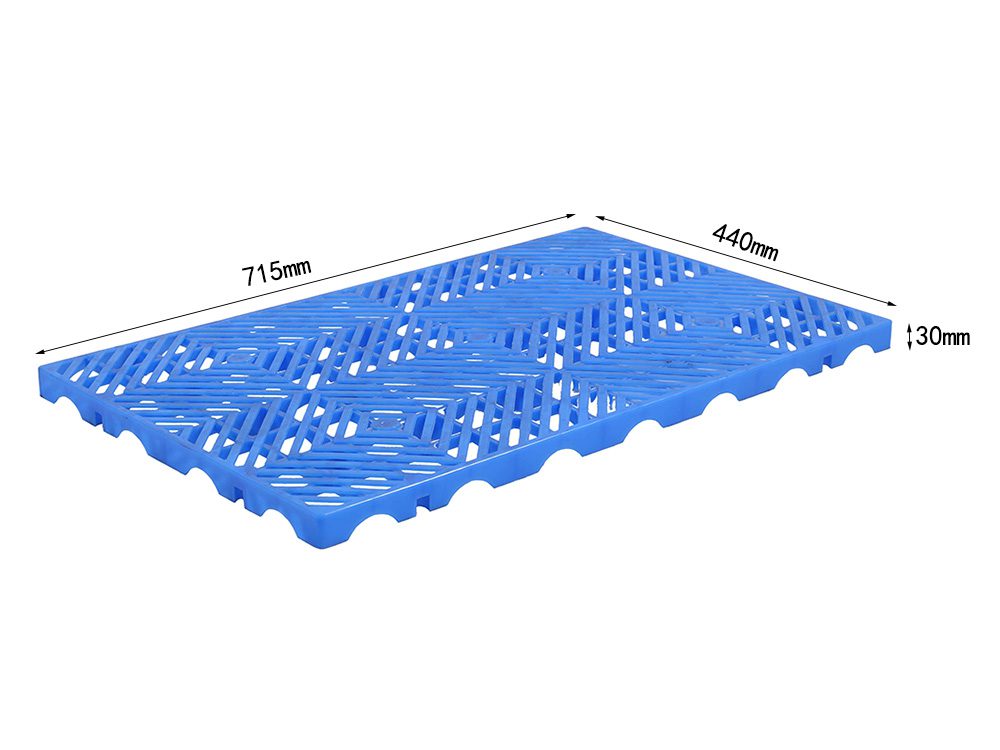
| 715 x 440 x 30 | 30 mm | Slatted | Light layers where weight matters |
Custom sizes, deck patterns and solid faces can be developed in our own mould workshop — tell us the footprint you need and we will confirm tooling.
Perforated or Slatted? Choosing the Deck Surface
The deck pattern decides what the pad does between the layers, so it is worth choosing deliberately rather than by habit.
- Perforated decks carry a dense pattern of moulded holes. They give strong, even support with steady airflow and drainage, and they are the usual choice when layers of bagged or boxed goods need to breathe — cold rooms and chilled storage in particular benefit.
- Slatted decks use open parallel bars with a moulded frame. They drain and ventilate the most freely and weigh less for the same footprint, which suits wet processing areas, washing stations and anywhere the pad itself gets hosed down.
Both designs are moulded with scalloped side edges and moulded feet, so a pallet truck or fork can pick the pad up from any side. If your stack carries a mixed load, the same principle we explain for pallets applies here — see open deck vs closed deck plastic pallets.
Typical Applications
- Warehouse and racking. Separating mixed SKU layers on one pallet so a layer can be lifted off without disturbing the rest. See warehouse ergonomics for manual pallet handling.
- Cold chain and freezer storage. Keeping air moving between layers where ice build-up and condensation would otherwise bond cardboard sheets together.
- Food and beverage. Slatted and perforated decks drain and clean easily, which suits food-contact environments — read our guide to food-grade plastic pallets, HACCP and cold storage.
- Glass, cans and bottled goods. Spreading the weight of a heavy layer so the layer below is not point-loaded by a small contact area.
- Agricultural and poultry logistics. Raising crates off wet floors to keep them dry and ventilated. See plastic crates and equipment for poultry farms.
- General manufacturing. Protecting machined or painted parts from contact with the layer below during internal transport.
Materials, Colours and Custom Sizes
We mould layer pads in HDPE and PP. Both take repeated impact without cracking, resist most industrial cleaning agents, and hold their shape in cold store. Tell us the temperature range and what will be stacked on the pad, and we will confirm the material grade that fits your application rather than guessing at it.
Blue is our standard moulding colour, as shown throughout this page. Other colours can be arranged where you use colour to identify a line, a customer or a zone — the same discipline we describe in our plastic pallet colour-coding guide.
Because we run our own mould workshop, a non-standard footprint is a tooling question rather than a dead end. Sending us the drawing or the exact internal dimensions of your crate or pallet is usually enough for us to quote.
How to Choose the Right Layer Pad
- Measure the real footprint first. Write down the internal dimensions of the pallet, crate or shelf the pad has to sit in — not the nominal size on the box.
- Decide what the pad must do. Load spreading, ventilation, drainage and separation are four different jobs, and the deck pattern should follow the one that matters most.
- Match thickness to the load and the handling. 30 mm pads suit light layers; 50 mm pads give more rigidity and clearance where a pallet truck or fork has to pick up the pad itself.
- Check the environment. Cold store, steam cleaning and food-contact areas all narrow the material and deck options, so raise them before tooling.
- Work out how many you actually need. Count the layers you separate, not the pallets you own — most stacks need more than one pad to stay stable.
Ordering from LSY Plastic
LSY Plastic has manufactured moulded plastic products for over 35 years, with injection moulding machines from 180 T to 2500 T, our own mould workshop and a 20,000 m² warehouse. We supply OEM customers including BYD, OPPO, vivo and Meituan, and we can support layer pad programmes the same way.
- Samples: supplied at cost price so you can test the deck against your own load.
- Customers in China: no minimum order quantity, shipped by courier or logistics.
- Export orders: shipped by full container load (FCL).
Send us your pad size, the weight it has to carry and the environment it works in, and we will come back with a recommendation. Our full logistics range is collected in the plastic pallets and logistics hub, and routine care is covered in our plastic pallet maintenance guide. To start a quote, use our contact page.
FAQ
What is a plastic layer pad used for?
A plastic layer pad is a rigid moulded board placed between layers of stacked goods — on a pallet, inside a crate or on a shelf — to spread load across the layer below, keep goods separated and allow air or water to move through the stack. It is also called a deck board, separator board or dunnage board.
What sizes of plastic layer pad does LSY Plastic make?
Our current moulded range covers 995 x 800 x 50 mm and 995 x 600 x 50 mm perforated decks, plus 900 x 300 x 50 mm, 600 x 300 x 50 mm and 715 x 440 x 30 mm slatted decks. Custom sizes can be developed in our own mould workshop.
How thick should a plastic layer pad be?
As a rule, 30 mm pads suit light layers where you mainly need airflow and separation, while 50 mm pads give more rigidity plus clearance for handling with pallet trucks and forks. The right choice depends on the weight per layer and how the pad will be lifted.
Do plastic layer pads need ISPM-15 treatment for export?
No. ISPM-15 is an international phytosanitary standard for wood packaging material. Moulded plastic layer pads contain no wood, so they are not subject to ISPM-15 heat treatment or fumigation marking, which removes quarantine delays at destination ports.
Can I get a sample of a plastic layer pad?
Yes. We supply samples at cost price so you can check the deck pattern, thickness and rigidity against your own load before ordering.
What about the sample price, colours and order quantities?
Samples are charged at cost price, not supplied free. Blue is our standard moulding colour and other colours can be arranged for colour-coding. For customers in China there is no minimum order quantity and we ship by courier or logistics; for export orders we ship by full container load (FCL).