Every moulder has had the call: the parts are dimensionally fine, the material is right, and the customer is rejecting them for a hairline on the surface. Sometimes it is cosmetic pedantry. Often it is a weld line that is genuinely weaker than the rest of the part, and the customer is right to worry.
What a weld line actually is
Molten plastic enters a cavity and flows. When the flow front splits — around a hole, an insert, a core, or a thin section — and the two fronts meet again on the other side, they have to fuse back into one mass. They do not always manage it. The melt fronts cool as they travel, and by the time they meet they may be too cold, too contaminated, or too poorly vented to fuse properly. The visible and structural result is a weld line (also called a knit line or meld line).

Where they always appear
| Feature | Why a weld line forms | Severity |
|---|---|---|
| Holes and windows | Flow splits around the core and rejoins | Unavoidable — must be positioned, not eliminated |
| Multiple gates | Two fronts advancing from different gates meet | Common; often long and continuous |
| Sudden wall thickness change | Flow races through the thick section and rejoins | Usually short but weak |
| Inserts and pins | Flow divides around the obstruction | Local, predictable |
| Glass-filled material | Fibre does not cross the interface | Severe — strength loss is large |
The glass-filled case deserves emphasis. In unfilled resin the two fronts can at least entangle polymer chains across the interface. In a fibre-filled compound the fibres orient along the flow and largely fail to bridge the meeting line, so the joint is resin-only and materially weaker. The strength loss at a weld line in a filled grade is substantially worse than in the same resin unfilled.
Fixes, in the order worth trying
Most weld line complaints are solved by the first three of these. The last two are design changes, which are cheaper before tooling than after.
- Raise melt and mould temperature. The fronts arrive hotter and fuse rather than butt together. This is the single most effective process change, and it costs cycle time rather than money.
- Increase injection speed. Faster filling means less cooling in transit. It also raises shear heating, which helps. Watch for flash and for burn marks from trapped air.
- Fix the venting. Air trapped at the meeting point prevents contact and can scorch the surface. Venting at the weld line location is a mould change, but it is the change that solves the stubborn cases.
- Move the gate. Relocating a gate moves where the fronts meet. The objective is to place the line in a non-cosmetic, low-stress area rather than to remove it.
- Change the wall section. If the line is caused by a thickness transition, a more gradual transition reduces the flow imbalance that creates it.
What does not work: raising holding pressure. Holding pressure packs out sink and dimensions; it does nothing for a front that has already frozen before contact.
How much strength is actually lost
It depends on the resin, the filler and how well the fronts fused. A well-fused weld line in unfilled material can retain most of the base strength; a poorly vented one in a glass-filled grade retains far less. This is why the honest engineering answer is to test the actual part rather than quote a percentage — a load test with the weld line in the load path tells you what you have.
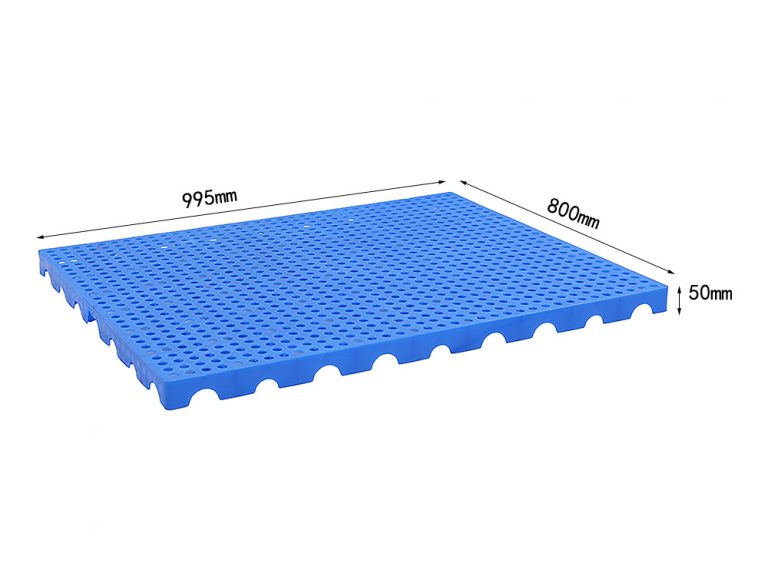
For a moulded pallet or crate, the practical implication is design: weld lines should not sit at rib junctions, corner radii or handle roots, where service loads concentrate. Deciding that at the design stage costs nothing; discovering it after tooling costs a mould modification.
How we handle it
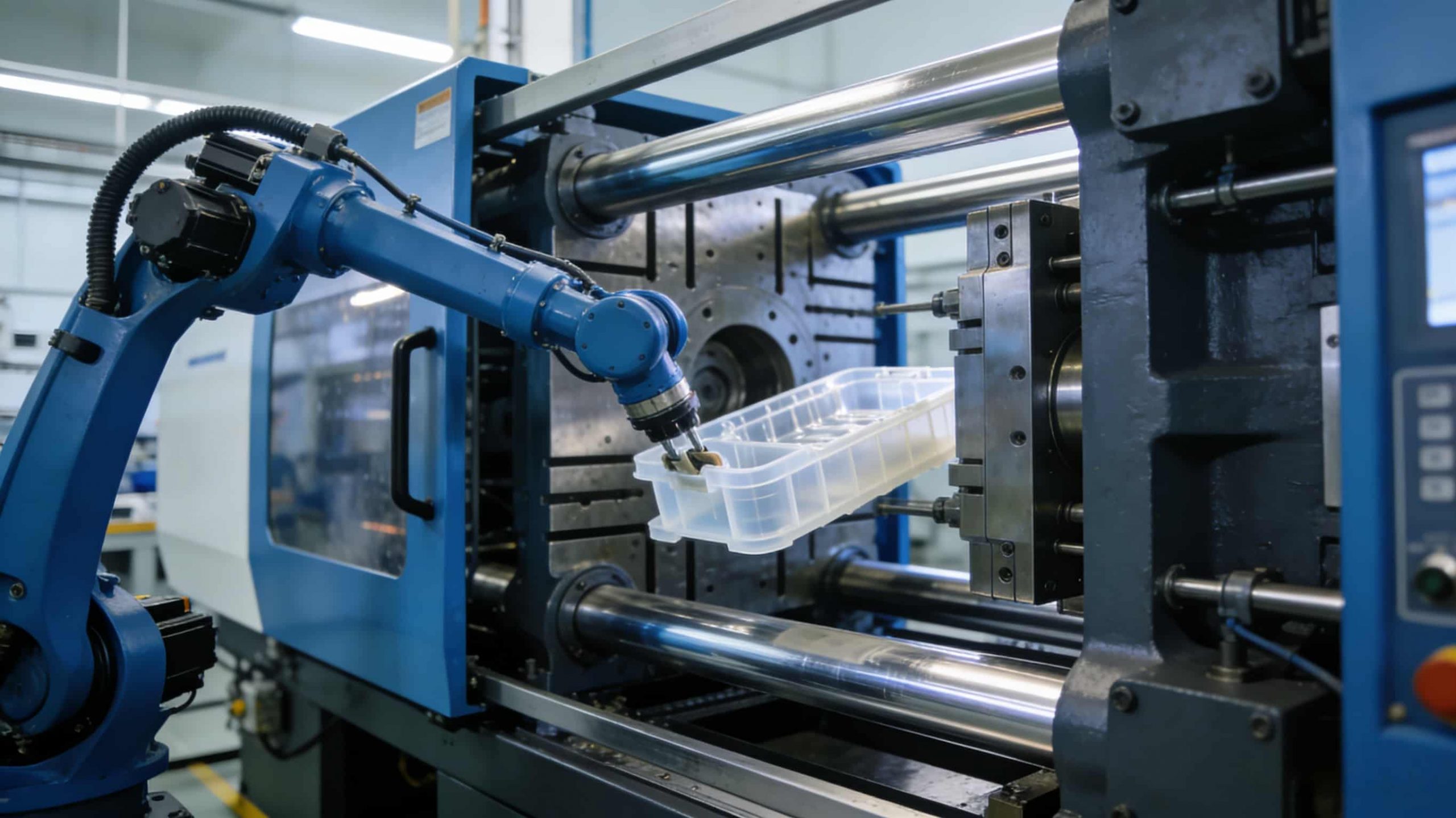
FOSHAN LSY Plastic runs injection machines from 180T to 2500T with an in-house mould workshop, so weld line problems get solved on the tool rather than argued about. Mould flow analysis is run before steel is cut for structural parts, which is where gate position and weld line location are decided — not after first shots.
FAQ
What is the difference between a knit line and a weld line?
They are the same phenomenon and the terms are used interchangeably. Some moulders reserve “knit line” for a shallow-angle meeting where the fronts travel on nearly parallel paths, and “weld line” for a head-on meeting, but both describe two flow fronts rejoining without full fusion.
Can weld lines be eliminated completely?
Not where the geometry causes them. A part with a hole will always have a weld line downstream of it. The realistic goals are to fuse it properly through process settings and to position it where it does no structural or cosmetic harm.
Does increasing holding pressure remove a weld line?
No. Holding pressure acts after the cavity is filled; the weld line formed during filling. Pressure affects sink marks and dimensions, not the fusion of two fronts that met while still filling.
Are weld lines weaker in glass-filled materials?
Yes, significantly. Fibres orient along flow direction and do not bridge the interface, so the joint is effectively unfilled resin. In filled grades the weld line region deserves specific design attention.
Related guide: draft angle requirements in injection molding.
Related guides:
Injection Molding Burn Marks: Causes & Fixes
Ejector Pin Marks: Why They Show & How to Fix
Injection Molding Warpage: Causes & How to Control