Electrostatic discharge (ESD) is one of the most common causes of damage in electronics manufacturing. A single static discharge of as little as 100 volts can destroy sensitive components, leading to costly rework, warranty claims, and production delays.
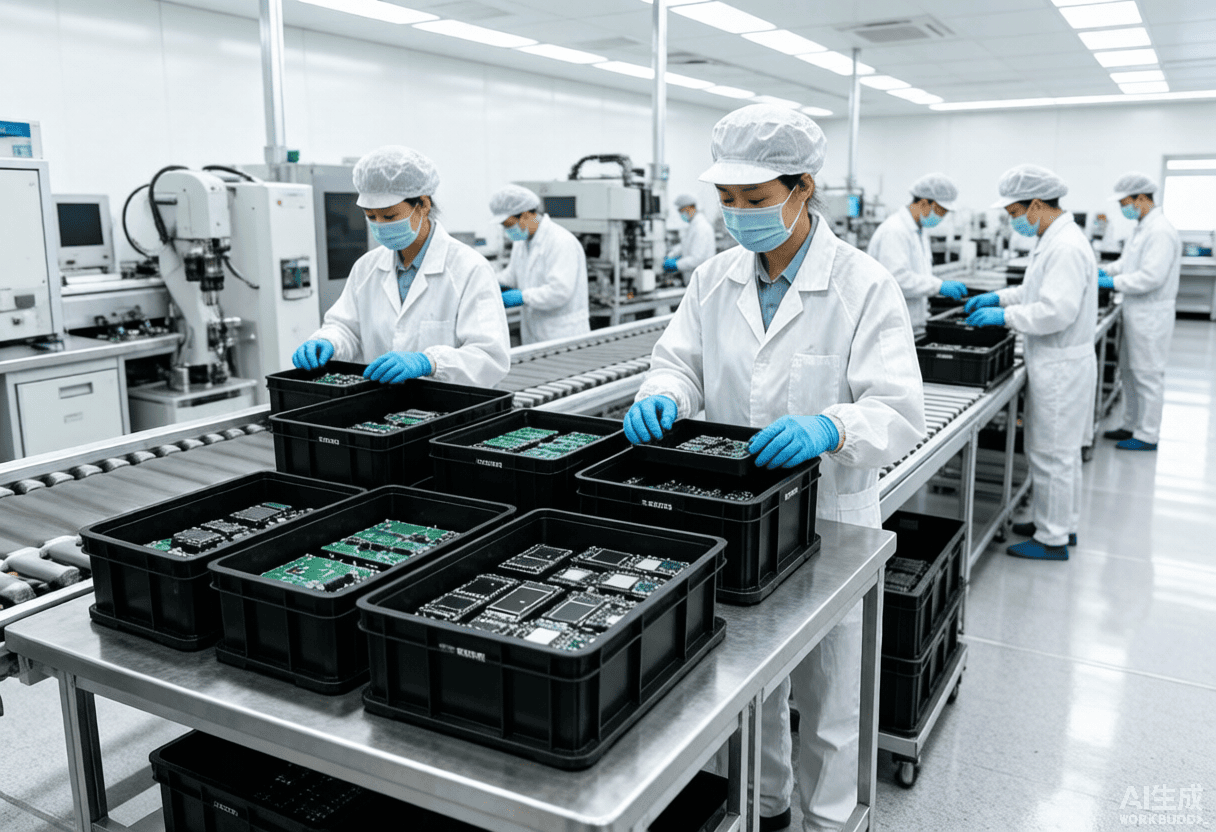
ESD plastic containers guide containers are engineered to prevent static buildup and safely dissipate charges, protecting electronic components throughout the manufacturing, transport, and storage process. This guide covers everything you need to know about selecting the right ESD container material guides for your facility.
Understanding ESD Material Types
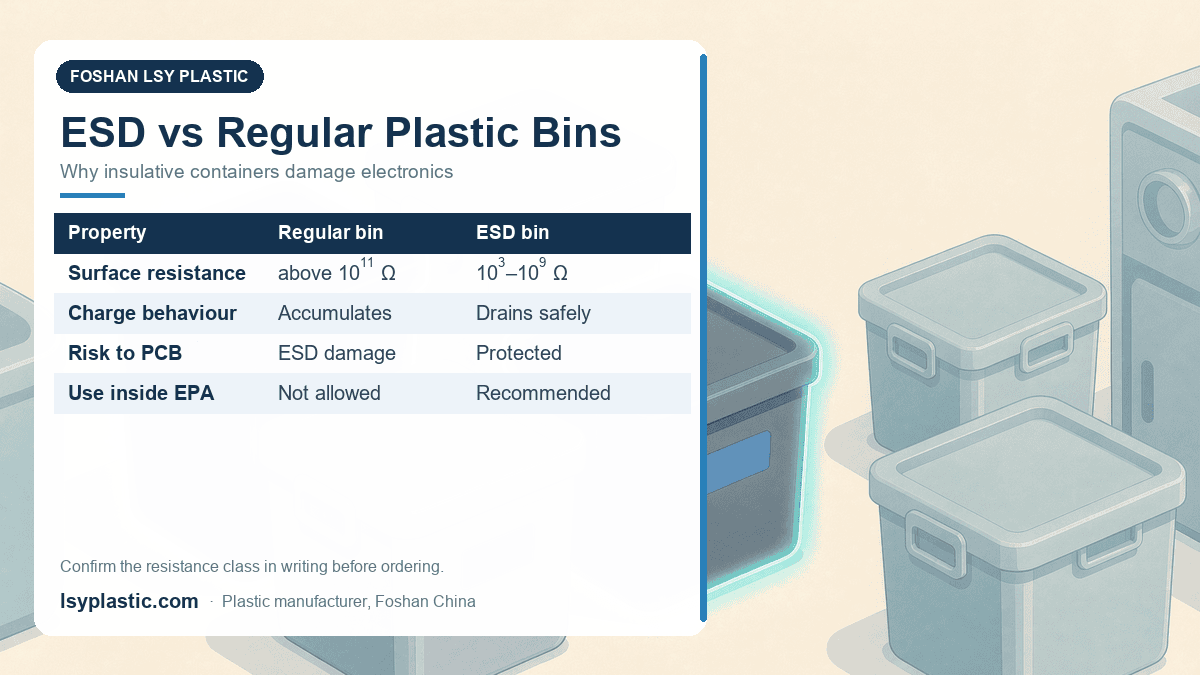
Not all “anti-static” plastics are the same. There are three distinct categories, each with different surface resistance ranges and applications:
1. Anti-Static (Insulative with Surface Treatment)
- Surface Resistance: 10^10 to 10^12 ohms
- Function: Prevents triboelectric charge buildup
- Best for: General packaging, non-critical components
- Lifespan: Treatment wears off over time (6-24 months)
2. Dissipative (Static Dissipative)
- Surface Resistance: 10^6 to 10^9 ohms
- Function: Allows controlled discharge of static electricity
- Best for: Electronics manufacturing, PCB handling, component storage
- Lifespan: Permanent (inherent material property)
3. Conductive
- Surface Resistance: 10^3 to 10^6 ohms
- Function: Rapidly conducts static charges to ground
- Best for: Highly sensitive components, cleanroom environments
- Lifespan: Permanent
Key Specifications to Look For
When selecting ESD plastic containers for your electronics manufacturing facility, verify these critical specifications:
| Specification | What to Look For | Standard |
|---|---|---|
| Surface Resistance | 10^6 – 10^9 ohms (dissipative) | IEC 61340-5-1 |
| Material | PP or PE with carbon/polymer additive | Permanent ESD |
| Temperature Range | -20C to +80C | Application-specific |
| Load Capacity | 25-50 kg (standard), 50-100 kg (heavy duty) | Dynamic load |
| Color | Black (conductive), Grey (dissipative) | Industry convention |
Types of ESD Containers
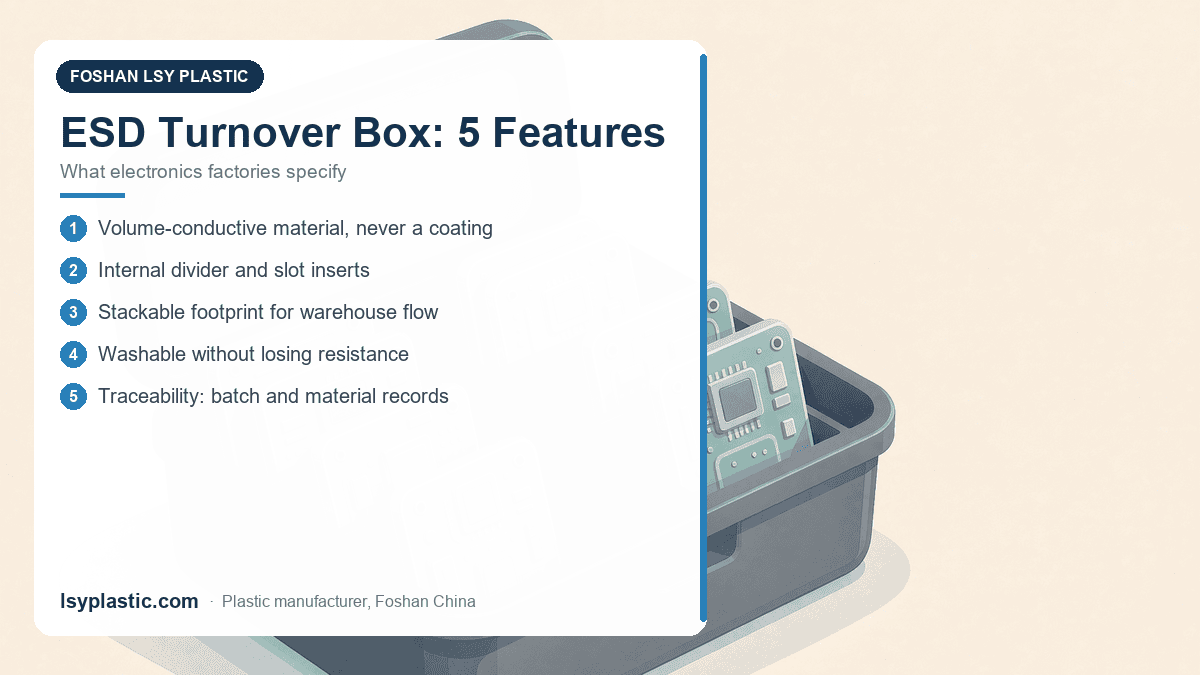
ESD Turnover Boxes
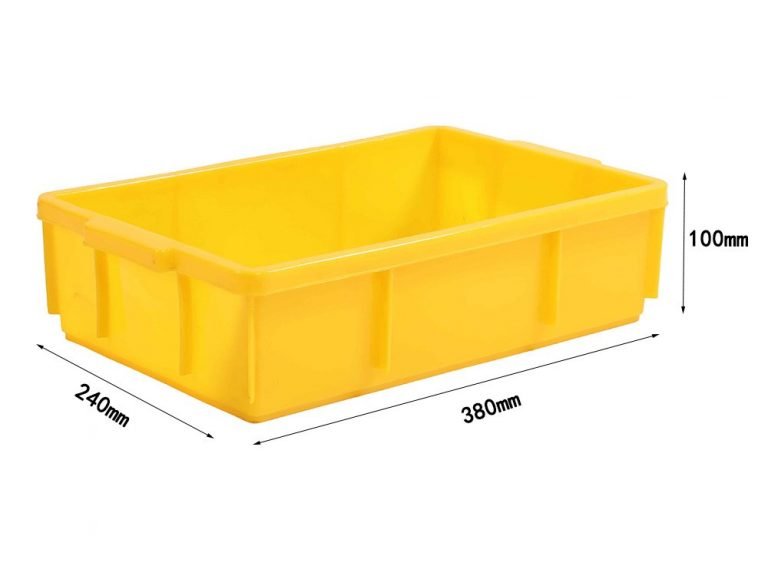
Stackable containers designed for work-in-progress (WIP) storage and transport between production stations. Available in standard sizes (300x200mm, 400x300mm, 600x400mm) that conform to EU box standards for automated handling systems.
ESD Trays
Flat trays with dividers for organizing individual components. Ideal for SMT (Surface Mount Technology) lines and final inspection stations. ESD trays with conductive dividers prevent component-to-component contact damage.
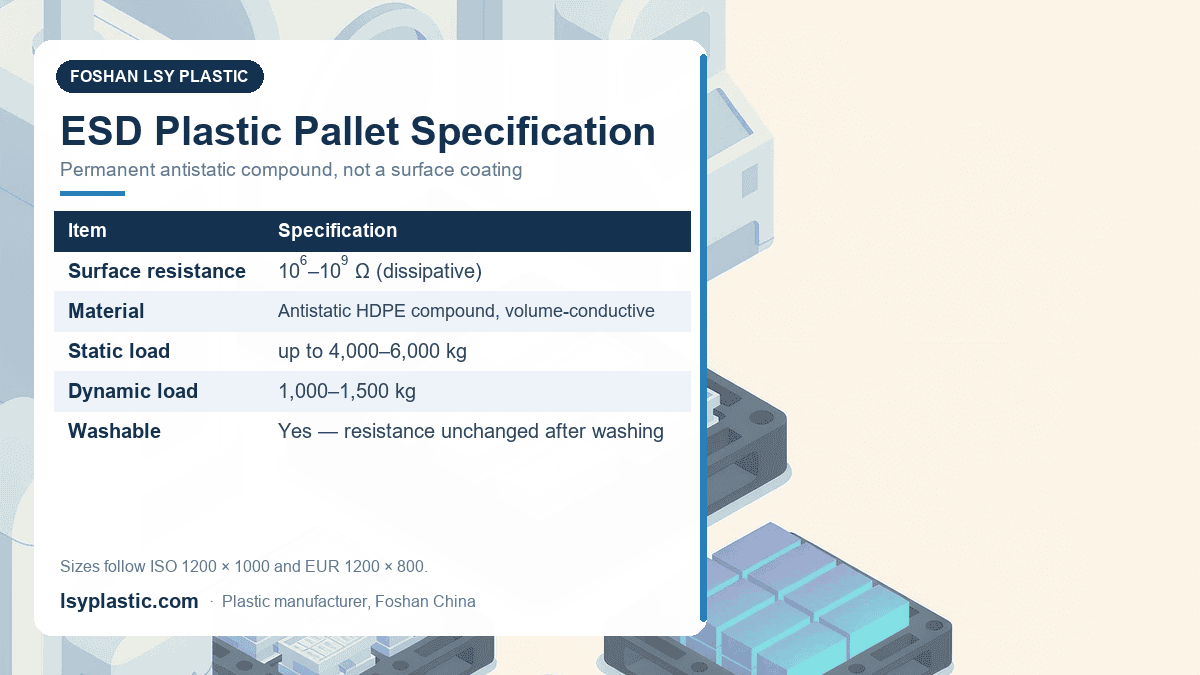
ESD Pallets
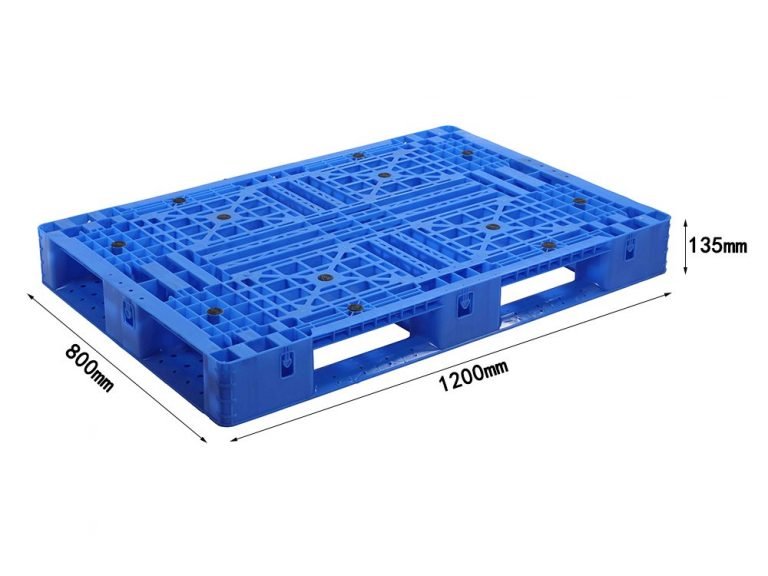
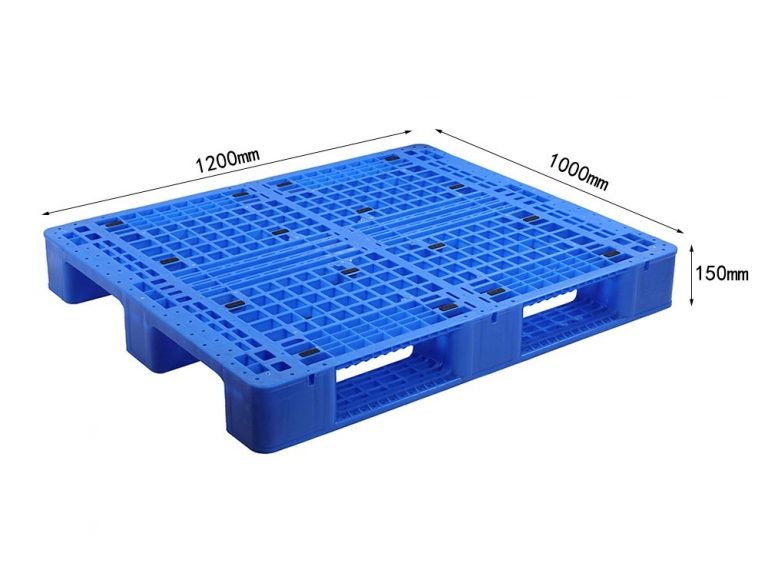
Full-size pallets (1200x1000mm or 1200x800mm) for bulk transport of packaged electronics. These are essential for warehouse-to-production-line logistics and conform to ISO 6780 standard pallet dimensions guides.
Why Choose LSY Plastic ESD Containers?
Our ESD container series is manufactured in our Foshan factory with over 30 years of injection molding process guide experience. Key advantages include:
- Permanent ESD properties – Carbon-impregnated material, not surface-coated
- Brand-trusted – Used by BYD, VIVO, OPPO in their electronics manufacturing
- Full size range – From 300x200mm trays to 1200x1000mm pallets
- OEM/ODM available – Custom sizes, colors, and branding
- Export-certified – Full QC inspection, compliant with IEC 61340 standards
Best Practices for ESD Container Usage
- Always ground containers before placing them on ESD-protected workstations
- Never use damaged containers – Cracks can create isolated conductive paths
- Clean with ESD-safe cleaners – Regular cleaning agents can leave insulative residues
- Test surface resistance quarterly – Even permanent ESD materials should be verified
- Replace containers showing surface wear – Visible whitening indicates material degradation
Conclusion
Choosing the right ESD plastic containers is a critical investment in quality and yield for any electronics manufacturing facility. By selecting dissipative-grade containers with permanent ESD properties, you protect sensitive components from the most common source of damage in the industry.
ESD Container Selection at a Glance: Size, Load, Application
The fastest way to specify an ESD container program is to match container type to production stage. The standard sizes below conform to EU box standards, so they integrate with automated handling and conveyors without custom tooling:
| Container type | Common sizes | Typical load | Best fit |
|---|---|---|---|
| ESD turnover box | 300×200, 400×300, 600×400 mm | 25–50 kg | WIP storage and transport between production stations |
| ESD tray with dividers | Fits SMT line carriers | Light component loads | SMT lines, final inspection, component-to-component isolation |
| Heavy-duty ESD box | 600×400 mm footprint | 50–100 kg | Machined parts, sub-assemblies, heavier WIP |
| ESD pallet | 1200×1000 / 1200×800 mm | 1,000–1,500 kg dynamic | Bulk transport of packaged electronics to and from the line |
Coated vs. carbon-loaded: the real cost difference
Anti-static treatments that are sprayed or coated onto a standard container cost less upfront but wear off within 6–24 months of handling and cleaning. Carbon-loaded material keeps its conductive property for the full 5–8 year container life, because the protection is in the resin, not on the surface. Count the cost per protected year, not per unit:
| Anti-static coated | Carbon-loaded (permanent) | |
|---|---|---|
| Surface resistance | 1010–1012 ohms | 103–106 ohms (conductive) / 106–109 ohms (dissipative) |
| Protection life | 6–24 months, wears off | Permanent — 5–8 year container life |
| Cleaning tolerance | Coating degrades with abrasion | Standard ESD-safe cleaning, no coating to damage |
| Best for | Non-critical, general packaging | PCB handling, EPA areas, controlled production |
A coated container replaced every 12–24 months costs more per protected year than a permanent carbon-loaded container bought once — before counting the requalification paperwork each replacement cycle triggers.
Need ESD containers for your electronics manufacturing? Contact us for a free consultation and quote, or browse our ESD product catalog for standard sizes and custom options. For more guides on this topic, check our ESD Containers Complete Guide.
Two Ways ESD Damage Happens
Static damage is not a single event — it takes two distinct forms, and only one of them is visible right away:
- Catastrophic failure. The component is destroyed on the spot. It shows up in testing and is traceable to a specific handling event.
- Latent defect. The component is weakened but keeps working. It fails in the field weeks or months later — far more costly, because the damaged part reaches your customer.
The voltages involved are deceptively small. A person walking across a floor can build up 3,000–5,000 volts, while a component can be damaged by a discharge as low as 100 volts — one no human could feel. That is why ESD-safe containers, not handling discipline alone, are the baseline defense in electronics plants.
Related ESD guides: ESD storage containers and bins · ESD safe storage containers
Frequently Asked Questions
What materials are ESD plastic containers made from?
Conductive or dissipative polypropylene loaded with carbon, giving a permanent controlled surface resistance rather than a temporary coating. Because the conductivity is in the material, it does not wear off with handling.
What specifications should I look for in ESD containers?
Surface resistance band (conductive 10^3 to 10^5 ohms, dissipative 10^5 to 10^11 ohms), the material type, and batch test data to IEC 61340-2-3 or an ANSI/ESD S20.20 programme. Verify the report names the exact model you buy.
How does ESD damage happen?
Two ways: direct discharge from a charged operator or container to a sensitive device, and induction, where a charged object near a device causes a damaging discharge. ESD containers control charge build-up on both counts.
Why choose LSY ESD containers?
LSY moulds ESD containers from carbon-loaded PP with controlled resistance and in-house quality control, so material and testing stay consistent batch to batch. Samples at cost price; overseas orders ship FCL.
Related guides:
esd containers humid tropical climate export
plastic seafood crates fish boxes cold chain
poultry farm plastic crates equipment