If you import plastic pallets, crates, dustbins or industrial containers into India, the decision is rarely about finding a factory. China has thousands. The real work is separating a factory that can hold specification across repeat orders from one that ships a good first container and then drifts. This guide is written for Indian importers, distributors and purchase heads, and it covers what to check before the first deposit.
What Indian buyers actually import
The four categories that move in volume from China into India are consistent year to year:
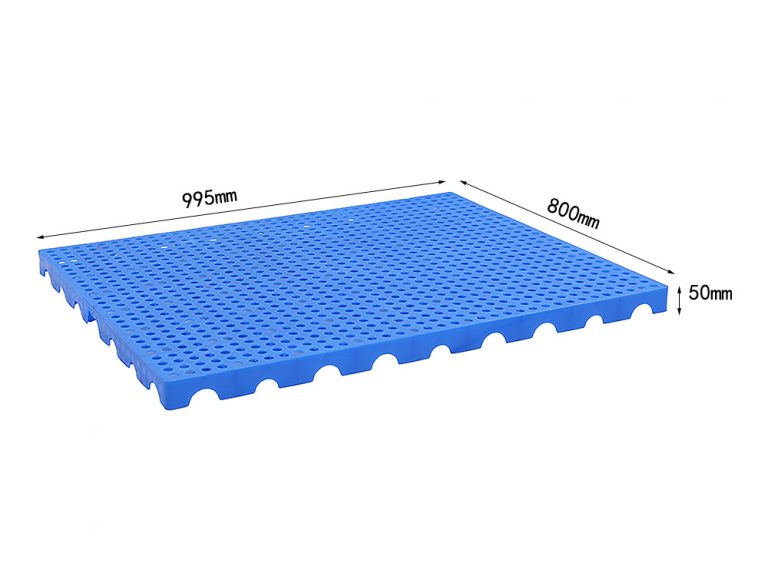
- Plastic pallets — mostly 1200×1000 mm and 1100×1100 mm footprints, in HDPE or PP. Importers either resell into warehousing and pharma, or use them in-house for export packing where ISPM-15 treatment exemptions make plastic preferable to wood.
- Plastic crates and turnover boxes — agricultural produce, dairy, beverage and fishery applications dominate. Standard footprints matter far more here than a marginal volume gain, because crates have to work with whatever racking and conveyors the buyer already runs.
- Waste bins and dustbins — municipal tenders, facility management contractors and hotel groups. Colour coding is often specified by the buyer’s own scheme rather than by standard.
- ESD containers and trays — electronics manufacturing in the Chennai, Bengaluru and Noida corridors. The specification question is always the same: surface resistance range, and whether the property is carbon-loaded or coated.
HS classification — get this right before you quote
Classification errors are the most expensive avoidable mistake in this category. Indian customs classifies most plastic transport and packaging articles under HSN 3923, not under the wood or metal headings that buyers sometimes assume. We have written a dedicated breakdown covering the lines for crates, bins and bus boxes in our guide to plastic crate HSN codes and GST.
Two practical points. First, confirm the line with your own clearing agent before submitting the purchase order — the classification depends on construction and stated use, and the agent carries the liability, not us. Second, ask the factory for the HS code it declares on the commercial invoice, so your agent and our documentation agree before the container ships. A mismatch discovered at Nhava Sheva is a demurrage bill, not a phone call.
Shipping to Nhava Sheva, Mundra, Chennai and Kolkata
Transit from South China ports to Nhava Sheva typically runs about two to three weeks depending on the sailing and whether the routing includes transhipment. Mundra and Chennai are comparable; Kolkata often adds time. On bulky plastic goods, freight per unit is what decides whether the import works at all, which brings us to the single most important number in the whole exercise.
The number that decides your landed cost
Plastic pallets and crates are volume-limited, not weight-limited. A 40HQ container holds about 76 cubic metres, and whether you fill that space with three hundred units or nine hundred units changes your landed cost per piece far more than any negotiation on unit price.
This is why we push every buyer to ask for a loading diagram for the specific model rather than a container estimate. The ratio depends entirely on whether the item nests, how far it nests, and whether it ships assembled:
- Fully nested crates can cut empty volume by roughly 60–75% compared with assembled units, so the same cube yields several times the quantity.
- Plastic pallets do not nest meaningfully. Some designs stack more efficiently than others, and the difference between a good and poor design is frequently a third of the container quantity.
- Bins with lids should be quoted either nested with lids shipped separately, or assembled — the two options give very different container quantities.
Ask for that figure in writing, for your exact model, before the deposit. Any supplier quoting container quantities without knowing the nesting ratio is guessing.
How to check a China factory before you pay
Indian importers ask us regularly how to verify a factory they found online. Six checks catch most problems:
- Ask for the part weight, not just the dimensions. Two crates can carry identical external measurements and differ by 40% in material. Weight is the honest specification, and it is the fastest way to compare two quotes that look similar.
- Ask which machines ran the sample. A factory with 180T to 2500T machines in-house will answer specifically. Capacity range tells you whether they can actually hold a large part’s dimensional stability.
- Ask whether they own the mould or buy it out. A factory with its own mould workshop can repair and modify tooling without reopening your schedule.
- Ask for the recycled percentage in writing. Recycled content is legitimate and often appropriate, but it changes impact strength. If a quote is unusually low, this is usually the reason.
- Ask for a sample before the container. We supply samples at cost price plus freight, not free. A sample that is free tells you nothing about how the factory will treat a problem.
- Ask whether export is FCL only. A factory that consolidates loose cartons for export is running a trading business on the side, and your documentation chain gets longer.
Material selection for Indian conditions
India is not one climate, and the specification should follow where the goods will actually be used:
- Coastal and monsoon regions. Sustained high humidity plus salt air attacks plain steel hardware. For wheeled bins, specify corrosion-resistant axles. UV stabilised compound matters where containers stand outdoors.
- North India summer. Surface temperatures on outdoor bins and crates climb high enough to warp unstabilised HDPE. Ask for UV-stabilised grade — carbon black or HALS through the wall, not a coating.
- Cold chain and food processing. Confirm food-grade resin in writing and ask for the usable temperature band. PP and HDPE behave differently at low temperature, and PP becomes noticeably more brittle in freezing conditions.
Frequently asked questions
What is the minimum order quantity for exports to India?
Export orders ship as full container loads (FCL). We do not consolidate loose cartons for overseas customers — on bulky plastic goods, part-container freight rarely justifies the cost and it complicates customs clearance at your end. For orders inside China we can ship smaller quantities by courier or truck with no minimum.
Can you supply mixed products in one container?
Yes, provided the total fills the container. Importers commonly combine pallets, crates and bins in a single 40HQ to cover several resale lines. Send the mix and we will prepare a loading plan showing what fits.
Do you provide samples before a bulk order?
Yes. Samples are supplied at cost price plus freight, not free of charge. For large orders we usually recommend confirming specification from drawings and the loading plan before sampling, because the sample cost is not normally credited against the bulk order.
What documents come with the shipment?
Commercial invoice, packing list and bill of lading as standard. Certificate of origin where your clearance requires it. We will state the HS code we declare on the invoice so your agent can cross-check it before shipment.
Can products be made in our brand colour with our logo?
Yes, subject to a minimum quantity per colour. Send a Pantone reference for the colour and vector artwork for the logo. In-mould branding carries a tooling cost; pad printing has a lower setup cost and a minimum per run.
How long does production take?
Stock colours from existing moulds typically run a few weeks from deposit and artwork confirmation. Custom colour or new tooling adds time, and we confirm the schedule in writing with the quotation.
Next step
Send the product type, footprint or capacity, quantity target and destination port. We will come back with a specification sheet, the part weight, and a loading plan for the model that fits. If you are comparing suppliers, ask each one for the part weight and the nesting ratio — those two answers separate the quotes faster than anything else.
Related reading: plastic crate HSN code and GST classification, plastic pallet sizes and dimensions, export one-way plastic pallets, and returnable packaging ROI.
Also supplying
Importing to other markets
The same product families ship to these markets. Freight, clearance and specification notes differ by destination: