
Fresh produce exporters weighing cardboard vs reusable plastic formats, see Returnable Plastic Crates vs Cardboard for Produce Shipping — cost per trip, FCL stacking, cold chain comparison.
The Cost of “Cheap” Plastic
If you run a warehouse or a production line, you know the sound. That sharp crack when a fully loaded pallet is set down too hard, and the bottom crate gives way.
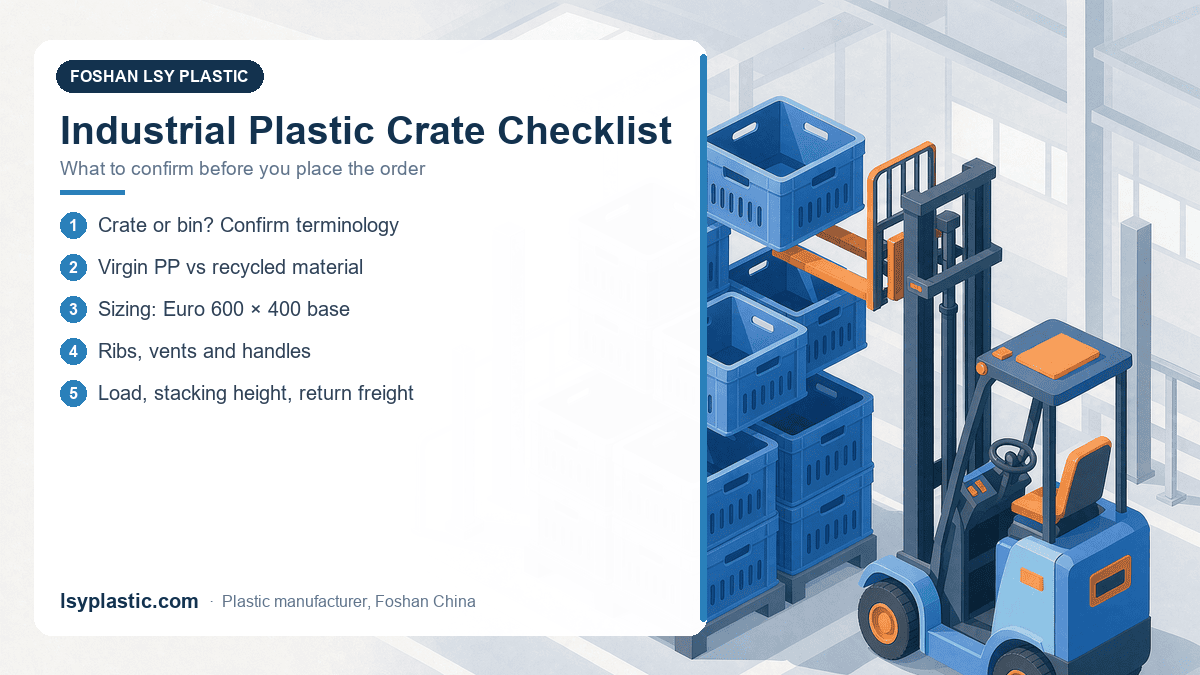
Why Industrial Plastic Crates Matter in Modern Logistics
It’s not just about losing a $10 box. It’s the downtime. It’s the safety risk. It’s the mess.
At LSY Plastic, we’ve spent years manufacturing industrial containers for clients ranging from automotive plants in Germany to electronics assemblers in Shenzhen. One thing we’ve learned? Not all plastic is created equal.
Whether you call them industrial plastic crate selection guides, storage totes, or use the industry term “turnover boxes,” choosing the right container is a balance of material science, load capacity, and logistics math.
In this guide, we’re going deep into what actually matters when buying in bulk.
1. Terminology: What Are You Actually Looking For?
Before you send out that RFQ (Request for Quote), let’s align on the language. Different regions use different terms for the exact same product.
- Industrial Plastic Crates (Europe/Global): Usually refers to standard, stackable boxes (often Euro-standard 600x400mm). These are the workhorses of logistics.
- Storage Totes (North America): Often implies a heavy-duty container, sometimes with a lid. If you are in the US, you probably search for “Heavy Duty Totes.”
- Turnover Boxes (Logistics Industry): This is a term you’ll see often in manufacturing specs. A “turnover box” is designed for closed-loop systems—meaning the box goes to the customer and comes back to you. It “turns over” hundreds of times.
Key Takeaway: Whether you search for a tote or a turnover box, at LSY Plastic, we categorize them by load capacity and application.
2. Material Matters: Virgin PP vs. Recycled (The “Black Box” Rule)
Look at our catalog. You’ll see bright blue/orange boxes and black boxes. This isn’t just a color choice; it tells you everything about the durability.
Option A: Virgin PP/PE (The “New” Series)
In our catalog, models labeled “New A#” or “Double A” are made from 100% Virgin Polypropylene (PP) or Polyethylene (PE).
- Pros: High impact resistance. You can drop them, freeze them, and stack them 10-high without warping.
- Best For: Food processing, cold chain logistics, and heavy automotive parts.
- Visual Cue: Bright colors (Blue, Green, Yellow).
Check here for product details→ https://lsyplastic.com/product/general-turnover-boxes/
Option B: Recycled / Export Grade (The Black Boxes)
Models like our “Old A#” are typically made from recycled materials.
- Pros: Significantly cheaper (often 30-40% less). Eco-friendly.
- Cons: More brittle. Good for static storage or “one-way” export shipping where you don’t expect to get the box back.
- Best For: Export shipments, light storage, hardware organization.
Pro Tip: Need to store electronics? Ask us specifically for ESD (Electrostatic Discharge) Black Crates. These look like recycled boxes but are made with special conductive carbon material to protect circuit boards. → LSY ESD Boxes
3. Sizing & The “Euro Standard” Advantage
Space is money. If your crates don’t fit your pallets perfectly, you are shipping air.
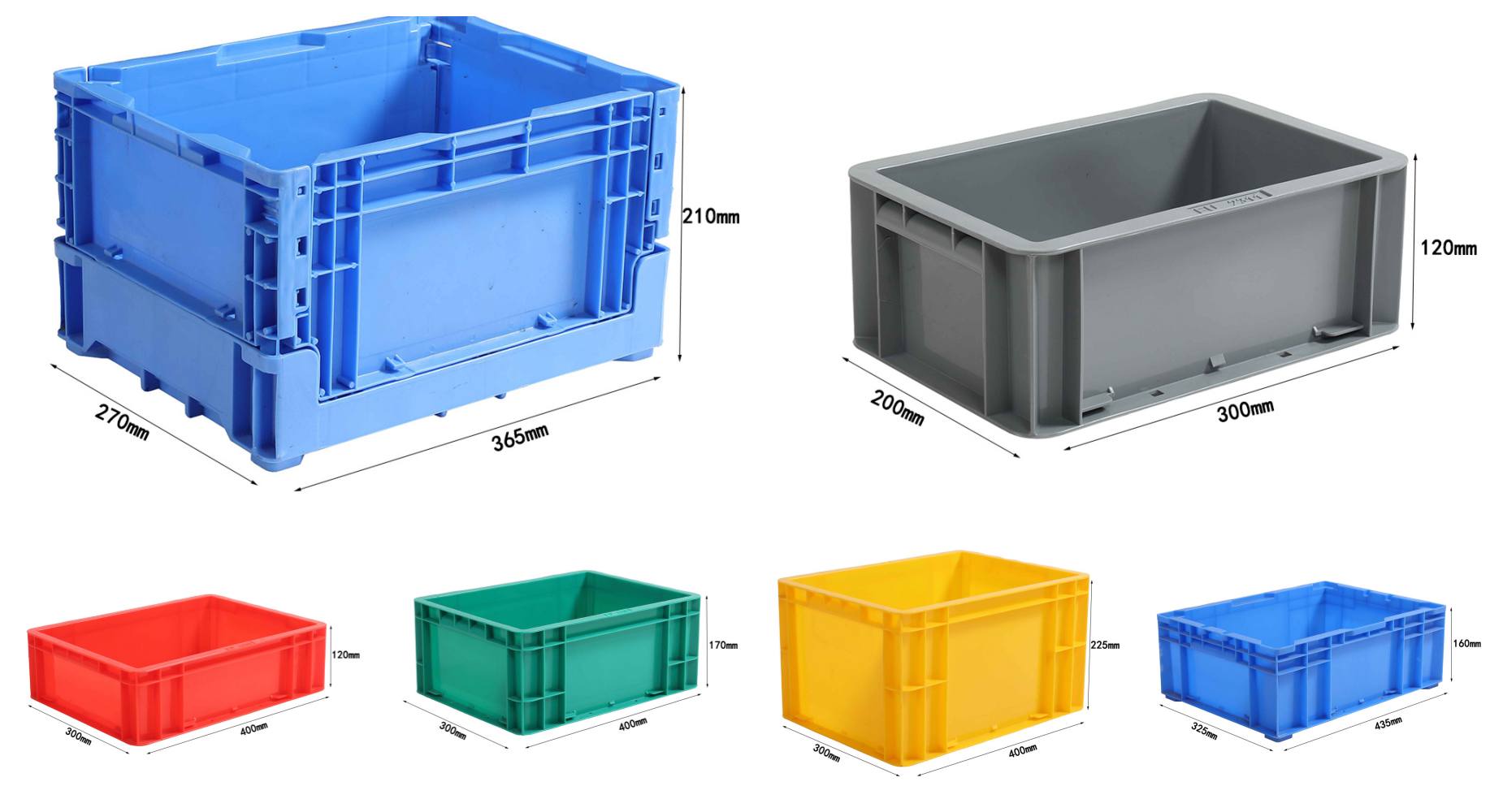
Most of LSY Plastic’s best-sellers (like the #19, #26, or #30 series) are engineered around the Euro Standard dimensions (600mm x 400mm).
- Efficiency: They fit perfectly on a 1200x800mm Euro Pallet (4 per layer) or a 1200x1000mm Standard Pallet (5 per layer).
- Internal vs. External: Crucial warning. A box listed as “400mm wide” is the external dimension. Due to the reinforced ribs (which give the box its strength), the internal usable space might be 365mm. Always check the “Inner Size” in our spec sheet before ordering.
LSY EU Boxes → https://lsyplastic.com/product/eu-standard-boxes/
4. Design Features: Ribs, Vents, and Handles
A plastic box is more than just a bucket. Here is what to look for in our catalog images:
- Reinforced Ribbing (The “Double” Series): Notice the grid pattern on the outside of our Double A boxes? Those ribs act like the beams in a building. They transfer the weight of the stack down to the floor, preventing the bottom box from crushing.
- Ventilated / Mesh Sides: See our Bread Crates and Shallow Trays. These are essential for agriculture and baking. They allow airflow to cool down hot bread or keep vegetables fresh. They are also lighter, reducing freight costs.
- Parts Bins (The Small Stuff): For hardware like screws, nuts, and bolts, you don’t need a giant crate. You need our #12 or #21 Hardware Boxes. These have thicker walls relative to their size to handle the extreme density of metal parts.
5. Why LSY Plastic?
We don’t just resell boxes; we mold them.
- Custom Colors: Need red for “Reject Parts” and green for “Approved”? We can color-code your entire warehouse.
- Logo Printing: Stop losing your turnover boxes. We can hot-stamp or screen-print your company logo directly onto the crate.
- Huge Inventory: From the massive #18 Crate (850mm long) to the tiny #12 Parts Bin, we have the molds ready to run.
Choosing the right industrial tote isn’t exciting, but getting it wrong is expensive. Don’t settle for flimsy retail-store bins that crack in a month.
Ready to optimize your warehouse?
- Check your dimensions: Measure your shelves and your product.
- Define your load: How heavy is the stuff going inside?
- Contact LSY Plastic: Let our team recommend the exact model (New vs. Recycled) for your budget.
[Request a Free Quote & Catalog] Need a sample to test durability? Just ask. For more guides on this topic, check our Plastic Storage Containers Complete Guide.
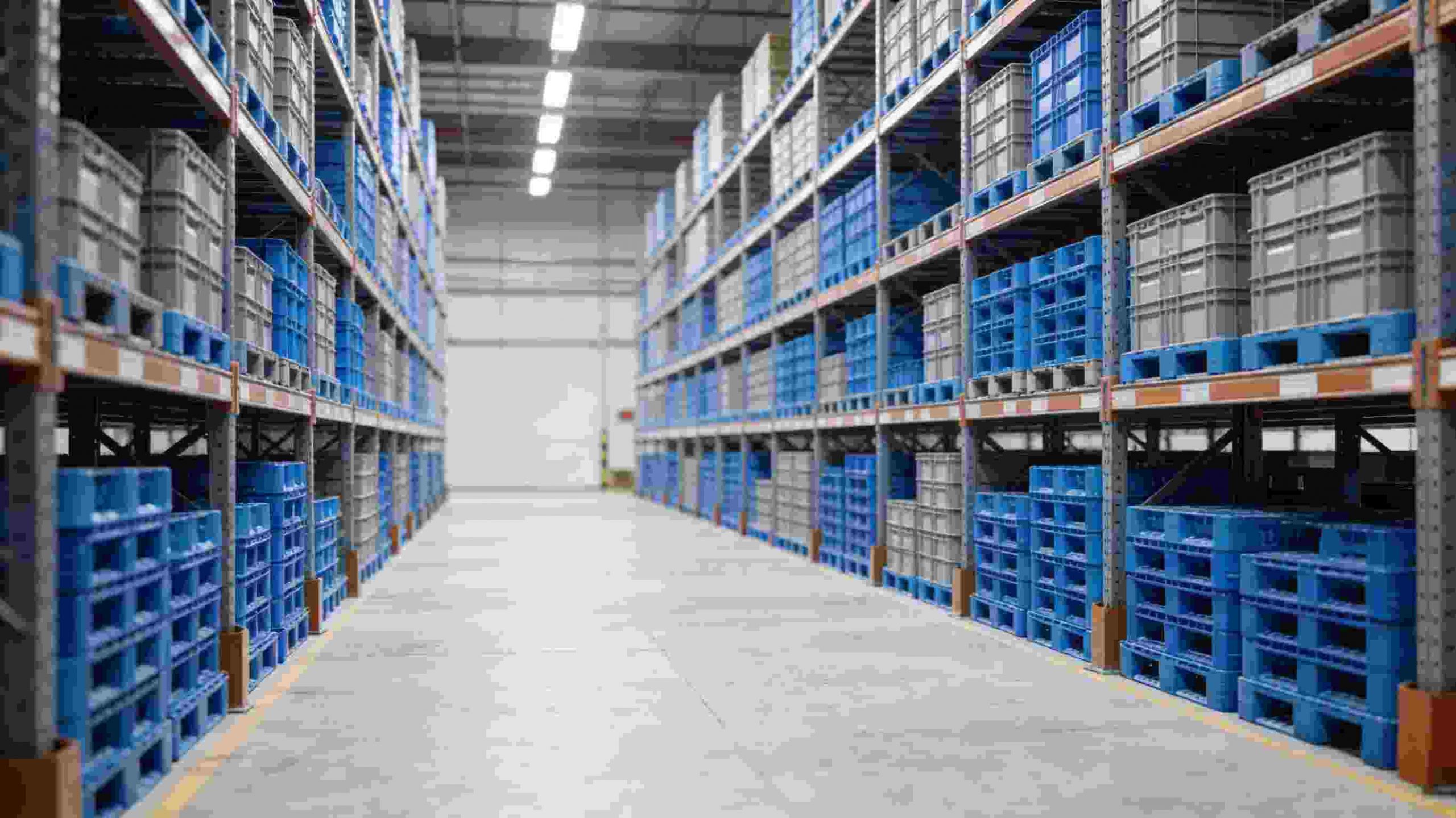
600×400 Produce Crate Chart
For a vent-pattern and load guide mapped to fresh produce, see the 600×400 plastic crate produce chart — covers airflow, stack heights and FCL terms.
Related Guides
- Ventilated Crates for Fresh Produce — perforated crate airflow guide
- Warehouse & Logistics Hub — pallets, crates, and turnover containers
- Plastic Crate Selection Guide — sizes, stacking, and materials
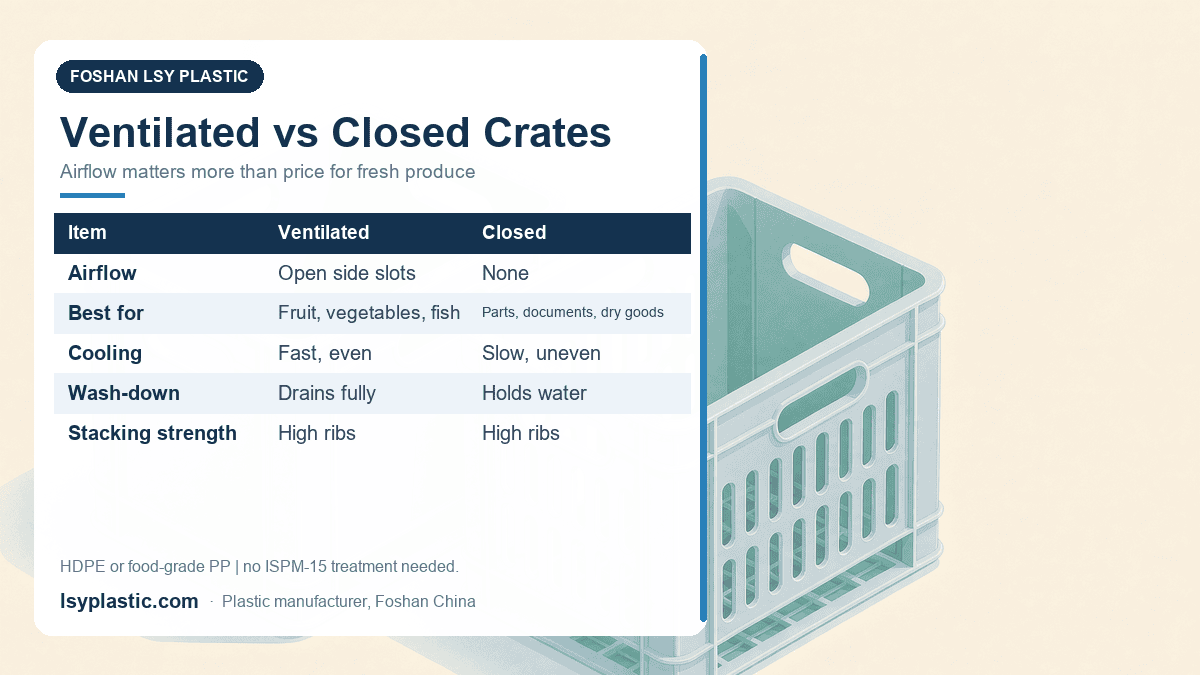
For poultry crate and table-egg layering stacks, see the poultry crate layer pad guide for drainage and stack-load specs.
🌍 Buyer Guides for Regional Markets
🇫🇷 Caisses Plastiques Industrielles — Guide d’Achat (Français)
🇲🇾 Kotak Plastik Industri — Panduan Pembeli (Bahasa Melayu)
🇻🇳 Thùng Nhựa Công Nghiệp — Hướng Dẫn Mua (Tiếng Việt)
🇮🇳 Plastic Crates Buyer Guide for Indian Importers (FCL shipping to Nhava Sheva, Mundra & Chennai)
Frequently Asked Questions
What are industrial plastic crates made from, and does it affect price?
Most LSY industrial crates are molded from polypropylene (PP) and HDPE. Bright blue or orange crates typically use virgin material, while black crates often use recycled or regrind resin. Virgin PP gives more consistent impact strength — critical in cold stores — so food, pharma and export programs specify it, while general warehousing can use recycled material if the supplier provides consistent batch test data.
What size plastic crates should I buy for standard pallets?
Use modular Euro dimensions: a 600×400 mm crate fits 4 per layer on a 1200×800 mm (EUR) pallet and 5 per layer on a 1200×1000 mm (ISO) pallet, with a 400×300 mm half-size filling the gap exactly. Modular sizing stops you shipping air and keeps pallet loads square and stable.
What design features should I check on an industrial crate?
Look for reinforced ribbing under the base for stacking strength, the correct vent pattern (solid walls for dry goods, ventilated sides for produce that respires), molded handles for safe lifting, and a flat label area for barcodes. LSY molds these features in-house — we are a manufacturer, not a reseller.
Can LSY make custom-coloured or custom-sized crates?
Yes. As a manufacturer we mold custom colours (for example red for reject parts, green for approved stock) and custom dimensions, and can add molded-in logos. Colour and size changes affect MOQ and lead time, so plan them into your first order. No MOQ for domestic orders; overseas orders ship FCL.
All industrial plastic crate guides in this cluster
- Plastic Parts Bins for Warehouse Picking: Building a Shelf, Trolley and Flow System
- Industrial Plastic Bins vs Metal Bins: Which Is Better? (2026)
- The 2026 Guide to Industrial Plastic Products for Warehousing & Manufacturing
- Combatting Economic Downturn: Turnover Boards Help Reduce Costs and Increase Efficiency in Agricultural Transport
- The Perfect Solution for Sorting Challenges: How Turnover Baskets Simplify Small-Scale Logistics
- How Turnover Boards Become Essential for Transportation Companies in the Era of Efficient Logistics
- Turnover Boards: An Essential Logistics Tool in 2024
- Boost Logistics Efficiency with Our High-Quality Turnover Boards
- Plastic Layer Pads for Beverage Crates: Sourcing Specs
- How to Stack Plastic Crates on Pallets: Layer Patterns, Stability and Load Safety
- Plastic Beverage Crates and Bottle Boxes: A Buying Guide for Drinks Distributors
- صناديق بلاستيكية للنقل والتخزين: دليل المشتري في السعودية والإمارات
- Plastic Crates and Equipment for Poultry Farms and Processing
- Stackable vs Nesting Plastic Crates: Space Economics Compared
- Plastic Crates vs Wooden Crates for Produce: Which Wins for Export and Cold Chain?
- Color Coded Crates for Food Safety: Preventing Cross-Contamination in Processing Plants
- Catering and Banquet Service Crates: Moving Plates, Glassware and Food Between Kitchens and Venues
- Ventilated Plastic Crates for Produce: How Hole Patterns Extend Freshness in the Cold Chain
- Euro Container Sizes Explained: 400×300, 600×400 and Plastic Crate Dimensions Guide
- Collapsible vs Rigid Plastic Crates: When Foldable Containers Save You Money
- Plastic Turnover Boxes for Automotive Parts Logistics: Protection, Traceability and Returnable Loops
- ESD Turnover Boxes vs ESD Trays: Choosing Containers for PCB Assembly and SMT Lines
- Plastic Crates for Bakery and Bread Distribution: Hygiene, Ventilation and Freight Guide
- How to Clean and Sanitize Plastic Crates: A Washing Guide for Food Processors and Distributors
- Nestable vs Stackable Plastic Containers: Which Saves More Space and Freight Cost?
- Plastic Milk Crates and Dairy Distribution: A Buyer’s Guide
- Color-Coded Plastic Crates for Warehouse 5S and Inventory Control
- Plastic Seafood Crates and Fish Boxes: Ventilation, Drainage and Cold Chain Guide
- Reusable Plastic Turnover Boxes: A Warehouse Buyer’s Guide (2026)
- Ventilated Plastic Crates for Produce: A Buyer’s Guide (2026)
- Plastic Pallet Nesting vs Stacking: Which Design Cuts Your Storage Cost?
- Large Plastic Crates With Vents: 488-850L Sizing Guide (2026)
- Large Plastic Bulk Crates (488L–850L): Sizes, Load Ratings and Applications
- Plastic Crates vs Cartons: Why Importers Go Reusable (2026)
- How to Choose Ventilated Crates for Fresh Produce Logistics in GCC
- Cold Chain Plastic Crates: Insulated Containers for Fresh Produce and Seafood
- Stackable vs Nestable Plastic Containers: Which Design Saves More Space and Money?
- Folding Plastic Crates vs Rigid Crates: Which Saves More Space and Money? (2026 Guide)
- Ventilated Plastic Crates for Agriculture: A Complete Guide for Fresh Produce Supply Chains
- Plastic Turnover Boxes Buying Guide: Stackable Containers for Logistics & Warehousing
- Plastic Crate Stacking Guide: Maximizing Warehouse Storage Efficiency
- 5 Ways Reusable Plastic Storage Crates Cut Warehouse Costs by 30% (Data-Backed Guide)
- Euro Standard Crates: The “Tetris” Solution for Efficient Warehousing
- The Power of Euro Stacking Containers for Warehouse Optimization
- EU Crates Help Factories Improve Logistics Efficiency and Cut Costs Amid Economic Downturn
- The Future of Standardized Logistics: How EU Crates Lead Smart Warehousing



